
Contractors and builders frequently struggle with on-site efficiency losses and tool redundancy, often facing costly downtime when a pneumatic nailer fails to meet strict residential building codes. Before allocating capital-whether through standard company tool budgets, equipment financing, or project-specific procurement funds-decision-makers must carefully analyze the long-term utility of their fleet.
Selecting the precise tool for the task grants installation teams an immediate boost in daily square-footage output, directly securing project timelines and profitability. However, it is crucial to stipulate that despite some overlapping features, a dedicated framing nailer and a specialized roofing nailer serve fundamentally different structural requirements. For instance, utilizing a high-capacity coil roofing nailer for shingle placement requires highly sensitive depth-of-drive precision that a 21-degree stick framing nailer designed for heavy-duty stud walls simply cannot replicate.
This comparative analysis evaluates the distinct mechanical differences, magazine capacities, and cost-to-utility ratios of these two essential pneumatic systems, guiding your next capital investment for residential construction.
| Factor | Summary |
|---|---|
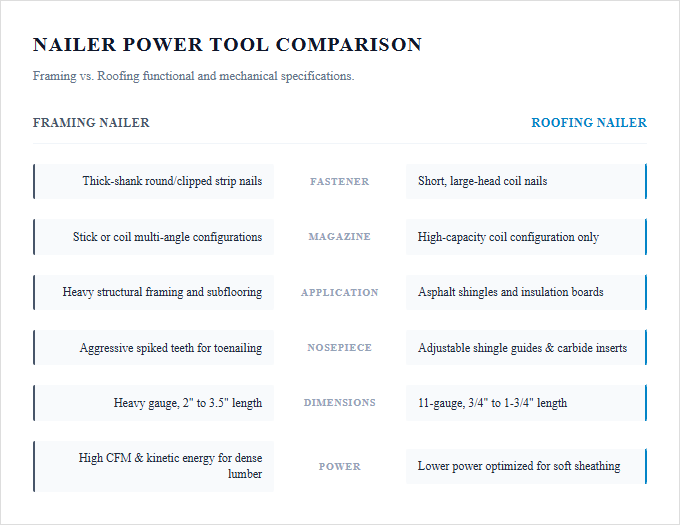
| Fastener Type | Framing nailers drive heavy-duty, thick-shank round or clipped-head strip nails, whereas roofing nailers utilize short, large-diameter head coil-collated nails designed to hold shingles securely. |
| Magazine Configuration | Roofing nailers exclusively feature high-capacity coil magazines to minimize reloads, while framing nailers are available in both stick and coil configurations depending on the required collation angle. |
| Primary Application | Framing nailers are engineered for heavy structural tasks like subflooring and wall framing, whereas roofing nailers are specialized for fastening asphalt shingles, insulation board, and house wrap. |
| Nosepiece Design | Framing nailers feature aggressive, spiked nose claws designed for secure toenailing, while roofing nailers use adjustable shingle guides and carbide inserts to prevent wear from abrasive asphalt. |
| Nail Dimensions | Framing nailers utilize 2-inch to 3.5-inch nails with a heavy wire gauge for structural integrity, whereas roofing nailers are restricted to shorter, 11-gauge nails ranging from 3/4-inch to 1-3/4 inches. |
| Driving Power and Energy | Framing nailers require significantly higher pneumatic volume (CFM) and kinetic energy to penetrate dense dimensional lumber, while roofing nailers operate at a lower power threshold suited for soft sheathing. |
Coil magazine versus stick magazine capacity and collation angles
Roofing nailers utilize coil magazines, which hold up to 120 nails wound in a spiral. This high capacity minimizes downtime for reloading during high-volume shingle installations. These tools typically feature a fixed collation angle of approximately 15 degrees, allowing the bulky drum to clear the roof surface while maintaining a perpendicular drive.
Framing nailers employ stick magazines holding fewer nails-typically 30 to 74-aligned in a straight strip. These nailers offer various collation angles, from 21 to 34 degrees, which enhances maneuverability in tight structural spaces. High-volume roofing contractors require the uninterrupted speed of coil-fed systems, whereas residential framing crews and general contractors benefit from the agility and balance of stick-fed models.
Full round-head framing fasteners versus large-diameter galvanized clout nails
Framing nailers are engineered for heavy-duty structural applications, utilizing full round-head framing fasteners. These robust fasteners provide the maximum holding power and shear resistance necessary for securing studs, joists, and subflooring. The tool itself is designed to deliver high impact energy, driving these thick, long-shank nails flush into dense engineered lumber.
Roofing nailers operate on a different principle, deploying large-diameter galvanized clout nails to secure asphalt shingles and underlayment. The wide head of the clout nail prevents the shingle material from tearing under wind uplift, while the galvanized coating provides essential corrosion resistance against outdoor exposure. Framing nailers are ideal for general contractors and carpenters engaged in structural woodwork, whereas roofing nailers are suited for specialized roofing installers and exterior renovators focused on weatherproofing and high-volume shingle application.
Contact actuation bump-firing speed versus single sequential trigger precision
Roofing nailers prioritize rapid installation, utilizing contact actuation, or bump-firing, to maximize efficiency on the job site. This mechanism drives a fastener every time the safety nose contacts the work surface while the trigger remains depressed, allowing operators to cover expansive shingle areas with exceptional speed.
Framing nailers demand a more deliberate approach, relying on single sequential triggers to ensure structural integrity and workplace safety. This setting requires the safety probe to be fully depressed before the trigger is pulled for each individual shot, preventing accidental discharges and guaranteeing precise depth placement in studs and joists. High-production roofing contractors thrive on the rapid speed of bump-fire systems, whereas custom home builders and structural framing crews require the absolute precision of sequential firing.
Tool-free depth-of-drive adjustment to prevent over-driving shingles
Roofing and framing nailers serve distinct structural purposes, yet depth control remains a critical differentiator between them. In roofing applications, precise depth-of-drive adjustment is vital to prevent fasteners from over-driving, which can easily rupture shingles and compromise weatherproofing. Integrating a tool-free depth-of-drive mechanism allows operators to make immediate, micro-adjustments on the pitch, ensuring nails sit perfectly flush against delicate asphalt shingles without tearing the substrate.
Framing nailers prioritize high-impact force to penetrate dense dimensional lumber, where minor depth variances are structurally acceptable. While framing models also feature depth adjustments, the specialized, sensitive controls on roofing nailers are engineered specifically to handle fragile materials under fluctuating air pressures. Dedicated roofing contractors require the precise, damage-preventing control of a roofing nailer, whereas home builders and structural carpenters are best served by the robust driving power of a framing nailer.
Pneumatic CFM and PSI for Varying Wood Densities
Framing nailers operate at high pressures, typically between 70 to 120 PSI, requiring approximately 2 to 4 CFM. This high-volume air delivery is essential for driving larger fasteners into dense engineered lumber and hardwoods. Proper pressure calibration ensures consistent flush drives without stalling the compressor during rapid-fire framing sequences.
Roofing nailers generally run within a similar 70 to 120 PSI range but consume less volume, averaging 1.5 to 2.5 CFM. Because roofing substrates like OSB and plywood are less dense than structural framing timber, precise pressure regulation prevents over-penetration through delicate asphalt shingles.
Framing nailers are ideal for structural carpenters executing heavy timber construction, whereas roofing nailers are best suited for specialized roofing contractors installing shingles and underlayment.
Paper-collated thirty-degree strips versus wire-collated fifteen-degree coils
Framing nailers utilizing thirty-degree paper-collated strips offer exceptional maneuverability in confined structural spaces. The steep angle allows the tool to fit easily between studs, while the paper collation shears cleanly upon firing, leaving no debris on the job site. This design prioritizes speed, safety, and structural integrity in heavy-duty wood framing.
Conversely, roofing nailers rely on fifteen-degree wire-collated coils to maximize installation runtime. By holding up to one hundred and twenty nails per load, these tools significantly reduce reloading interruptions during high-production shingle applications. The wire collation withstands harsh outdoor conditions but does discard small metal fragments during operation.
Thirty-degree strip nailers are ideal for residential carpenters seeking precision and agility in tight framing bays, whereas fifteen-degree coil nailers are best suited for high-volume roofing contractors prioritizing continuous, rapid output on expansive slopes.
Ring-Shank vs. Smooth-Shank: Framing vs. Underlayment
Framing nailers operate at high pressures to drive heavy-duty fasteners into structural lumber. For load-bearing assemblies, ring-shank nails are the industry standard due to their exceptional holding power. The threaded ridges on these fasteners lock directly into the wood fibers, effectively resisting the withdrawal forces caused by structural settling, temperature fluctuations, and high winds.
Roofing nailers are optimized for high-volume, rapid installation of shingles and underlayment. Smooth-shank nails are typically preferred in these applications, as underlayment does not experience the same multidirectional shear stresses as structural framing. The smooth surface allows for fast, flush driving through asphalt and synthetic barriers without tearing the protective materials.
Structural carpenters require heavy-duty framing nailers with ring-shank fasteners to ensure building integrity under heavy loads, whereas roofing contractors rely on specialized roofing nailers for fast, weather-tight sheathing and shingle installations.
Leave a comment