
Achieving flawless precision in micro-crafting or industrial engraving often ends in frustration when a microscopic wobble ruins hours of meticulous work-a common struggle caused by mismatched shank and collet diameters. While standard funding sources for workshop acquisitions typically prioritize heavy, high-voltage machinery, the true margin of success in detailed work lies in these minute accessory interfaces.
Selecting the correct collet size grants operators a level of rotational concentricity that virtually eliminates costly tool runout. However, this precision is bound by the technical stipulation that users must meticulously match their tool's collet to the specific shank diameter, rather than relying on overtightened, ill-fitting components. For example, artisans utilizing the Dremel 4000 for intricate glass etching or PCB drilling rely on true 1/16-inch collets to prevent micro-bit slippage.
Below, we will analyze the mechanical differences between 1/8-inch and 1/16-inch collets, evaluate their respective application strengths, and provide a clear framework for selecting the right shank diameter for your high-precision projects.
| Factor | Summary |
|---|---|
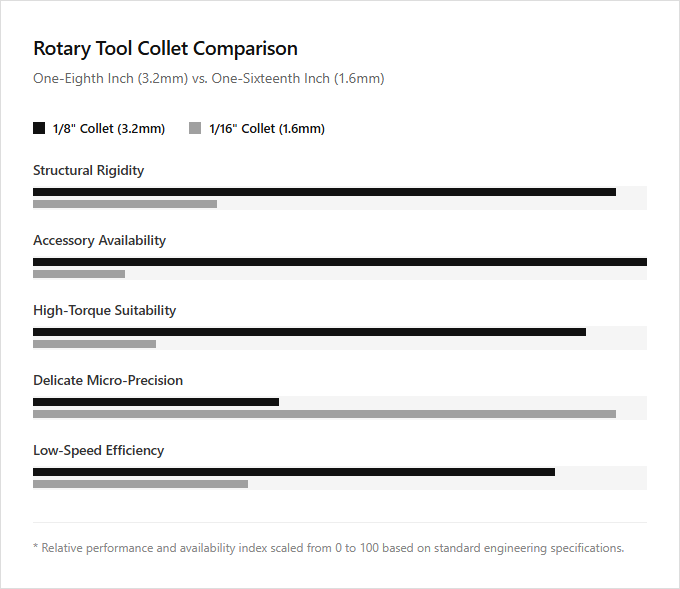
| Shank Diameter Compatibility | One-eighth inch collets accommodate the standard 3.2mm shank diameter common to most rotary accessories, whereas one-sixteenth inch collets are designed specifically for ultra-thin 1.6mm micro-tool shanks. |
| Application Suitability | The larger one-eighth inch collet is ideal for high-torque cutting and material removal, while the one-sixteenth inch variant excels in delicate tasks like micro-drilling and intricate jewelry fabrication. |
| Structural Rigidity | One-eighth inch collets offer superior resistance to lateral deflection and spindle runout under load, whereas one-sixteenth inch collets are more susceptible to bending under heavy side-forces. |
| Accessory Availability | The vast majority of commercial aftermarket mandrels, burrs, and sanding drums are sized for one-eighth inch collets, making one-sixteenth inch options highly specialized and harder to source. |
| Rotational Speed Performance | One-sixteenth inch bits require significantly higher RPM (revolutions per minute) to achieve optimal cutting speeds due to their smaller diameter, whereas one-eighth inch accessories remain efficient at lower speeds. |
1/8-Inch Collets: Superior Concentricity at High Speeds
In precision rotary tool applications, the choice between a one-eighth inch collet and a one-sixteenth inch collet directly impacts machining accuracy and tool longevity. The one-eighth inch collet represents the industry standard for high-performance tasks, offering superior concentricity and significantly lower radial runout during high-speed rotation. This structural rigidity minimizes rotational vibration, ensuring cleaner cuts and reducing wear on the tool's internal bearings under demanding workloads.
Smaller one-sixteenth inch collets accommodate micro-accessories designed for intricate detailing, though their reduced surface area increases susceptibility to rotational deflection. Securely clamping these ultra-fine shanks requires careful torque management to prevent bit slippage or breakage. Professional fabricators requiring maximum stability and high material removal rates thrive with the robust one-eighth inch collet, whereas hobbyists and artisans engaged in micro-engraving find the delicate one-sixteenth inch size indispensable.
1/16-Inch Collets for Micro-Drills and Fine Burs
Rotary tool versatility depends heavily on collet selection, with one-eighth inch and one-sixteenth inch sizes serving distinct applications. While the standard one-eighth inch collet accommodates most general-purpose cutting, sanding, and polishing accessories, the smaller size offers specialized precision. One-sixteenth inch collets are engineered specifically to accommodate delicate micro-drills and ultra-fine engraving burs, ensuring optimal concentricity and minimizing runout during intricate, high-speed operations.
Selecting the appropriate collet size prevents accessory slippage and ensures operational safety. General hobbyists and DIYers require the robust grip of the one-eighth inch collet for heavy-duty carving and grinding, whereas jewelry makers, electronics technicians, and detailed model builders rely on the one-sixteenth inch collet for ultra-fine micro-drilling and high-precision detailing.
Why 1/8-Inch Collets Prevent Shank Slippage
Rotary tool performance relies heavily on the collet's ability to secure the accessory shank. When comparing one-eighth inch collets to one-sixteenth inch collets, the primary distinction lies in grip stability under load. The larger surface area of one-eighth inch collets generates higher clamping force to prevent shank slippage during high-speed applications. This increased contact area distributes pressure more evenly, minimizing runout and ensuring precise control.
One-sixteenth inch collets are engineered specifically for micro-accessories. While they offer less total clamping force due to their smaller surface area, they provide the necessary tight fit for delicate, ultra-fine detailing. Heavy-duty DIYers and woodworkers benefit from the robust hold of one-eighth inch collets, whereas precision jewelers and model makers require the specialized capability of one-sixteenth inch options.
1/8-Inch Shanks Reduce Tool Deflection and Chatter
In rotary tools, selecting the correct collet size is essential for optimizing performance and safety. While both one-eighth inch and one-sixteenth inch collets serve distinct roles, the difference in shank diameter directly impacts mechanical stability. One-eighth inch shanks provide significantly greater torsional rigidity, which minimizes tool deflection and chatter when the tool is subjected to lateral loads.
The smaller one-sixteenth inch collets excel in ultra-fine, delicate applications where minimal material removal is required, though they are more prone to bending under force. In contrast, the robust build of the one-eighth inch system supports high-speed, heavy-duty carving and cutting operations. Professional trade workers and heavy-duty hobbyists benefit most from the robust one-eighth inch collet, whereas jewelers and fine-scale modelers require the precision of the one-sixteenth inch variant.
High-RPM Bending Risk in 1/16-Inch Shanks
Rotary tools utilize different collet sizes to secure various accessories, with one-eighth inch and one-sixteenth inch being two common standards. The primary distinction lies in their structural stability under operational stress. One-eighth inch collets accept thicker shanks that easily withstand high-speed rotation, whereas one-sixteenth inch collets accommodate much thinner accessories designed for delicate applications.
This difference in shank diameter directly impacts safety and performance. One-sixteenth inch shanks have a much lower critical speed threshold, making them highly susceptible to bending or whipping at high RPMs. Operating these thinner accessories requires precise speed regulation to prevent tool deflection and ensure user safety during operation.
One-eighth inch collets are ideal for professionals and heavy-duty crafters requiring high-torque routing, cutting, and grinding, while one-sixteenth inch collets are best suited for detail-oriented hobbyists and artists performing delicate, micro-precision engraving at controlled speeds.
Match Collet Taper to Spindle for Proper Seating
Selecting between a one-eighth inch and a one-sixteenth inch collet for a rotary tool depends primarily on the shank size of the intended accessory. When interchanging these collet sizes, matching the correct collet taper to the specific rotary tool spindle is critical for proper seating. Exact alignment ensures optimal concentricity, minimizes tool runout, and prevents dangerous accessory slippage during high-speed operation.
The robust one-eighth inch collet is engineered for heavy-duty applications like cutting and grinding, while the delicate one-sixteenth inch collet provides the tight grip needed for micro-drilling and detailing. Fine-scale modelmakers and jewelers typically require the extreme precision of the one-sixteenth inch collet, whereas general DIYers and woodworkers favor the versatile one-eighth inch collet for broader, high-torque projects.
One-Sixteenth Inch Collets for Precision Micro-Machining
Rotary tool collets dictate the shank size of compatible accessories, directly influencing the tool's application. The standard one-eighth inch collet serves as the industry benchmark, providing a robust grip and high stability for tasks demanding significant material removal, such as cutting, carving, and routing. Conversely, the smaller one-sixteenth inch collet accommodates ultra-fine accessories designed for highly controlled, delicate procedures.
One-sixteenth inch collets are essential for specialized micro-machining where precision detailing outweighs material removal rate. This compact size minimizes runout and deflection, allowing for intricate engraving and micro-drilling on fragile workpieces without causing structural damage.
General hobbyists and fabricators requiring versatile, heavy-duty applications benefit most from the one-eighth inch collet, whereas jewelers, model makers, and electronics technicians rely on the one-sixteenth inch variant for high-precision, microscopic craftsmanship.
Leave a comment