
Achieving a flawless concrete substrate is often a frustrating bottleneck for contractors. Selecting the wrong equipment for surface preparation commonly leads to ruined slabs, blown project timelines, and wasted labor hours. While contractors often turn to standard equipment financing or operational capital to secure their fleet, making the wrong machinery purchase can severely dent your bottom line.
Choosing the correct tool grants unparalleled efficiency and immediate return on investment, with the stipulation that tool selection must align perfectly with your target Concrete Surface Profile (CSP). For instance, leveling a severely uneven joint or removing heavy mastic requires vastly different mechanics than refining a slab with a planetary concrete grinder.
In this guide, we will break down the fundamental engineering differences between concrete planers and grinders, comparing their removal capacities, surface finishes, and ideal project applications to ensure you select the optimal tool for your next job.
| Factor | Summary |
|---|---|
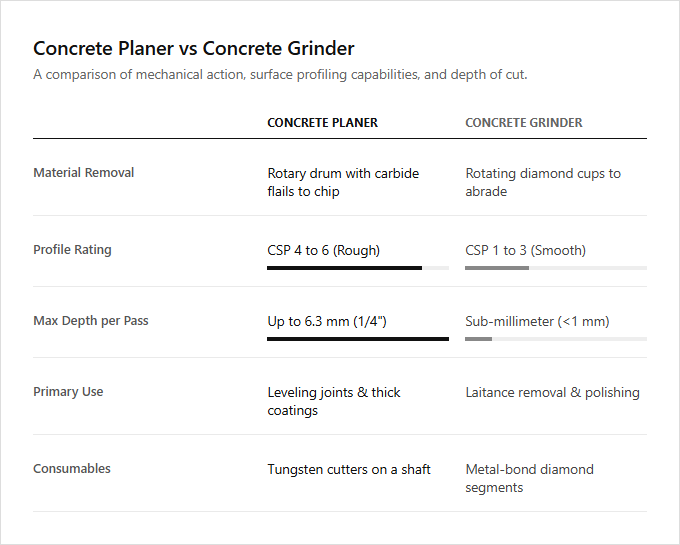
| Material Removal Method | Concrete planers utilize a rotary drum with carbide flails to impact and chip the surface, whereas concrete grinders employ rotating diamond grinding cups to abrade the substrate. |
| Concrete Surface Profile (CSP) | Planers produce a rough, grooved texture rated at CSP 4 to 6, while grinders deliver a smoother finish typically rated at CSP 1 to 3. |
| Depth of Cut | Planers excel at bulk material removal of up to a quarter-inch per pass, whereas grinders are limited to shallow, sub-millimeter surface leveling. |
| Primary Applications | Planers are ideal for leveling misaligned sidewalk joints and removing thick elastomeric coatings, whereas grinders are preferred for laitance removal and polishing. |
| Consumable Wear | Planers require replacing individual steel or tungsten cutters on a shaft, while grinders utilize metal-bond diamond segments that wear down uniformly. |
Concrete Planers vs. Grinders: Key Differences
When preparing concrete surfaces, selecting the correct power tool depends on your specific project requirements. Concrete planers utilize a percussion-driven drum assembly equipped with carbide cutters to perform heavy scarifying. This high-impact mechanical action aggressively chips away thick coatings, adhesives, and uneven high spots by repeatedly striking the substrate.
Concrete grinders employ rotary abrasive diamond discs to achieve precise surface leveling. This method relies on horizontal rotational friction to smooth out minor imperfections, clean the concrete, and prepare the surface for sealers or paints without fracturing the underlying structure.
Planers are ideal for heavy-duty demolition contractors requiring rapid, deep material removal, while grinders are best suited for finishing specialists and floor installers aiming for flat, polished, and highly refined surfaces.
Concrete Profiles: Aggressive Planers vs. Smooth Grinders
Selecting the appropriate concrete surface preparation tool depends heavily on the desired Concrete Surface Profile (CSP) rating. Concrete grinders are designed for precision and smoothing. Utilizing rotating diamond discs, these machines efficiently remove thin coatings, curing compounds, and minor imperfections, resulting in a smoother CSP 1 to CSP 3 preparation that is ideal for thin-film coatings, sealers, or aesthetic stains.
Concrete planers, or scarifiers, perform a much more aggressive operation by utilizing a rotating drum equipped with multi-pointed cutters. This high-impact action chips away at the substrate to generate a rough CSP 4 to CSP 6 profile, which is necessary for thick self-leveling underlayments and heavy-duty polymer overlays. Grinders are best suited for decorative concrete specialists focusing on high-gloss finishes, while planers are the preferred choice for industrial remediation contractors requiring deep surface removal and profiling.
Planers vs. Grinders: Thick vs. Thin Coating Removal
When preparing concrete surfaces, selecting the appropriate tool is critical for project efficiency and structural integrity. Concrete planers utilize a drum with rotating cutters to impact the surface, making them highly effective for the bulk removal of thick elastomeric coatings and self-leveling underlayments. This aggressive mechanical action quickly profiles heavily deteriorated or uneven slabs.
In contrast, concrete grinders employ horizontally rotating diamond discs to smoothly abrade the concrete. These machines are optimized for thin-film adhesive residue and laitance removal, offering a refined finish suitable for polishing or sealing. Demolition contractors tackling thick membrane removal and heavy leveling require the aggressive cutting power of a concrete planer, whereas flooring installers and decorative concrete specialists benefit most from the precision and versatility of a concrete grinder.
Planing Risks Micro-Cracking; Grinding Preserves Integrity
When preparing concrete surfaces, choosing between a concrete planer and a concrete grinder depends heavily on the required impact level and the preservation of the substrate. Concrete planers operate through a high-impact milling action, where rotating flails strike the surface to remove thick overlays. While highly efficient for bulk removal, this aggressive process carries a distinct risk of inducing sub-surface micro-cracking, which can compromise the structural integrity of the concrete matrix.
In contrast, concrete grinders utilize a non-impact rotary grinding mechanism equipped with diamond-segmented discs. This method smoothly abrades the surface, preserving the underlying structural integrity without creating internal fractures. Heavy-duty demolition contractors require planers for rapid, deep material removal, whereas decorative flooring installers and refinishing specialists prefer grinders to achieve a smooth, damage-free profile.
Planers vs. Grinders: Tooling and Texture Differences
Selecting the appropriate concrete surface preparation tool depends heavily on the desired finish and depth of material removal. Concrete planers, also known as scarifiers, employ rotating drums equipped with star-shaped or beam-shaped flails to aggressively impact the concrete. This process chips away the surface to create a distinct, grooved texture suitable for heavy-duty leveling and coating removal.
Concrete grinders utilize rotating horizontal discs fitted with various grit-size metal bond diamond segments to control the scratch pattern on the substrate. This method offers a more precise, smoother finish by gradually wearing down imperfections rather than fracturing the surface. Planers are preferred by demolition contractors requiring rapid, deep material reduction, whereas grinders are favored by decorative concrete specialists and flooring installers who demand a refined, level profile for subsequent coatings.
Concrete Planers vs. Grinders: When to Use Which
Selecting the correct surface preparation equipment depends entirely on the severity of the concrete irregularity. Concrete planers are heavy-duty machines designed for high-impact material removal. These tools utilize rotating, multi-pointed cutter assemblies to level significant height discrepancies, making them ideal for correcting severe slab curling and uneven expansion joints.
Concrete grinders employ horizontal rotating discs embedded with industrial diamonds to abrade the surface. This method is engineered for precision, focusing on floor flatness refinement, removing thin coatings, and preparing concrete surfaces for high-gloss polishing. Demolition contractors facing major structural leveling tasks require the aggressive capability of a planer, while decorative flooring specialists aiming for smooth, aesthetic finishes are best suited for a grinder.
Planer Drum Shafts vs. Grinder Planetary Gears
Selecting the appropriate surface preparation equipment depends on the specific mechanical action required for the substrate. Concrete planers require a rotating drum shaft configuration equipped with multi-pointed cutters to impact the surface directly. This aggressive chipping action is engineered for heavy material removal, leveling uneven joints, and creating a highly textured profile.
Concrete grinders utilize a planetary gear system that rotates multiple abrasive discs simultaneously to achieve a uniform scratch distribution across the floor. This multi-directional rotational movement delivers a smooth, flat finish ideal for thin coatings, sealers, or aesthetic refinement. Demolition contractors requiring rapid, deep excavation will benefit most from the robust planer, while decorative concrete specialists prioritizing high-precision finishes should select the planetary grinder.
Leave a comment