
Selecting the right heavy-duty demolition equipment often presents a frustrating challenge for project managers, who frequently battle costly job site downtime and operator fatigue when underpowered tools struggle against high-PSI concrete. Traditionally, firms address these procurement challenges through standard equipment financing and capital expenditure budgets, balancing initial acquisition costs against projected project timelines.
However, optimizing your fleet with the correct power source grants your crew unmatched operational efficiency and significantly lower cost-per-square-foot demolition rates. This competitive edge is highly achievable, with the stipulation that your site's utility access and compressor logistics are carefully pre-evaluated. For example, leading infrastructure firms rely on heavy-duty pneumatic breakers for highway pavement projects, while utilizing advanced electric systems, like the Bosch Brute, for municipal indoor renovations.
Below, we compare pneumatic and electric jackhammers across critical performance metrics-including impact energy, mobility, and maintenance-to guide your next strategic equipment investment.
| Factor | Summary |
|---|---|
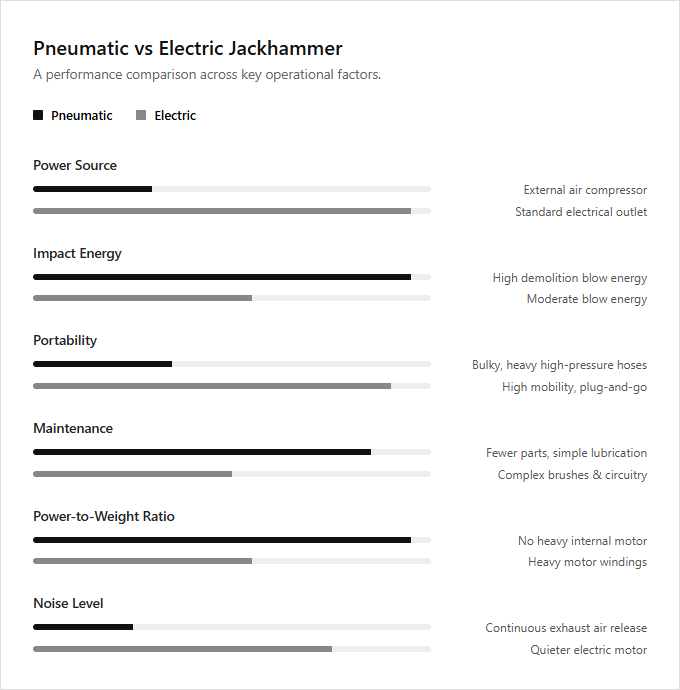
| Power Source | Pneumatic jackhammers rely on an external air compressor to function, whereas electric jackhammers utilize a standard electrical outlet to power an internal motor. |
| Impact Energy | Pneumatic jackhammers generally deliver a much higher blow energy measured in Joules, making them more effective for heavy-duty demolition than electric models. |
| Portability | Electric jackhammers offer superior jobsite mobility because they do not require bulky, high-pressure air hoses to operate. |
| Maintenance | Pneumatic tools have fewer moving parts but require regular lubrication of the piston, whereas electric models require monitoring of carbon brushes and electrical circuitry. |
| Power-to-Weight Ratio | Pneumatic jackhammers achieve a superior power-to-weight ratio because they lack the heavy copper windings and internal motor found in electric alternatives. |
| Noise Level | Pneumatic models produce significantly higher decibel emissions due to the continuous release of compressed exhaust air during operation. |
Pneumatic vs. Electric Jackhammers: Air vs. Electricity
Selecting the right concrete demolition equipment requires understanding the distinct power delivery methods of pneumatic and electric jackhammers. Pneumatic jackhammers are high-performance tools that rely on a continuous, high CFM airflow supplied by a large, external air compressor. This system delivers maximum impact energy for breaking dense concrete, though it demands significant supporting infrastructure on the job site.
Electric jackhammers offer a highly portable alternative, operating directly off standard mains voltage and amperage. These units plug into standard electrical outlets or portable generators, eliminating the need for bulky hoses and tow-behind compressors while maintaining reliable power for medium-duty demolition. Heavy-duty road crews and industrial contractors require the raw power of pneumatic jackhammers, while residential renovators and utility workers benefit from the rapid setup and mobility of electric models.
Pneumatic Demolition Tools Yield Higher Impact Energy
When selecting professional concrete demolition equipment, evaluating impact energy is critical for project efficiency. Pneumatic jackhammers consistently outperform electric alternatives in raw power, yielding significantly higher single-impact energy measured in both Joules and foot-pounds. This superior force is driven by continuous compressed air, delivering rapid, high-velocity blows capable of fracturing thick, high-psi concrete. Electric jackhammers offer excellent portability and convenience, but their motor-driven mechanical systems generally limit their maximum impact energy on heavy-duty substrates.
Operating environment and job site infrastructure dictate the optimal tool choice. Pneumatic jackhammers are best suited for industrial demolition contractors tackling high-volume, deep-slab highway or commercial concrete removal, while electric jackhammers are ideal for renovation tradespeople and utility installers requiring maximum maneuverability on lighter-duty residential indoor projects.
Electric hammers provide electronically regulated variable BPM for precision chipping.
Pneumatic jackhammers remain a standard for heavy-duty demolition, relying on external air compressors to deliver high-impact force, while electric jackhammers offer excellent portability and ease of setup by eliminating the need for bulky support equipment.
A key advantage of modern electric demolition hammers is the integration of advanced electronics. These systems provide electronically regulated variable blows per minute (BPM), allowing operators to adjust impact energy for precision chipping. This control prevents damage to surrounding structures, where the raw power of pneumatic systems is too aggressive.
Pneumatic models are ideal for heavy highway contractors requiring continuous high-output demolition, while electric jackhammers best serve interior renovators and general contractors who need mobility and precise control for varied masonry tasks.
Motorless Pneumatics: Superior Power-to-Weight Ratio
When selecting concrete demolition equipment, the choice between pneumatic and electric jackhammers depends on operational efficiency. Pneumatic jackhammers excel in heavy-duty applications because they leverage an external air compressor. By removing the heavy onboard motor found in electric models, pneumatic systems deliver a superior power-to-weight ratio, allowing operators to utilize maximum impact energy without experiencing extreme physical fatigue.
Electric jackhammers offer plug-and-play convenience but carry the extra weight of an internal motor. While electric models are ideal for indoor renovations where compressor access is limited, pneumatic units remain the standard for continuous, high-volume excavation. High-production commercial contractors benefit most from the relentless power of pneumatic systems, whereas independent contractors and facility maintenance crews find the mobility of electric jackhammers better suited to their localized projects.
Pneumatic Jackhammers: Continuous Operation Without Overheating
When selecting demolition equipment, understanding the operational differences between pneumatic and electric jackhammers is essential for project efficiency. Pneumatic jackhammers excel in demanding environments because they sustain a continuous duty cycle without the risk of thermal overload. Because they are powered by compressed air rather than an internal electric motor, these tools do not accumulate heat during prolonged operation, ensuring reliability during uninterrupted, heavy-duty breaking.
Electric jackhammers offer excellent portability and plug-and-play convenience, though their internal motors require periodic rest to prevent overheating during intense tasks. Pneumatic models are best suited for industrial contractors requiring non-stop excavation power, while electric variants are ideal for independent renovators needing maneuverability and quick setup on lighter job sites.
Hex Shank and SDS-Max Tool Holder Interfaces
When selecting concrete demolition equipment, choosing between pneumatic and electric jackhammers involves evaluating power sources and application demands. Despite their different propulsion methods, both variations utilize specialized accessory interfaces including hex shank and SDS-Max tool holders. These standardized chuck systems ensure efficient power transmission and secure bit retention, allowing operators to quickly swap out chisels, spades, and points across both platforms.
Pneumatic models rely on external air compressors to deliver high-impact energy for continuous, heavy-duty demolition. Electric jackhammers offer plug-and-play convenience from standard power outlets, making them highly portable for indoor or light-to-medium renovation projects. Pneumatic systems are ideal for industrial demolition contractors requiring maximum material removal rates, while electric units best serve general contractors and utility workers seeking mobility and rapid setup.
Pneumatic vs. Electric Tool Maintenance
When selecting concrete demolition equipment, understanding the distinct maintenance profiles of pneumatic and electric jackhammers is essential for operational efficiency. Pneumatic jackhammers are highly durable but require constant system care, relying heavily on inline lubricators to deliver a continuous mist of oil that protects internal valves and pistons from friction. Failure to maintain this lubrication system can lead to immediate tool degradation and costly downtime.
Electric jackhammers eliminate the need for air compressors, but they require regular carbon brush replacements to maintain electrical conductivity and motor performance. Over time, these brushes wear down and must be proactively swapped out to prevent motor failure and ensure consistent power delivery. Heavy-duty industrial contractors undertaking continuous, high-volume roadwork benefit most from the rugged reliability of pneumatic models, whereas independent renovators and utility crews seeking highly portable, low-setup solutions find electric units more suitable for intermittent indoor tasks.
Leave a comment