
For professional contractors, finding the balance between maximum holding power and material preservation is a persistent challenge. Too often, choosing the wrong pneumatic tool results in split finish trim or structural joints that fail under stress. While standard equipment procurement budgets typically fund catch-all fastening systems to reduce overhead, relying on a single tool for diverse tasks compromises craftsmanship.
Investing in the correct gauge size grants operators the ability to achieve flawless, structurally sound results across different material profiles. However, this success is subject to the stipulation that users strictly align operating air pressure with the specific density of the wood species. For example, deploying a robust 16-gauge crown stapler secures heavy subflooring and framing with ease, whereas a delicate 18-gauge model is required to pin cedar casing without marring the surface.
Below, we analyze the mechanical differences between these two pneumatic powerhouses, compare their holding capacities, and provide a clear framework to help you select the optimal tool for your assembly needs.
| Factor | Summary |
|---|---|
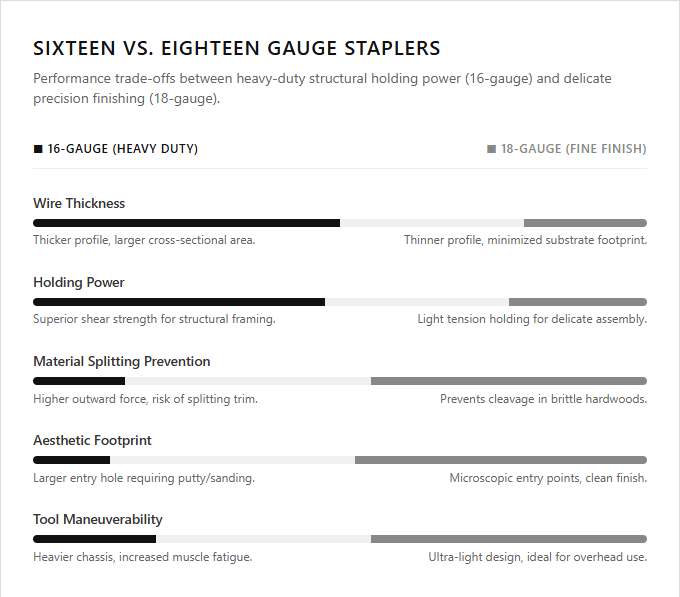
| Wire Thickness | 16-gauge staplers utilize a thicker wire diameter that provides a larger cross-sectional area compared to the thinner profile of 18-gauge fasteners. |
| Holding Power | Heavy-duty 16-gauge staples deliver superior shear strength for structural fastening, whereas 18-gauge staples provide lighter tension holding suited for delicate assembly. |
| Material Splitting | The thin profile of 18-gauge staples prevents substrate cleavage in brittle hardwoods, whereas 16-gauge staples exert higher outward force that can split delicate trim. |
| Aesthetic Impact | 18-gauge fasteners leave a microscopic footprint that minimizes the need for countersinking and wood putty filling. |
| Common Applications | 16-gauge staplers are preferred for heavy-duty subflooring and sheathing, while 18-gauge pneumatic tools are optimized for finish carpentry and cabinetry. |
| Tool Maneuverability | An 18-gauge pneumatic stapler features a lighter tool chassis, which significantly reduces operator fatigue during overhead fastening tasks. |
16-Gauge vs. 18-Gauge Staplers: Strength vs. Precision
In professional construction and woodworking, selecting the correct fastener gauge is essential for project durability and material integrity. Sixteen-gauge staplers utilize a larger wire shank diameter, which provides substantial structural holding power. This heavy-duty design makes them highly effective for demanding applications such as subflooring, sheathing, and framing where maximum joint strength is required.
In contrast, eighteen-gauge staplers feature a thinner wire engineered to prevent wood splitting in delicate materials. These fasteners leave smaller, less visible entry holes, preserving the aesthetic quality of finish carpentry, trim work, and thin cabinetry. Framing contractors requiring robust structural holding power rely on sixteen-gauge models, while finish carpenters and detailed woodworkers benefit most from the precision of eighteen-gauge staplers.
16-Gauge vs. 18-Gauge Pneumatic Staplers
Selecting the appropriate pneumatic stapler depends on the structural requirements and delicacy of the project. The primary distinction lies in the gauge thickness and crown width of the fasteners. Sixteen-gauge pneumatic tools drive robust medium crown staples, providing the superior holding power necessary for heavy-duty applications like wall sheathing, subflooring, and roof decking.
Eighteen-gauge models utilize narrow crown staples designed for delicate trim carpentry, cabinetry, and detailed woodworking. These thinner fasteners minimize the risk of splitting fragile wood while remaining virtually inconspicuous after installation. Structural contractors and framing crews benefit most from the high-holding capability of the sixteen-gauge system, while finish carpenters and furniture makers require the precision and subtlety of the eighteen-gauge model.
Why Load-Bearing Framing Requires 16-Gauge Fasteners
When selecting pneumatic staplers for construction and woodworking, understanding the mechanical differences between sixteen-gauge and eighteen-gauge fasteners is essential. Sixteen-gauge staples feature a thicker wire diameter, providing the robust holding power necessary for structural integrity. The higher shear strength of sixteen-gauge fasteners is required for load-bearing framing applications, subflooring, and heavy-duty sheathing where structural movement and stress are expected.
For delicate applications, eighteen-gauge staplers utilize thinner wire fasteners designed to minimize material splitting and leave smaller entry holes. These tools are ideal for trim work, cabinet assembly, and finish carpentry where neat aesthetics are paramount. Structural framing contractors rely on sixteen-gauge staplers for heavy-duty structural fastening, whereas finish carpenters and hobbyists prefer eighteen-gauge models for detailed, split-free installation.
Minimize Wood Putty with 18-Gauge Staplers
When selecting pneumatic staplers, the gauge of the fastener determines both holding power and finish quality. Sixteen-gauge staplers utilize thicker wire to offer robust structural support for heavy-duty applications. Eighteen-gauge staplers are engineered for delicate tasks where preserving the material's surface integrity is paramount.
By utilizing a thinner wire, eighteen-gauge models minimize the countersunk hole footprint left on the wood. This design characteristic significantly reduces the need for wood putty and extensive sanding in finish carpentry, ensuring a cleaner aesthetic. Sixteen-gauge models are ideal for construction contractors requiring maximum holding strength for framing, while eighteen-gauge staplers are best suited for detail-oriented finish carpenters seeking flawless wood surfaces.
Powering 16-Gauge Staplers for Dense Engineered Lumber
Selecting between sixteen-gauge and eighteen-gauge pneumatic staplers depends primarily on the structural demands of the installation. Sixteen-gauge staplers are engineered for heavy-duty fastening, utilizing a thicker wire profile to ensure superior holding power. To successfully drive these robust fasteners into dense engineered lumber, these tools require significantly higher pneumatic operating pressure and increased CFM consumption from the air compressor.
In contrast, eighteen-gauge staplers utilize thinner wire, which minimizes wood splitting during delicate trim work and allows the tool to operate efficiently at lower air volumes. Framing contractors and subfloor installers rely on the high-powered sixteen-gauge models for structural integrity, whereas finish carpenters and furniture builders benefit most from the precision and neatness of eighteen-gauge staplers.
Tool-Free Depth Adjustment for Precise Dual-Gauge Placement
Selecting between a sixteen-gauge and an eighteen-gauge pneumatic stapler requires an understanding of holding power and material thickness. While sixteen-gauge staplers provide robust structural support for heavy-duty applications, eighteen-gauge models offer a finer touch for delicate trim work. Regardless of the gauge chosen, achieving precise fastener placement and avoiding wood splitting depends heavily on a tool-free depth-of-drive adjustment mechanism. This feature allows operators to quickly calibrate the drive depth to match varying wood densities.
Consistent countersinking ensures a professional finish without damaging the work surface. Heavy-duty construction workers and cabinet makers benefit from the high holding power of the sixteen-gauge stapler, whereas finish carpenters and DIY hobbyists find the eighteen-gauge stapler ideal for detailed, mar-free installations.
High-Impact Strip Magazines for 16-Gauge Staplers
In professional fastening, selecting between sixteen-gauge and eighteen-gauge pneumatic staplers depends on the structural demands of the application. Heavy-duty sixteen-gauge staplers utilize adhesive-collated strip magazines designed to withstand rapid, high-impact actuation. This robust collation method ensures the thicker fasteners remain intact during intense cycling, preventing tool jams in high-volume environments like subflooring, sheathing, and roof decking.
Eighteen-gauge staplers, by comparison, feature a thinner wire profile that minimizes wood splitting in delicate trim, cabinetry, and underlayment. These lighter tools require less driving force, resulting in a smaller footprint on the finished workpiece. Heavy-duty sixteen-gauge staplers are ideal for framing contractors and deck builders requiring maximum holding power, while eighteen-gauge models best serve finish carpenters and furniture makers focused on precision and split-free aesthetics.
Leave a comment