
For trade professionals and high-volume manufacturers, few frustrations match the hand fatigue and inconsistent drive depths caused by underpowered fastening tools during critical production runs. When upgrading workshop capabilities, organizations typically rely on standard equipment funding sources and capital budgets to finance these essential assets.
However, selecting the correct motor technology is the pivotal decision that grants operators unparalleled runtime and tool longevity. Of course, maximizing this investment comes with the stipulation that the tool must be paired with a compatible, high-capacity battery system. In demanding environments-such as rapid-fire subflooring installations or high-volume furniture upholstery-motor efficiency directly dictates project margins.
This article provides a comprehensive comparison of brushed and brushless cordless staplers, examining their mechanics, cost-to-value ratios, and performance metrics to guide your next procurement decision.
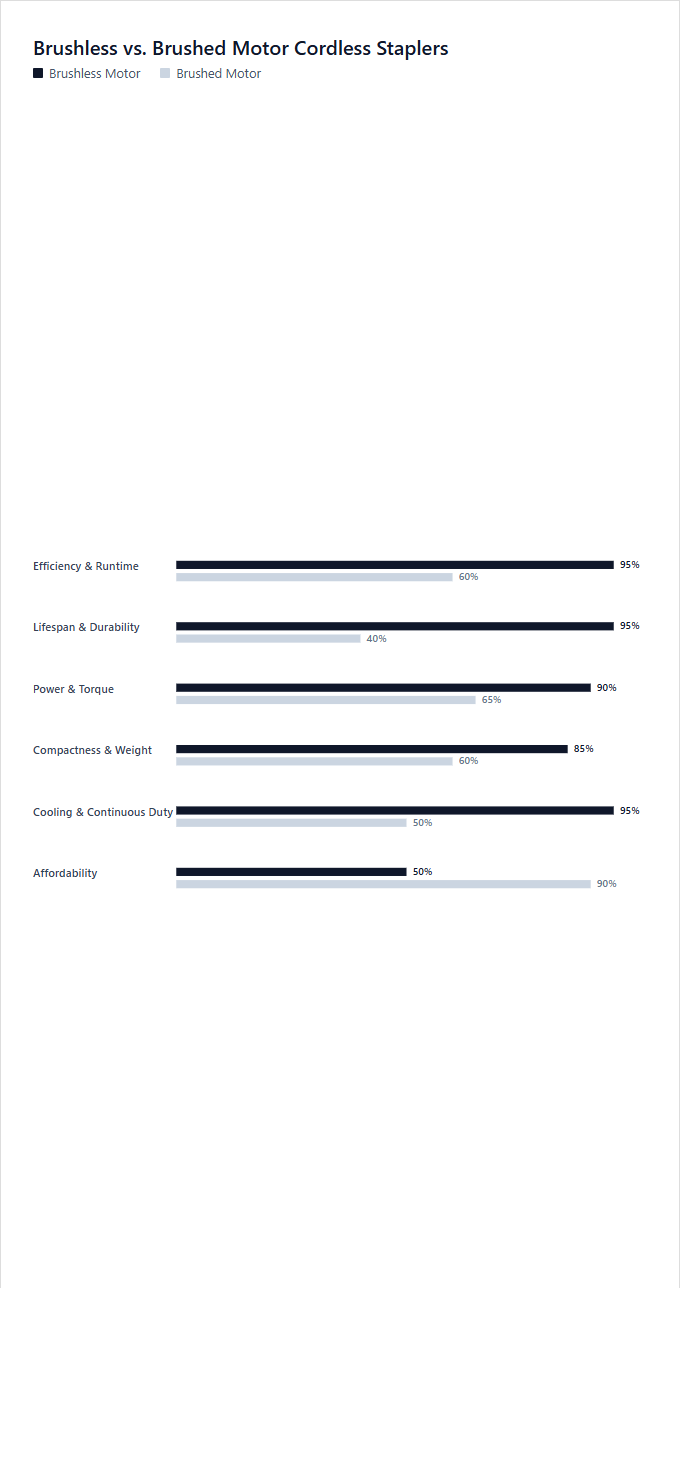
| Factor | Summary |
|---|---|
| Motor Efficiency & Battery Runtime | Brushless cordless staplers utilize an electronic controller instead of physical brushes, significantly reducing energy loss from friction to maximize battery duty cycle. |
| Lifespan & Maintenance | Brushed motors require periodic replacement of carbon brushes due to mechanical wear, whereas brushless designs eliminate friction-induced degradation for a longer operational lifespan. |
| Power Output & Torque | Brushless staplers deliver higher torque-to-weight ratios and maintain constant driving force by dynamically adjusting power output via microprocessor-controlled feedback loops. |
| Form Factor & Ergonomics | The absence of a bulky commutator and brush assembly allows brushless cordless staplers to have a much more compact physical footprint and reduced overall mass. |
| Thermal Management | Without current-carrying brushes creating friction, brushless motors experience minimal thermal generation, reducing the risk of motor stalling from overheating during rapid-fire stapling. |
| Initial Purchase Cost | Brushed staplers feature simpler circuitry and lower manufacturing complexity, making them a more budget-friendly initial investment despite their lower long-term cost-efficiency. |
Electronic commutation efficiency eliminating mechanical friction energy losses
Cordless staplers have evolved significantly with the integration of brushless motor technology. Unlike traditional brushed motors that rely on physical carbon brushes to deliver current, brushless systems utilize advanced electronic commutation. By controlling the electrical current via an internal microprocessor, these tools eliminate the mechanical friction and thermal energy losses inherent in physical contact. This transition results in superior power transfer, extended runtime per battery charge, and a significantly longer tool lifespan.
In contrast, brushed cordless staplers maintain a simpler, traditional design but suffer from energy dissipation and eventual wear due to friction. Professionals requiring high-volume, rapid-fire fastening on commercial jobsites will benefit most from the high efficiency of brushless staplers, whereas occasional DIY hobbyists undertaking light upholstery or home repairs will find brushed models to be a highly economical choice.
Carbon brush wear and replacement cycles in traditional DC motors
Traditional cordless staplers utilize brushed DC motors, which rely on physical carbon brushes contacting a spinning commutator to deliver electrical current. Over time, this constant mechanical friction inevitably leads to brush wear, necessitating regular maintenance and replacement cycles to prevent tool failure. This friction also generates heat, which reduces battery runtime and shortens the overall lifespan of the motor components.
Conversely, brushless cordless staplers eliminate these physical contact points entirely, managing the power distribution through electronic circuitry. This design completely removes the issue of carbon brush wear, significantly extending the tool's operating life and eliminating maintenance downtime. Brushed staplers are ideal for budget-conscious DIYers undertaking occasional home projects, whereas brushless models are best suited for high-volume trade professionals requiring daily reliability and maintenance-free operation.
Optimizing Torque-to-Weight for High Power and Low Fatigue
When selecting cordless staplers, the motor technology directly impacts both mechanical performance and tool ergonomics. Brushless motor cordless staplers offer a superior torque-to-weight ratio compared to traditional brushed designs. By eliminating physical brushes, brushless motors reduce internal friction and heat generation, allowing manufacturers to deliver higher driving power within a more compact, lightweight housing. This optimization significantly minimizes operator fatigue during prolonged use, particularly in repetitive or overhead fastening tasks.
Brushed motor staplers remain a cost-effective alternative, though they require a larger, heavier motor configuration to achieve comparable driving force, which can accelerate user fatigue during extended shifts. High-volume construction professionals requiring maximum endurance and power benefit most from brushless models, while DIY enthusiasts and occasional crafters will find the budget-friendly brushed models perfectly adequate for intermittent household projects.
Microcontroller-driven power regulation maximizing battery runtime per charge
Cordless staplers have evolved significantly with the integration of microcontroller-driven power regulation. While traditional brushed motors rely on mechanical carbon brushes that create friction and energy loss, brushless motors utilize electronic controllers to manage energy flow. A central microcontroller monitors the load in real-time, precisely regulating power delivery to ensure the motor only draws the exact current required for each staple cycle, which maximizes battery runtime per charge.
This efficient electronic management also reduces heat generation and extends the overall lifespan of the tool. Budget-conscious DIYers often favor dependable, cost-effective brushed staplers for occasional home improvement tasks, whereas high-volume professional contractors require the prolonged runtime and heavy-duty performance of advanced brushless models.
Thermal dissipation management preventing tool overheating during high-frequency fastening
In high-frequency fastening, thermal dissipation management is the primary differentiator between cordless stapler motor designs. Brushed motors generate substantial heat due to physical contact between carbon brushes and the commutator, which risks thermal overload during continuous use. Conversely, brushless motors eliminate this friction, utilizing electronic controllers to optimize energy flow and minimize heat generation, allowing the tool to run cooler during rapid, repetitive tasks.
Effective heat management directly impacts tool longevity and duty cycle capacity. While brushed models rely on basic fan cooling that can struggle under heavy loads, brushless models integrate advanced thermal pathways to actively mitigate temperature spikes. High-volume upholstery professionals and commercial contractors requiring continuous, rapid-fire fastening benefit most from the thermal efficiency of brushless staplers, whereas DIY enthusiasts performing intermittent tasks will find brushed models sufficient.
Duty cycle longevity differences between brush-free and contact-based motors
In cordless staplers, the operational lifespan and duty cycle are heavily dictated by motor design. Traditional brushed motors rely on physical carbon brushes that slide against the commutator, generating significant friction and thermal stress during repetitive firing. This mechanical wear inherently limits the tool's continuous runtime and shortens the overall service life of the motor under demanding conditions.
Brushless technology eliminates these contact points, utilizing an electronic controller to manage power delivery. This frictionless operation reduces heat buildup, significantly extending the duty cycle and optimizing battery efficiency for sustained performance. High-volume construction professionals and industrial upholsterers require the relentless durability of brushless staplers, whereas occasional DIY users will find the cost-effective simplicity of brushed models perfectly adequate for lighter home projects.
Consistent staple drive depth through electronic voltage sag compensation
When selecting a cordless stapler, the choice between brushless and brushed motors significantly impacts performance consistency. As a battery discharges during heavy use, voltage sag typically occurs, leading to inconsistent staple drive depths in traditional brushed models. Brushless cordless staplers address this issue through advanced electronic communication. Integrated microprocessors actively monitor battery output, dynamically compensating for voltage drops to ensure each staple is driven to a precise, uniform depth regardless of remaining battery charge.
Brushed motor staplers lack this digital regulation, resulting in gradually shallower drives as the battery drains. High-volume construction professionals demanding flawless, repetitive fastening will benefit most from brushless staplers, while occasional DIY hobbyists prioritizing budget over continuous precision will find brushed models sufficient.
Leave a comment