

Achieving flawless, burn-free profiles is a persistent challenge in precision joinery, where packed wood chips and tear-out frequently ruin expensive workpieces. While shop managers often look to standard funding sources and capital equipment budgets for major machinery upgrades to solve these finish issues, optimizing your consumable tooling provides a much faster return on investment. Specifically, selecting the correct router bit geometry grants woodworkers immediate improvements in cut cleanliness and processing speed without the need for capital reinvestment.
However, maximizing this efficiency is contingent upon the stipulation that spindle speeds and directional feed rates are precisely calibrated to the workpiece material. For demanding tasks-such as plunging deep mortises in white oak or executing high-speed CNC profiles in Baltic birch-flute design dictates success. Below, we compare straight versus spiral router bits, detailing how their respective chip evacuation dynamics impact tool life and edge quality.
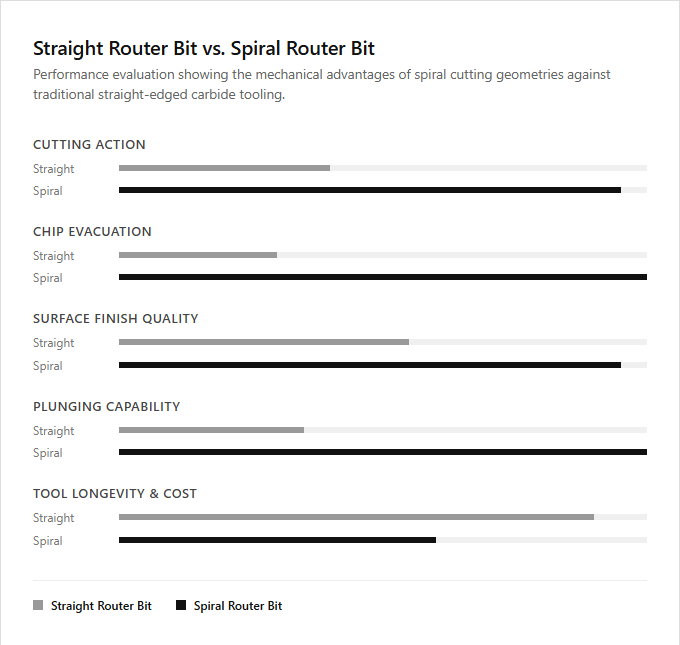
| Factor | Summary |
|---|---|
| Cutting Action | While straight bits chop material using flat edges, spiral bits utilize a continuous shearing action along their helical path to significantly reduce vibration during operation. |
| Chip Evacuation | Spiral bits efficiently clear debris using helical flutes that pull chips upward or push them downward, whereas straight bits rely primarily on centrifugal force for waste clearance. |
| Surface Finish Quality | Spiral bits drastically minimize fiber tear-out on the face of the workpiece due to their slicing cutting angle, producing a cleaner edge than traditional straight bits. |
| Plunging Capability | Spiral bits excel at axial penetration because of their end-cutting geometry, whereas standard straight bits struggle with plunging unless they feature specialized plunge-cutting tips. |
| Tool Longevity and Cost | Straight bits offer a more economical purchase price and simpler maintenance, while spiral bits are machined from solid carbide for maximum durability and edge retention. |
How Up-Cut Spiral Bits Clear Waste Upward
Selecting the correct router bit is essential for achieving precise results in woodworking. While traditional straight router bits cut with a flat edge, spiral router bits feature a continuous helical cutting edge. Specifically, up-cut spiral bits utilize a positive helix angle to pull waste material upward out of deep mortises, which prevents heat buildup and clogging during operation.
In contrast, straight bits shear wood with flat, vertical carbide edges, making them ideal for straightforward edge-forming and shallow grooving where chip clearance is less critical. Production shops and professional furniture makers requiring deep, clean mortises find spiral bits indispensable, while general DIYers and hobbyists performing standard joinery or edge profiling are better served by the simplicity and cost-effectiveness of straight bits.
Down-Cut Spiral Bits Protect Top Surface Veneer
When selecting tooling for a CNC or handheld router, the choice between straight and spiral router bits significantly impacts edge quality and material yield. Straight bits cut with a flat edge, making them suitable for standard grooving and trenching. In contrast, spiral bits utilize a continuous helical cutting edge that shears the material. Down-cut spiral bits employ a negative helix angle to push chips downward, protecting the top surface veneer from tear-out and ensuring an exceptionally clean upper edge.
While straight bits offer a cost-effective solution for general joinery, spiral bits provide superior chip clearance and finish quality in demanding materials like plywood and laminates. Straight bits are ideal for budget-conscious hobbyists performing basic template routing, whereas spiral bits are best suited for high-production woodworkers requiring flawless finishes on delicate veneered surfaces.
Straight Router Bits Increase Grain Tear-Out Risk
When selecting between straight and spiral router bits, the primary distinction lies in their cutting geometry and material interaction. Straight router bits feature an orthogonal cutting angle that lacks axial shear. Because the straight edge strikes the workpiece perpendicular to the rotation, it creates a high-impact chopping action rather than a slicing motion, significantly increasing the risk of grain tear-out on delicate or figured woods.
Spiral router bits utilize a helical design to provide continuous axial shear. This continuous contact slices through wood fibers smoothly, effectively evacuating chips and minimizing surface defect risks. Straight bits are best suited for budget-conscious hobbyists performing basic, utility-grade grooving, while spiral bits are ideal for precision woodworkers demanding flawless surface finishes on complex grain patterns.
Compression Spiral Bits for Clean, Double-Sided Cuts
Straight router bits cut with a flat edge that enters the wood all at once, which can sometimes cause tear-out on delicate surfaces. In contrast, spiral router bits utilize a continuous helical shearing action to slice smoothly through fibers, significantly reducing vibration and improving chip clearance during operation.
Among spiral designs, compression spiral bits offer a distinct advantage by combining opposing up-cut and down-cut shear angles. This dual-action geometry compresses the wood fibers toward the center of the workpiece, yielding exceptionally clean, chip-free cuts on both the top and bottom faces of double-sided sheet goods.
Standard straight bits are ideal for budget-conscious hobbyists performing basic utility cuts, while high-performance spiral and compression bits are best suited for precision cabinetmakers and CNC operators requiring flawless finishes on premium veneered panels.
Spiral Flutes Minimize Tool Deflection and Chatter
When selecting tooling for CNC or handheld routing, the geometry of the cutting edge dictates both finish quality and tool longevity. While traditional straight router bits enter the material with a repetitive, high-impact chopping motion, spiral router bits utilize a continuous helical design. These spiral flutes maintain continuous cutting edge engagement with the workpiece, which significantly reduces tool deflection and chatter during high-speed passes, ensuring cleaner cuts and tighter tolerances.
The shearing action of the spiral design also improves chip evacuation, which prevents heat buildup and extends the life of the tool. Straight bits remain highly effective for standard grooving, rebating, and simple edge-shaping applications. Precision woodworkers requiring flawless surface finishes on complex materials benefit most from premium spiral bits, whereas general hobbyists executing basic jointing and profiling tasks will find straight bits highly practical and cost-effective.
Proper Chip Evacuation Prevents Carbide Thermal Degradation
In precision routing, the choice between straight and spiral router bits is defined by chip clearance and thermal management. Spiral bits utilize a helical geometry to actively shear material and pull waste away from the workpiece. This proper chip evacuation directly influences the chip load, preventing premature thermal degradation of the solid carbide substrate and extending tool life during demanding operations.
Straight bits, by contrast, lack an upward or downward flute angle to clear debris, which increases friction and heat retention in deep cuts. Straight bits are best suited for budget-conscious hobbyists performing basic shallow-groove tasks, while spiral bits are the premier choice for production-grade fabricators executing deep mortises and continuous CNC machining.
Straight Bits: Inefficient for Deep Plunge Routing
Selecting the appropriate router bit is essential for achieving clean cuts and maintaining tool longevity. Straight router bits feature vertical cutting edges that rely entirely on rotational centrifugal force to eject wood chips. This design makes them highly inefficient for deep plunge routing operations, as waste material becomes trapped in the groove, leading to excessive friction and heat buildup.
Spiral router bits utilize a helical geometry to actively shear wood fibers and continuously evacuate chips from the cut. This continuous clearance ensures cooler, faster operations during demanding deep-plunging tasks. Straight bits are ideal for occasional DIYers performing basic shallow edge profiling, while spiral bits are best suited for CNC operators and woodworking professionals requiring flawless deep-pocket mortising.
Leave a comment