
Achieving seamless alignment in panel layups is a constant struggle for woodworkers, who frequently battle joint slippage, tear-out, and misaligned faces. While many craftsmen attempt to resolve this by relying on standard workshop tooling budgets and traditional sourcing channels for default replacement blades, they often overlook the critical role of cutter tooth configuration.
Optimizing this variable-specifically choosing between six-tooth and eight-tooth designs-grants the woodworker absolute control over feed speed, slot cleanliness, and joint integrity. We must stipulate, however, that selecting the ideal tooth count is contingent upon understanding your specific material density; for example, plunging into dense red oak face frames demands different chip clearance than routing slots in delicate Baltic birch plywood.
This article will analyze the technical differences between six- and eight-tooth cutters, evaluate their performance across various wood species, and provide a definitive roadmap to selecting the ideal blade for your plate joiner.
| Factor | Summary |
|---|---|
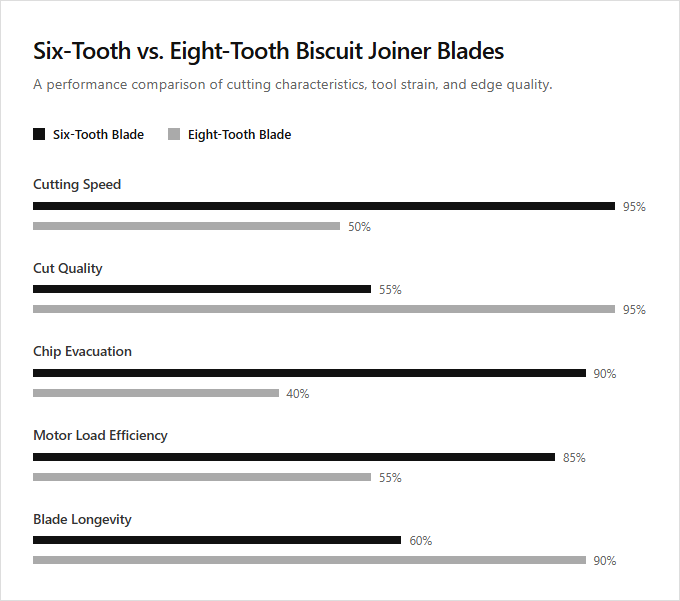
| Cutting Speed | Six-tooth blades allow for a significantly faster feed rate through dense hardwoods, whereas eight-tooth blades require a slower plunge to prevent friction burns. |
| Cut Quality | Eight-tooth blades yield a much cleaner cut with minimal tear-out along the kerf edges, making them ideal for delicate plywood veneers. |
| Chip Evacuation | The larger gullet capacity of a six-tooth blade prevents sawdust clogging by rapidly clearing waste material during high-RPM plunging. |
| Motor Load | Fewer teeth on a six-tooth blade reduce rotational resistance, which minimizes the torque requirement and thermal strain on the biscuit joiner's motor. |
| Blade Longevity | Eight-tooth blades distribute the impact force across more cutting edges, thereby reducing individual carbide degradation and extending the tool's lifespan. |
Six-tooth blades allow for a significantly faster feed rate
When selecting a blade for a biscuit joiner, the choice between a six-tooth and an eight-tooth configuration primarily impacts cutting speed and finish quality. A six-tooth blade features larger gullets between the carbide teeth, which facilitates efficient waste clearance. This design allows for a significantly faster feed rate, enabling operators to plunge and release quickly without overloading the tool's motor or scorching the workpiece.
In contrast, an eight-tooth blade distributes the cutting workload across more points of contact, yielding a smoother, cleaner cut with minimal tear-out, albeit at a slower pace. High-volume cabinetmakers and production carpenters prioritizing speed benefit most from the fast-feeding six-tooth blade, while precision furniture makers working with delicate veneers or hardwoods prefer the cleaner cut of the eight-tooth alternative.
Six-tooth blades feature larger gullets for superior chip clearance
When selecting a blade for a biscuit joiner, the choice between a six-tooth and an eight-tooth configuration directly impacts cutting efficiency and joint quality. Six-tooth blades feature larger gullets, which provide superior chip clearance during operation. This generous spacing allows the tool to rapidly evacuate wood debris during deep plunges, effectively minimizing heat buildup and reducing the risk of scorching the workpiece.
In contrast, eight-tooth blades offer a higher frequency of cuts per revolution, yielding a smoother finish with less risk of tear-out. Production-oriented woodworkers prioritizing rapid material removal and cool operation will benefit most from the six-tooth blade, while detail-oriented artisans working with delicate veneers or brittle composites will find the eight-tooth blade more appropriate for their precision joinery needs.
Eight-tooth blades minimize tear-out at the entry of the slot
When selecting a blade for a biscuit joiner, the choice between a six-tooth and an eight-tooth configuration directly impacts cut quality. Standard six-tooth blades offer rapid material removal but can leave rougher edges. Conversely, an eight-tooth blade features more cutting points, which significantly minimizes tear-out at the entry of the slot by shearing wood fibers more cleanly.
This smoother cutting action makes the eight-tooth option superior for delicate materials like veneered plywood where splintering must be avoided. The robust six-tooth blade is ideal for general construction workers who prioritize speed and tool longevity in solid framing, whereas the refined eight-tooth blade is best suited for precision furniture makers who require flawless joints in finished surfaces.
Eight-tooth blades offer a finer tooth pitch for cleaner cuts
When selecting a blade for a biscuit joiner, the tooth count significantly influences both the cutting speed and the finish of the slot. Standard six-tooth blades feature wider gullets that facilitate rapid material removal, making them highly efficient for high-volume tasks. Conversely, eight-tooth blades offer a finer tooth pitch for cleaner cuts, reducing the risk of fiber tear-out and ensuring a precise fit in delicate materials.
The choice between these configurations depends heavily on the specific application and the workpiece material. The fast-clearing six-tooth blade is ideal for framing carpenters and general contractors seeking speed, while the refined eight-tooth blade is best suited for fine cabinetmakers and hobbyists working with sensitive hardwoods or veneered plywood.
Six-tooth blades create less cutting resistance on the tool motor
When selecting a blade for a biscuit joiner, the choice between a six-tooth and an eight-tooth configuration significantly impacts both tool performance and motor longevity. A six-tooth blade features larger gullets and fewer cutting points, which inherently creates less cutting resistance on the tool motor. This reduced drag allows the joiner to maintain high RPMs with less strain, making it highly efficient for rapid plunging and prolonged use without overheating the machine.
An eight-tooth blade distributes the cutting workload across more teeth to deliver a cleaner, smoother finish with minimal tear-out, though it places a slightly higher demand on the motor. Production-oriented woodworkers prioritizing speed and tool longevity benefit most from the six-tooth design, while artisans focusing on delicate, splinter-prone materials typically choose the eight-tooth option.
Both blade types require a precise four-millimeter kerf width
When selecting a blade for a biscuit joiner, the choice between a six-tooth and an eight-tooth configuration directly impacts cutting efficiency and finish quality. Regardless of the tooth count, both blade types require a precise four-millimeter kerf width to function correctly. This exact measurement ensures that standard wooden biscuits fit snugly within the milled slots, preventing joint misalignment and maintaining structural integrity during the gluing process.
A six-tooth blade features larger gullets, allowing for rapid waste removal and faster cuts in softer materials. The eight-tooth blade distributes the cutting load across more points, delivering a cleaner, tear-out-free finish on delicate veneers and dense hardwoods. High-production cabinetmakers prioritizing speed will benefit most from the six-tooth variety, while detail-oriented artisans focused on flawless exposed joints should opt for the eight-tooth alternative.
High-performance blades utilize an Alternate Top Bevel (ATB) grind
Biscuit joiners typically utilize either a six-tooth or an eight-tooth blade to plunge-cut precise slots for wooden biscuits. High-performance options in both configurations feature an Alternate Top Bevel (ATB) grind. This specific tooth geometry alternates the bevel angle from left to right, slicing cleanly through wood fibers rather than tearing them, which ensures flat-bottomed, splinter-free slots in various wood species.
While the six-tooth configuration offers rapid waste clearance and runs cooler during high-volume cuts, the eight-tooth blade provides a smoother, more refined finish in delicate materials. The fast-clearing six-tooth blade serves high-production framing professionals prioritizing speed and tool efficiency, whereas the smoother-cutting eight-tooth blade is ideal for precision furniture makers and cabinetmakers working with fragile veneers or brittle hardwoods.
Leave a comment