
Selecting the wrong angle grinder configuration often leads to chronic operator fatigue, compromised control, and heightened safety risks during intensive fabrication cycles. While procurement teams typically rely on standard capital budgets or tool-refresh funding sources to acquire fleet machinery, true operational efficiency lies in the micro-decisions of tool specification.
Prioritizing the correct actuation interface is vital, as the right mechanism grants operators enhanced tactile control and immediate shut-off capabilities, significantly mitigating workplace injuries. To fully realize these benefits, however, organizations must adhere to the safety training stipulations associated with each mechanism, a critical factor for teams deploying heavy-duty DeWalt or Makita fleets in high-risk environments.
This article provides an analytical comparison of paddle switches and slide switches, examining their ergonomics, safety mechanisms, and application suitability to guide your next procurement decision.
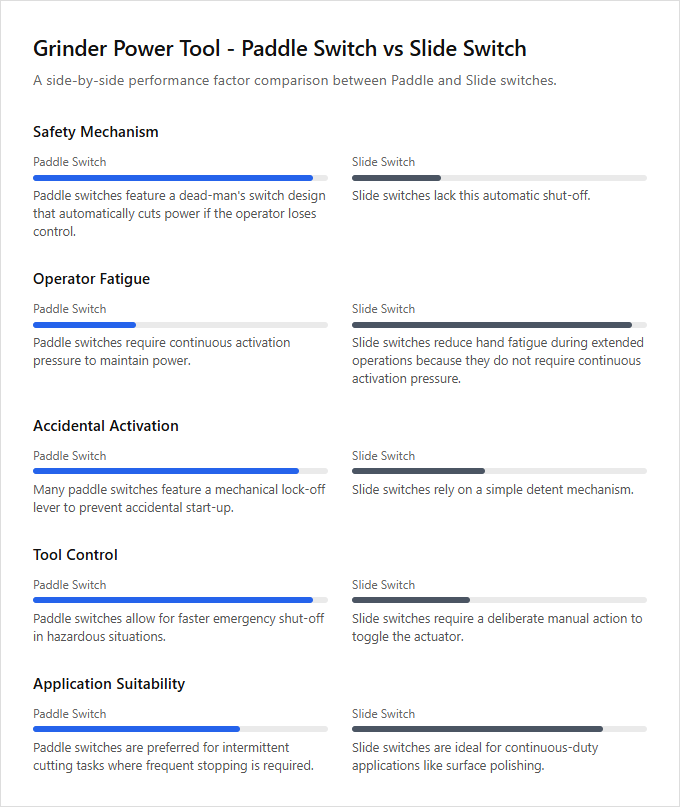
| Factor | Summary |
|---|---|
| Safety Mechanism | Paddle switches feature a dead-man's switch design that automatically cuts power if the operator loses control, whereas slide switches lack this automatic shut-off. |
| Operator Fatigue | Slide switches reduce hand fatigue during extended operations because they do not require continuous activation pressure to maintain power. |
| Accidental Activation | Many paddle switches feature a mechanical lock-off lever to prevent accidental start-up, whereas slide switches rely on a simple detent mechanism. |
| Tool Control | Paddle switches allow for faster emergency shut-off in hazardous situations, while slide switches require a deliberate manual action to toggle the actuator. |
| Application Suitability | Slide switches are ideal for continuous-duty applications like surface polishing, while paddle switches are preferred for intermittent cutting tasks where frequent stopping is required. |
Presence-Sensing Dead-Man Paddle Switch with Instant Cutoff
When selecting an angle grinder, the choice between a paddle switch and a slide switch significantly impacts job site safety and operational control. Paddle switches are engineered with a presence-sensing dead-man mechanism, which serves as a critical safety feature. If the operator loses their grip or drops the tool, the switch instantly releases, cutting power to the motor immediately to prevent severe injury.
Conversely, slide switches lock into the "on" position, allowing for continuous operation without maintaining constant hand pressure. This design reduces finger fatigue during extended grinding applications but lacks the rapid shutdown capability of the dead-man system. Slide switch grinders are ideal for experienced fabricators performing prolonged surface preparation, while paddle switch models are best suited for safety-conscious industrial environments and users prioritizing maximum hazard mitigation.
Lock-On Slide Switches for Fatigue-Free Operation
When selecting an angle grinder, the switch configuration significantly impacts operator comfort and operational efficiency. Slide switches are engineered for extended use, frequently incorporating a lock-on detent mechanism. This integration allows the operator to lock the tool in the active position, eliminating the need to maintain constant finger pressure. By removing this continuous physical exertion, slide switches substantially reduce hand fatigue during prolonged grinding or cutting applications.
Conversely, paddle switches require continuous manual depression to operate, serving as a safety feature that immediately cuts power if the tool is dropped. While paddle switches offer superior control in intermittent or overhead tasks, they can cause grip strain over long durations. Slide grinders are ideal for high-volume fabricators undertaking continuous surface preparation, whereas paddle grinders are best suited for utility contractors and maintenance technicians prioritizing maximum safety during brief, precise cuts.
Two-Stage Lock-Off Paddles Prevent Accidental Startup
When selecting an angle grinder, the choice between a paddle switch and a slide switch significantly impacts both operational control and user safety. Paddle switch grinders are highly favored in industrial environments due to their safety mechanisms, particularly the integration of two-stage mechanical lock-off levers on the actuators. These levers require a deliberate, dual-action motion to engage the tool, which effectively prevents accidental startup if the grinder is dropped or bumped. Conversely, slide switches lock into the "on" position, offering continuous operation without constant hand pressure but lacking an automatic shut-off when released.
Slide switch models are best suited for experienced tradespeople performing continuous, long-duration grinding where reducing hand fatigue is the priority, while paddle switch models with mechanical lock-offs are ideal for safety-conscious operators and high-risk job sites requiring frequent, intermittent cuts.
IP Rating Variance Against Dust in Switch Housings
Industrial angle grinders operate in environments saturated with conductive, abrasive debris, making switch housing integrity critical to tool longevity. Slide switches utilize mechanical linkages that often create vulnerable ingress pathways, potentially lowering the effective Ingress Protection (IP) rating of the internal contact housing. Over time, this exposure allows fine particulates to migrate into the switch chamber, causing contact degradation, resistance spikes, or mechanical sticking.
In contrast, premium paddle switches frequently incorporate fully encapsulated micro-switches or magnetic sensing elements, providing superior localized sealing against dust accumulation. Slide switch models are best suited for operators requiring continuous, locked-on operation in stationary fabrication shops, whereas paddle switch grinders are ideal for safety-conscious field contractors performing intermittent cutting and overhead demolition in high-dust environments.
Instant Paddle-Switch Shutdown During Tool Kickback
An angle grinder's switch design directly impacts operational safety, particularly during high-torque applications. Paddle switches, often referred to as "dead-man" switches, provide crucial protection by requiring continuous manual pressure to operate. In the event of a sudden tool kickback or loss of control, the operator's natural reflex is to release their grip, which immediately cuts power to the motor. This achieves instantaneous emergency de-energization, drastically reducing the risk of severe injury from a spinning disc.
In contrast, slide switches lock into the active position, maintaining continuous power without constant finger pressure. While this reduces hand fatigue during prolonged grinding, it lacks the automatic shutoff safety feature if the tool escapes the operator's grasp. Professionals prioritizing maximum safety during heavy-duty fabrication prefer paddle switch grinders, whereas users performing extended, repetitive surface preparation often opt for the locked-on convenience of slide switch models.
Grip Ergonomics and Hand Adaptability Across Grinding Angles
Slide switch grinders typically feature a narrow, uniform barrel circumference because the switch mechanism is integrated flush along the housing. This slim profile allows for a secure, wrap-around grip that minimizes hand fatigue. Paddle switch models require a wider, asymmetric barrel to accommodate the under-body lever, demanding constant hand pressure to keep the tool engaged during operation.
During multi-angle applications, slide switches offer excellent hand placement adaptability since operators can shift their grip freely along the tool body without power interruption. Paddle switches restrict the primary hand to the lever area but deliver an immediate shut-off safety mechanism when released. Slide switch grinders are preferred by fabricators performing continuous, flat-surface grinding, whereas paddle switch models are ideal for safety-conscious operators working in elevated or restricted spaces.
Duty Cycle Durability of High-Current Microswitch Contacts
In high-current grinding applications, the internal microswitch architecture determines long-term tool reliability. Slide switches typically employ a mechanical detent mechanism that maintains consistent contact pressure, minimizing electrical resistance and contact arcing during prolonged high-draw operations. This design effectively manages thermal dissipation under heavy loads, preserving the integrity of the conductive contacts over extended duty cycles.
In contrast, paddle switches rely on momentary spring-loaded microswitches. While highly responsive, these contacts are more susceptible to pitting and micro-welding when subjected to frequent inrush currents and repetitive cycling. Slide switch grinders are best suited for fabrication professionals performing continuous, long-duration grinding, while paddle switch models are ideal for operators prioritizing safety and intermittent, high-control cutting tasks.
Leave a comment