
Selecting the wrong power saw for a project often leads to splintered materials, stalled progress, and costly mistakes. Traditionally, craftspeople and DIYers attempt to bypass this challenge by relying on standard, all-purpose circular saws or manual hand saws. However, utilizing a specialized tool offers an immediate surge in cutting precision and operator safety that generalist equipment simply cannot replicate.
To manage expectations, we must stipulate that no single saw excels at both delicate shaping and heavy-duty destruction. For example, cutting tight, custom curves in a maple countertop requires the delicate orbital control of a jigsaw, whereas tearing through nail-embedded wall framing during a remodel demands the raw, linear force of a reciprocating saw.
In this guide, we will compare the distinct mechanics, blade stroke profiles, and optimal use cases of jigsaws and reciprocating saws, providing you with a clear decision framework to choose the exact tool your project requires.
| Factor | Summary |
|---|---|
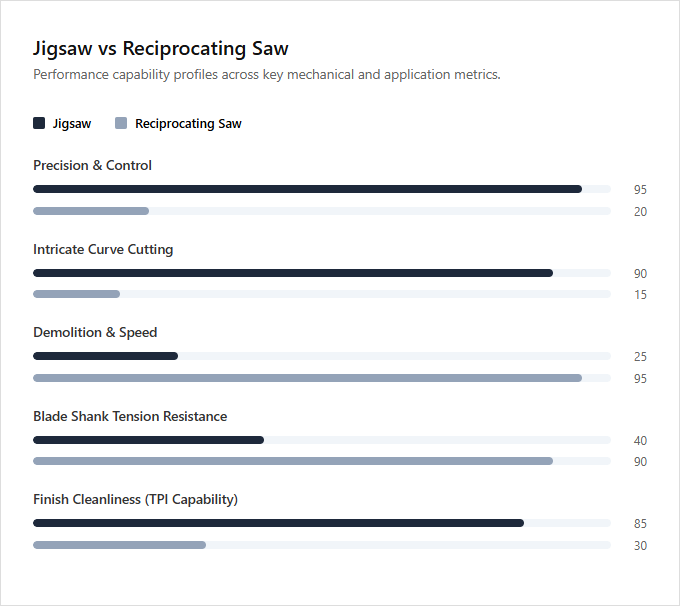
| Blade Motion | The jigsaw utilizes a vertical reciprocating motion with optional orbital action for intricate curves, whereas the reciprocating saw uses an aggressive push-pull stroke optimized for rough demolition. |
| Precision and Guide | Jigsaws feature an adjustable shoe plate that rests flat on the workpiece to ensure stable, high-precision cuts, while reciprocating saws are designed for freehand, low-tolerance rough cutting. |
| Blade Shank Style | Jigsaws primarily utilize specialized T-shank blades for quick, tool-less changes during detailed work, whereas reciprocating saws use standardized universal shank blades engineered to withstand extreme heavy-duty tension. |
| Teeth Per Inch (TPI) | Jigsaws employ high-TPI blades to achieve clean, splinter-free finishes on delicate materials, while reciprocating saws typically use low-TPI blades to rapidly clear debris during aggressive cuts. |
| Primary Application | The jigsaw is the preferred tool for delicate woodworking joinery and scrollwork, whereas the reciprocating saw is indispensable for construction-site demolition and pipe cutting. |
Orbital action selectability versus linear reciprocating stroke
Jigsaws and reciprocating saws employ different mechanical strokes to suit distinct cutting tasks. Jigsaws often feature selectable orbital action, which introduces a circular, forward-and-back motion to the blade rather than a strictly vertical path. This selectable setting allows users to prioritize cutting speed over finish quality depending on the material. In contrast, reciprocating saws rely primarily on a robust, straight linear reciprocating stroke, engineered to deliver maximum power for demolition and rough cutting.
While the orbital capability of a jigsaw minimizes tear-out in delicate materials, the linear motion of a reciprocating saw excels at shearing through nails, wood, and metal with high force. Jigsaws are ideal for woodworkers and crafters requiring precise, curved cuts, whereas reciprocating saws are suited for demolition contractors and renovators who prioritize rapid, heavy-duty material removal.
T-shank blade attachment versus universal tang shank
When selecting power saws, the blade attachment mechanism directly influences both cutting precision and tool durability. Jigsaws predominantly utilize T-shank blades, which feature a top tang with two lateral ears. This design allows for a secure, toolless quick-release connection that ensures precise vertical alignment, making it ideal for intricate, curved maneuvers in delicate materials.
In contrast, reciprocating saws rely on the universal tang shank, characterized by a flat, standardized end with a central hole for clamp or pin-locking systems. This robust connection is engineered to withstand the extreme, high-vibration forces of aggressive push-and-pull cutting without loosening or breaking.
Creative woodworkers and finish carpenters requiring detailed, curved cuts benefit most from the precision of a T-shank jigsaw, whereas demolition contractors and plumbers tackling rough pipe and stud slicing require the rugged endurance of a universal shank reciprocating saw.
Fine scrollwork capability versus aggressive demolition plunge cutting
The jigsaw is engineered for precision and control, utilizing a thin, vertical blade to execute intricate curves and tight radiuses. This capability makes it indispensable for fine scrollwork, detailed cabinetry, and custom shape cutting in wood, plastics, and light metals. Its orbital action and stable footplate allow operators to guide the tool with high accuracy along complex lines.
In contrast, the reciprocating saw is designed for raw power and heavy-duty demolition. Featuring a robust, horizontal blade that moves in a rapid back-and-forth motion, this tool excels at aggressive plunge cutting through tough materials like nail-embedded wood, metal pipes, and masonry. It sacrifices surgical precision for sheer speed and the ability to access awkward spaces during tear-downs.
Woodworkers and craftspeople requiring intricate, detailed finishes will benefit most from the jigsaw, whereas contractors and demolition specialists prioritizing rapid, forceful material removal will find the reciprocating saw essential.
Bevel-adjustable shoe plate versus pivoting shoe stabilizer
When comparing cutting precision and adaptability, the shoe designs of jigsaws and reciprocating saws serve highly distinct structural roles. A jigsaw features a bevel-adjustable shoe plate, which allows the operator to tilt the base of the tool at precise angles, typically up to 45 degrees. This adjustable flat plate ensures the tool remains securely supported flat against the workpiece, enabling controlled, angled bevel cuts along intricate curves.
A reciprocating saw utilizes a pivoting shoe stabilizer. This mechanism pivots freely to adapt to uneven, non-flat surfaces, absorbing severe vibrations and allowing the user to leverage the tool directly against the material during aggressive demolition or flush cuts. The precision-focused jigsaw is best suited for furniture makers and detailed crafters, while the rugged reciprocating saw is ideal for demolition contractors and plumbers needing rapid, heavy-duty cutting.
High-precision strokes per minute (SPM) control versus high-torque motor amperage
Selecting the right power saw depends on the balance between precision and raw power. A jigsaw utilizes high-precision strokes per minute (SPM) control, allowing operators to execute delicate, curved cuts with meticulous accuracy. This fine-tuned speed adjustment prevents material scorching and ensures clean, detailed edges in delicate workpieces.
In comparison, a reciprocating saw relies on a high-torque motor with high amperage, typically between 7 and 15 amps, to deliver aggressive cutting force. This robust design prioritizes sheer power over neatness, easily tearing through nail-embedded timber, heavy metals, and masonry.
Jigsaws are ideal for woodworkers requiring intricate, detailed shapes, while reciprocating saws are suited for demolition contractors performing heavy-duty material removal.
Splinter guard chip clearance versus wide kerf blade clearance
The jigsaw is engineered for precision, utilizing a splinter guard that fits tightly around the blade to minimize chip clearance. This design supports the wood fibers directly at the cut line, preventing unsightly tear-out and ensuring clean, detailed curves in delicate materials.
In contrast, the reciprocating saw features a wide kerf blade clearance designed for rapid material removal. The generous spacing around the blade allows for efficient chip and debris evacuation, preventing binding during aggressive, high-speed cuts through dense or nail-embedded substrates.
Detailed artisans requiring clean, intricate finishes benefit most from the jigsaw, whereas demolition specialists and renovators tackling heavy-duty dismantling favor the robust power of the reciprocating saw.
Vertical perpendicular guidance versus horizontal flush cutting flexibility
The jigsaw is engineered for precision, utilizing a flat shoe that rests securely on the workpiece. This design provides steady vertical perpendicular guidance, ensuring highly accurate, controlled cuts along intricate curves and straight lines in woodwork and sheet materials.
In contrast, the reciprocating saw prioritizes maneuverability and reach. Its exposed, flexible blade facilitates horizontal flush cutting, enabling users to sever materials level with adjacent surfaces. This tool excels in demolition and rough construction where rigid guidance is secondary to accessibility.
Fine woodworkers and cabinetmakers benefit most from the jigsaw's meticulous accuracy, while demolition contractors and plumbers require the rugged versatility of the reciprocating saw.
Leave a comment