
Selecting the wrong cordless ratchet drive size often leads to stripped fasteners, busted knuckles, and costly project delays. Traditionally, technicians have relied on standard hand ratchets or cumbersome pneumatic lines to handle these varied fastening tasks, tolerating the physical strain and limited mobility of legacy tools.
However, choosing the precise cordless platform grants mechanics instant speed, reduced fatigue, and optimal fastening efficiency. Crucially, this upgrade operates under the stipulation that raw torque must always be balanced against tight spatial constraints and specific fastener ratings. For instance, a compact 1/4-inch drive is indispensable for delicate under-dash wiring, whereas a robust 3/8-inch drive is required for stubborn engine mounts and brake calipers.
To help you make an informed investment, this guide provides a comprehensive comparison of 1/4-inch versus 3/8-inch cordless ratchets, analyzing torque output, head clearance, and practical applications for your workshop.
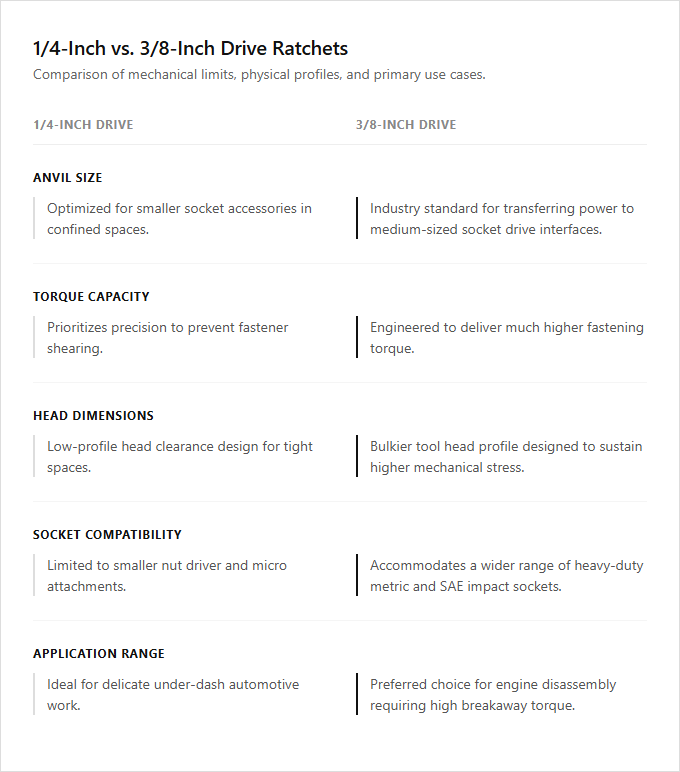
| Factor | Summary |
|---|---|
| Anvil Size | The 1/4-inch drive size is optimized for smaller socket accessories in confined spaces, while the 3/8-inch drive serves as the industry standard for transfering power to medium-sized socket drive interfaces. |
| Torque Capacity | Power ratchets with a 3/8-inch configuration are engineered to deliver much higher fastening torque, whereas 1/4-inch models prioritize precision to prevent fastener shearing. |
| Head Dimensions | The 1/4-inch power ratchet features a low-profile head clearance design, allowing mechanics to reach tight spaces that are inaccessible to the bulkier 3/8-inch tool head. |
| Socket Compatibility | A 3/8-inch ratchet accommodates a wider range of heavy-duty metric and SAE impact sockets, while the 1/4-inch version is limited to smaller nut driver attachments. |
| Application Range | The 1/4-inch tool is ideal for delicate under-dash automotive work, whereas the 3/8-inch tool is the preferred choice for engine disassembly requiring high breakaway torque. |
Max Breakaway Torque Difference: 3/8" vs. 1/4" Drive
Power ratchets exhibit distinct performance profiles based on drive size, particularly regarding maximum breakaway torque capacity. A standard 3/8-inch drive power ratchet typically delivers between 35 and 55 foot-pounds of torque, with heavy-duty models reaching even higher. In contrast, the smaller 1/4-inch drive configuration generally caps out between 10 and 30 foot-pounds of breakaway force. This discrepancy stems from the larger anvil and robust internal gearing of the 3/8-inch model, which is engineered to withstand greater rotational stress without mechanical failure.
While the 3/8-inch drive provides the necessary muscle to loosen stubborn, rusted fasteners, the 1/4-inch drive excels in delicate assemblies where overtightening could damage components. Automotive technicians tackling engine bays and suspension work require the robust power of the 3/8-inch drive, whereas electronics installers and precision assembly workers favor the lightweight control of the 1/4-inch configuration.
Anvil shear strength and socket drive size compatibility limits
The primary differentiator between 1/4-inch and 3/8-inch cordless ratchets lies in anvil shear strength and torque capacity. A 1/4-inch anvil is engineered for low-torque precision, with a lower shear threshold designed to prevent damage to delicate fasteners. In contrast, the 3/8-inch anvil features a thicker steel cross-section, providing the structural integrity needed to withstand higher torsional forces without risking mechanical failure.
Drive size also dictates socket compatibility limits. Driving large sockets with a 1/4-inch anvil risks snapping the drive under load, whereas the 3/8-inch drive natively accommodates larger, heavy-duty sockets. Precision technicians working on electronics or interior trim benefit most from the compact 1/4-inch ratchet, whereas automotive mechanics and industrial maintenance personnel require the robust capability of the 3/8-inch model.
Head Profile Clearance in Tight Engine Bays
When navigating the tight spatial constraints of modern engine bays, head profile clearance is a critical factor. A 1/4-inch drive ratchet offers an exceptionally compact head design, allowing technicians to slip the tool into narrow gaps. This low-profile geometry is essential for accessing fasteners near firewall obstructions and intricate electrical harnesses where larger tools cannot fit.
A 3/8-inch drive ratchet features a slightly larger head profile to accommodate robust internal gearing for higher torque. While it requires more clearance, it remains the standard for general mechanical tasks requiring a balance of power and reach. The ultra-compact 1/4-inch drive is ideal for precision specialists working on delicate, highly restricted components, while the stronger 3/8-inch drive is best suited for general automotive technicians handling larger engine assemblies.
No-load speed measured in RPM determining fastener rundown efficiency
When selecting cordless ratchet wrenches, the choice between 1/4-inch and 3/8-inch drive sizes often hinges on no-load speed, measured in revolutions per minute (RPM). This metric directly dictates fastener rundown efficiency, which is the speed at which a tool spins a free-running bolt before resistance is met. Generally, 1/4-inch drive ratchets feature higher RPM ratings, allowing operators to rapidly spin down small fasteners in confined compartments.
In comparison, 3/8-inch drive ratchets typically sacrifice some rundown speed for increased torque capacity, yielding lower RPMs but greater mechanical leverage. The high-speed 1/4-inch ratchet is ideal for electronics technicians performing rapid, light-duty assemblies, while the high-torque 3/8-inch model is best suited for automotive mechanics tackling stubborn engine fasteners.
Brushless Motor Efficiency: Battery and Thermal Impacts
Brushless motor technology in cordless ratchet wrenches significantly optimizes energy delivery. By eliminating mechanical brush friction, these motors achieve superior energy conversion efficiency, which directly extends the battery duty cycle. For both 1/4-inch and 3/8-inch drive models, this efficient power management translates to prolonged runtimes under continuous use. Furthermore, advanced thermal management prevents heat buildup, protecting internal components and ensuring consistent torque output during demanding fastening applications.
While the brushless efficiency remains consistent across both platforms, the drive size dictates the mechanical application. The compact 1/4-inch drive utilizes this power for high-speed, low-torque tasks in confined spaces, whereas the robust 3/8-inch drive handles higher torque thresholds without overloading the motor. The nimble 1/4-inch model is ideal for precision electronics technicians and interior automotive installers, whereas the high-torque 3/8-inch drive is best suited for heavy-duty mechanics and industrial maintenance professionals.
Fastener thread diameter constraints defining the optimal working torque envelope
The choice between a 1/4-inch and a 3/8-inch cordless ratchet is strictly governed by the fastener thread diameter, which dictates the optimal working torque envelope. A 1/4-inch drive is engineered for smaller fasteners, typically ranging from M4 to M8 thread diameters. This mechanical constraint limits the torque delivery to lower thresholds, preventing the shearing of delicate threads during assembly in highly confined spaces.
A 3/8-inch drive accommodates larger fasteners, generally spanning M8 to M12 thread diameters. The robust internal gearing of this platform supports the elevated torque envelopes necessary to break loose stubborn, high-tensile bolts. Automotive technicians and heavy-equipment mechanics require the high-torque capabilities of the 3/8-inch ratchet, while electronics technicians and instrument calibrators are best suited for the precision and compact profile of the 1/4-inch drive.
Lithium-ion battery voltage platforms determining the overall power-to-weight ratio
Cordless ratchet wrenches rely heavily on their lithium-ion battery platforms to balance performance and ergonomics. Typically, 1/4-inch drive ratchets pair with compact 12-volt battery systems, prioritizing a lightweight profile and maneuverability in confined spaces. This integration yields an optimal power-to-weight ratio for low-torque applications where physical access is severely restricted.
Conversely, 3/8-inch drive ratchets often utilize robust 12-volt high-capacity or 18-volt battery platforms. This higher voltage increases torque output and fastening speed, though it introduces additional weight to the tool. Precision-focused electronics installers and interior technicians benefit most from the nimble 1/4-inch drive, whereas automotive mechanics and heavy machinery technicians require the high-torque capability of the 3/8-inch drive.
Leave a comment