
Navigating the cramped confines of a modern engine bay or industrial machinery often leads to bruised knuckles and frustratingly limited swing arcs. Traditionally, technicians have relied on standard hand ratchets or bulky pneumatic lines as their primary resources for tackling these tight spots. However, upgrading to cordless power grants professionals unmatched speed, efficiency, and torque-on-demand without the physical constraints of manual labor.
While cordless ratchets are highly efficient, a critical stipulation remains: tool geometry directly dictates accessibility. For instance, servicing deep-seated serpentine belts or recessed suspension components requires precise clearance planning, as a standard-length tool body simply cannot reach certain fasteners regardless of its power.
This article provides an in-depth comparison of extended reach versus standard reach cordless ratchets. We will evaluate head clearance, torque capabilities, and leverage dynamics to help you determine the most productive investment for your specific fastening applications.
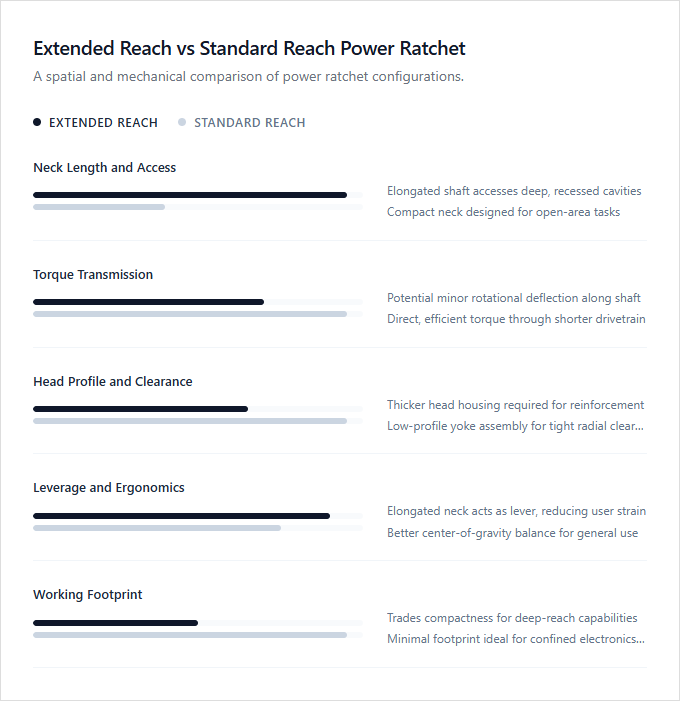
| Factor | Summary |
|---|---|
| Neck Length and Access | Extended reach power ratchets utilize an elongated drive shaft housing to access fasteners in deep, recessed cavities, whereas standard models feature a compact neck designed for open-area tasks. |
| Torque Transmission | Standard reach ratchets deliver more direct torque transmission through a shorter drivetrain, while extended reach models can suffer from minor rotational deflection along the lengthened shaft. |
| Head Profile and Clearance | Standard reach ratchets generally offer a lower-profile yoke assembly for tight radial clearances, whereas extended models require structural reinforcement that can increase head thickness. |
| Leverage and Ergonomics | The elongated neck of an extended reach ratchet increases the lever arm, reducing user strain in deep engine bays, whereas standard models offer better center-of-gravity balance for general-purpose fastening. |
| Working Footprint | Standard reach tools maintain a minimal overall tool footprint ideal for confined under-dashboard electronics, while extended reach tools trade compactness for deep-reach capability. |
Extended-Reach Models for Recessed Fasteners
When selecting a cordless power ratchet, the primary distinction between standard and extended reach models lies in physical accessibility. Standard power ratchets offer a compact footprint ideal for general-purpose fastening in easily accessible areas. In contrast, extended reach models utilize an elongated neck shaft to access fasteners recessed beyond standard clearance limits, bridging the gap where traditional tools cannot reach.
The prolonged neck of the extended reach variant provides the necessary clearance to bypass obstructions like engine components or structural brackets without sacrificing torque. Standard models are best suited for general assembly technicians requiring maximum maneuverability in open areas, whereas extended reach models are ideal for automotive mechanics who frequently navigate crowded, deep engine bays.
Compact Head Ratchets for Narrow Clearances
Selecting between an extended reach and a standard reach power ratchet depends heavily on the spatial constraints of the application. Standard reach power ratchets are engineered with a significantly more compact head profile. This design is crucial for navigating extremely narrow radial clearances, allowing users to easily access fasteners in tightly packed engine bays or dense machinery where tool maneuverability is severely restricted.
Extended reach models feature a longer neck that provides the necessary depth to reach deeply recessed bolts. While these tools sacrifice some radial clearance due to their elongated structure, they eliminate the need for manual extensions in deep workspaces. Professional automotive technicians working in dense engine compartments typically benefit most from the compact standard reach, whereas industrial maintenance personnel dealing with deeply recessed machinery find the extended reach indispensable.
Extended Reach Tools Provide Superior Torque Leverage
When selecting between standard and extended reach power ratchets, mechanical leverage is a key differentiator. While standard models excel in tight, direct-access spaces, extended reach variations offer a distinct physical advantage during high-torque applications. The longer body of an extended reach tool acts as a superior lever arm, allowing operators to easily counteract reactionary torque during manual break-away maneuvers. This extra length significantly reduces physical strain and enhances control when breaking loose stubborn fasteners.
Standard reach tools prioritize compact maneuverability, whereas the extended shaft bridges the gap to deeply recessed components. Standard models are ideal for general automotive technicians working in open engine bays, while extended reach ratchets are best suited for heavy equipment mechanics who frequently encounter obstructed, high-torque fasteners in deep recesses.
Brushless Motors Maintain Torque in Extended Models
When selecting between standard and extended reach power ratchets, the mechanical design dictates performance efficiency. Standard reach ratchets offer compact maneuverability in open work areas, whereas extended reach models utilize a longer neck to access deeply recessed fasteners. In these extended models, high-efficiency brushless motors are critical to maintain consistent torque output across the lengthened drive assembly, minimizing the rotational energy loss that naturally occurs over a longer distance.
Brushless technology ensures that the extended tool delivers necessary fastening power without overheating during prolonged use. Professional automotive technicians working on crowded engine blocks benefit most from the leveraged access of the extended reach brushless ratchet, while general maintenance mechanics typically prefer the compact agility of the standard reach model for everyday fastening.
Standard Reach: Better Balance, Less Fatigue
When selecting a cordless power ratchet, the choice between standard and extended reach configurations significantly impacts tool ergonomics and overall productivity. Standard reach power ratchets are engineered with a compact profile that positions the motor and battery closer to the user's hand. This design yields superior weight distribution and an optimized center of gravity, which minimizes leverage-induced strain on the wrist and forearm during prolonged operation.
Extended reach models feature an elongated neck to access deeply recessed fasteners, though this extension shifts the balance point forward and increases the physical effort required to stabilize the tool. Standard models are ideal for high-volume assembly technicians prioritizing all-day comfort and control, whereas extended reach units are best suited for automotive diagnostic specialists who regularly negotiate tightly packaged engine bays.
Minor RPM Parasitic Loss in Extended Shafts
When selecting between standard and extended reach power ratchets, understanding the mechanical trade-offs is essential for optimizing workshop productivity. While both configurations utilize similar motor platforms to ensure the no-load speed measured in RPM remains highly efficient, the extended shafts can experience minor drivetrain parasitic loss due to increased rotational mass and surface friction along the elongated drive line.
Standard reach models deliver direct torque transfer in unobstructed spaces, whereas extended versions excel at navigating tight obstacles. Automotive technicians servicing complex, crowded engine bays require the specialized access of the extended reach tool, while general assembly technicians or bench mechanics prefer the lightweight, high-leverage control of the standard reach design.
Anvil Size Dictates Strength and Socket Compatibility
When choosing between standard and extended reach power ratchets, the drive anvil size remains the critical factor governing both socket compatibility and maximum shear strength. Standard configurations offer a compact footprint, while extended reach models utilize an elongated neck to access deeply recessed fasteners. In both designs, smaller anvils like 1/4-inch facilitate extreme tight-space fastening but limit torque capacity, whereas larger 3/8-inch and 1/2-inch anvils handle higher rotational forces without risking drive shear failure.
Standard reach ratchets are ideal for general assembly workers requiring quick, balanced operation, whereas extended reach models are best suited for automotive technicians who frequently service tightly packed engine bays.
Leave a comment