
Mechanics and industrial assembly technicians frequently struggle with cordless ratchet wrenches losing torque mid-job, stalling under heavy loads, or suffering from premature battery degradation that halts assembly lines. When seeking upgrades to resolve these bottlenecks, procurement managers typically look to standard equipment funding sources and traditional capital expenditure budgets to replace failing tool fleets.
However, selecting the optimal battery chemistry-specifically understanding how advanced Lithium-Ion technology grants unprecedented runtime and consistent torque delivery-is what truly unlocks maximum tool efficiency. To manage operational expectations, it must be stipulated that while Li-ion offers superior fade-free power, legacy Nickel-Cadmium options still offer niche durability benefits in extreme-temperature environments, as observed in heavy-duty diesel workshops utilizing Milwaukee M12 or legacy DeWalt systems.
This article compares Lithium-Ion and Nickel-Cadmium chemistries across discharge profiles, thermal performance, and long-term ROI to help you choose the right power source for your cordless ratchet wrench.
| Factor | Summary |
|---|---|
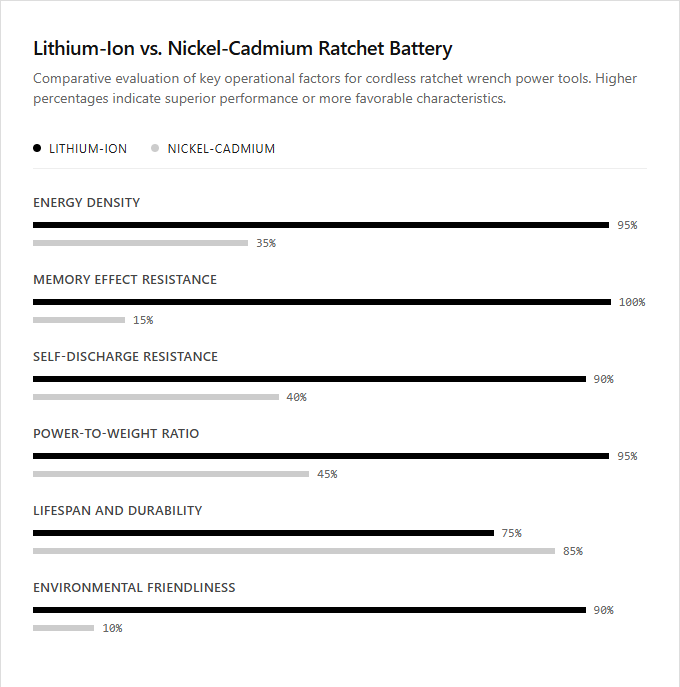
| Energy Density | Lithium-ion batteries offer a significantly higher gravimetric energy density than nickel-cadmium, allowing cordless ratchet wrenches to run longer on a single charge. |
| Memory Effect | Nickel-cadmium batteries suffer from voltage depression if recharged before being fully depleted, whereas lithium-ion chemistry is completely immune to this effect. |
| Self-Discharge Rate | Lithium-ion batteries maintain their charge during long periods of inactivity due to a very low self-discharge rate compared to nickel-cadmium cells. |
| Power-to-Weight Ratio | Lithium-ion technology provides a superior power-to-weight ratio, making the ratchet wrench much lighter and reducing user fatigue during overhead fastening tasks. |
| Lifespan and Durability | Nickel-cadmium batteries can withstand more charge-discharge cycles in extreme temperatures, though lithium-ion batteries offer longer overall operational shelf-life. |
| Environmental Impact | Nickel-cadmium batteries contain toxic heavy metals that pose severe risks of cadmium contamination, requiring strict hazardous waste recycling protocols. |
Lithium-Ion Enables Lighter, More Compact Wrenches
When selecting a cordless ratchet wrench, the choice between Lithium-Ion and Nickel-Cadmium battery technology determines the tool's physical footprint and handling. Lithium-ion chemistry delivers a substantially higher energy density than traditional nickel-cadmium cells. This superior energy-to-weight ratio allows manufacturers to engineer a lighter and more compact wrench chassis, which significantly minimizes operator fatigue during prolonged overhead tasks and improves access to confined workspaces.
Conversely, Nickel-Cadmium batteries, though heavier and bulkier, offer consistent performance in extreme temperatures and durable cycle life under heavy discharge. Professional automotive technicians requiring high maneuverability in tight engine bays will benefit most from lightweight Lithium-Ion models, while budget-conscious DIYers operating in harsh, unheated workshops are best suited for the rugged, cost-effective resilience of Nickel-Cadmium tools.
Lithium-Ion: Constant Torque Until Fully Depleted
When selecting a cordless ratchet wrench, the battery chemistry significantly influences tool performance and project efficiency. Lithium-ion technology offers a distinct advantage over legacy nickel-cadmium options due to its advanced power delivery. Specifically, lithium-ion batteries maintain a flat discharge curve, ensuring the ratchet wrench delivers consistent torque output from the first turn until the battery is fully depleted.
In contrast, nickel-cadmium batteries suffer from a gradual voltage drop, causing the tool's power and rotation speed to diminish steadily during use. High-volume automotive technicians requiring uninterrupted, peak torque choose lithium-ion models, whereas occasional DIY hobbyists seeking a durable, budget-friendly tool for intermittent repairs may still find value in nickel-cadmium options.
Memory Effect Permanently Reduces NiCad Battery Capacity
When selecting a cordless ratchet wrench, the battery chemistry plays a critical role in long-term performance and tool efficiency. Traditional Nickel-Cadmium (NiCad) batteries are highly durable but suffer significantly from the "memory effect," a phenomenon where premature recharging permanently reduces the battery's usable capacity over time. Lithium-Ion (Li-Ion) options maintain their full charge capacity regardless of recharge cycles, offering a higher energy density and a lighter profile for confined mechanical spaces.
Lithium-Ion technology delivers consistent, fade-free power throughout the discharge cycle, making the tool highly reliable for demanding environments. Busy automotive technicians requiring daily, high-torque reliability will benefit most from Lithium-Ion models, whereas budget-conscious DIY hobbyists undertaking occasional home maintenance may find the ruggedness of Nickel-Cadmium sufficient.
Lithium-Ion Batteries Retain Power During Storage
When selecting a cordless ratchet wrench, the battery chemistry significantly impacts performance and tool readiness. Lithium-ion technology offers a distinct advantage over traditional nickel-cadmium options due to its exceptionally low self-discharge rate. While nickel-cadmium batteries steadily lose charge when idle, lithium-ion cells retain their energy over extended periods of inactivity, preventing sudden power loss when the tool is retrieved from storage.
Lithium-ion packs deliver a more consistent power output throughout the discharge cycle and offer a superior power-to-weight ratio. Nickel-cadmium batteries, though heavier and prone to memory effect, remain durable in extreme temperatures. Occasional users and mobile technicians requiring a highly dependable, low-maintenance tool benefit most from lithium-ion models, while budget-conscious operators working daily in harsh, high-impact shop environments may still utilize nickel-cadmium systems.
Nickel-Cadmium: High Peak Current but Significant Voltage Sag
When selecting a cordless ratchet wrench, the underlying battery chemistry significantly influences tool performance under load. Nickel-Cadmium (Ni-Cd) batteries are historically valued for their robust design and ability to deliver high peak currents. However, during demanding fastening applications, Ni-Cd technology suffers from significant voltage sag, which rapidly reduces the motor's rotational speed and torque output when encountering high resistance.
In contrast, Lithium-Ion (Li-ion) batteries maintain a flat discharge curve, delivering consistent voltage and sustained power throughout the entire operating cycle. This modern chemistry also provides a higher energy density, reducing tool weight and hand fatigue during prolonged use. Lithium-Ion models are ideal for automotive professionals requiring sustained, high-efficiency performance throughout the workday, whereas Nickel-Cadmium options remain suitable for budget-conscious hobbyists performing occasional, light-duty repairs.
Lithium-ion Delivers Superior Cycle Life
When selecting a cordless ratchet wrench, the choice between Lithium-Ion and Nickel-Cadmium batteries significantly impacts long-term performance and tool longevity. Lithium-ion technology delivers a superior cycle life, providing substantially more total charge-discharge cycles over its lifespan compared to Nickel-Cadmium chemistry. This endurance ensures that the battery retains its capacity and power output through years of frequent workshop use, reducing the frequency of costly replacements.
While Nickel-Cadmium batteries are durable and perform well in extreme temperatures, they suffer from memory effect and a much lower overall cycle life. Nickel-Cadmium options suit budget-conscious DIY hobbyists who use their tools infrequently for light garage maintenance, whereas Lithium-Ion models are ideal for professional mechanics requiring reliable, high-frequency performance and constant daily recharging.
Battery Management for High-Torque Lithium-Ion Safety
When selecting a cordless ratchet wrench, the choice between Lithium-Ion (Li-ion) and Nickel-Cadmium (Ni-Cad) batteries significantly impacts tool performance and safety. Lithium-ion technology offers superior energy density and steady voltage, but its chemistry demands sophisticated oversight. Specifically, Li-ion batteries require an integrated battery management system (BMS) to actively monitor cell balance and prevent thermal runaway during demanding high-torque operations. This electronic safeguard ensures the tool operates safely within optimal thermal limits under heavy mechanical loads.
Nickel-Cadmium batteries utilize a simpler chemistry that tolerates extreme temperatures and deep discharges without complex monitoring circuitry, though they suffer from a lower energy density and the memory effect. Ni-Cad options suit budget-conscious DIYers seeking durable, low-maintenance tools for intermittent tasks, while advanced Li-ion systems are ideal for high-volume automotive mechanics requiring continuous, high-performance power throughout the workday.
Leave a comment