
Selecting the right cordless drill often leaves professionals and DIY enthusiasts torn between the lightweight agility of a 12-volt system and the heavy-duty power of an 18-volt platform, risking either chronic hand fatigue or insufficient torque. Traditionally, tool procurement relies on standard workshop budgets designed to cover versatile, all-in-one hardware solutions. However, strategically optimizing your toolkit platform grants operators a distinct competitive edge in both daily productivity and project precision.
As an important educational stipulation: higher voltage does not automatically translate to a superior tool, as overall efficiency is highly application-dependent. For example, while an 18V motor excels at driving heavy 3-inch lag bolts into dense timber, a compact 12V model is far superior for delicate cabinet hinge installations where over-torqueing risks stripping the material.
In this analysis, we will evaluate the critical differences in torque threshold, battery duty cycles, ergonomic weight distribution, and overall cost-efficiency to help you select the optimal voltage for your specific operational demands.
| Factor | Summary |
|---|---|
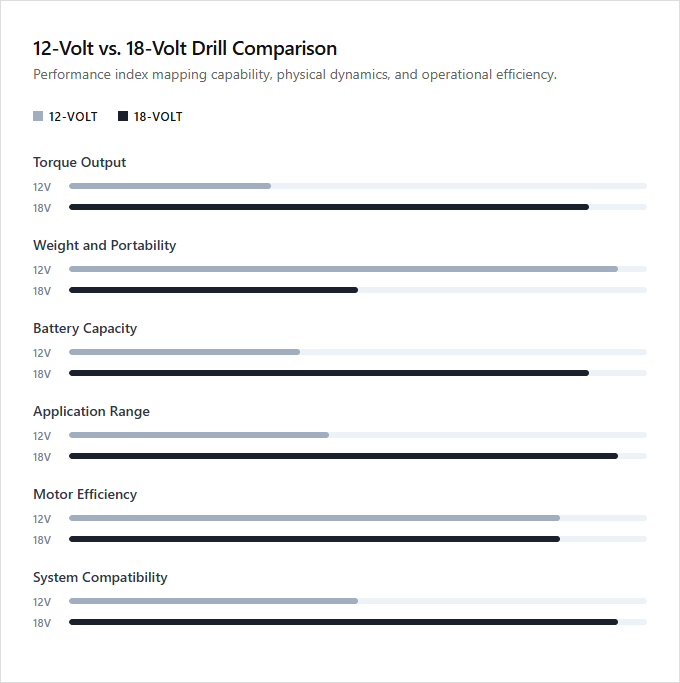
| Torque Output | 18-volt drills deliver significantly higher torque measured in Newton-meters (Nm), making them superior for driving large fasteners into dense materials. |
| Weight and Portability | 12-volt drills feature a much lighter, compact form factor that minimizes user fatigue and easily maneuvers into tight interstitial spaces. |
| Battery Capacity | 18-volt platforms accommodate larger battery packs with higher Ampere-hour (Ah) ratings, resulting in prolonged runtime under heavy duty cycles. |
| Application Range | While 12-volt drills excel at light-duty tasks like cabinetry, 18-volt drills are designed for high-stress applications like boring large holes with spade bits. |
| Motor Efficiency | Both classes increasingly utilize brushless motor technology to maximize energy transfer and extend the overall lifespan of the power tool. |
| System Compatibility | Purchasing an 18-volt drill often provides entry into a much larger ecosystem of shared-battery cordless trade tools. |
18V Platforms: Superior Torque for Large Fasteners
When selecting between 12-volt and 18-volt drill platforms, power and application requirements dictate the optimal choice. The 18-volt platform excels in demanding applications, delivering superior maximum torque measured in Newton-meters (Nm). This high torque output is essential for driving large fasteners, drilling deep into dense hardwoods, or boring through masonry.
The 12-volt drills offer a compact, lightweight alternative that prioritizes maneuverability in tight spaces. These tools handle standard fastening and light drilling tasks efficiently while reducing user fatigue during prolonged overhead work. Lightweight 12-volt models are ideal for cabinet installers and technicians seeking portability, whereas robust 18-volt systems are suited for heavy-duty construction professionals requiring maximum power.
12V Tools: Lightweight Power for Tight Spaces
When selecting between 12-volt and 18-volt drills, understanding the specific demands of your workspace is essential. While 18-volt platforms deliver maximum torque for high-resistance drilling, modern 12-volt tools offer a superior power-to-weight ratio. This compact design minimizes muscle fatigue during prolonged overhead installations and allows for effortless maneuvering in tight, restricted spaces. Brushless 12-volt motors provide impressive capability without the physical strain associated with heavier equipment.
In contrast, 18-volt drills excel in demanding applications such as boring large holes through dense lumber. Heavy-duty construction professionals requiring maximum torque for framing and masonry work are best suited for 18-volt models, while cabinet installers, electricians, and homeowners prioritizing precision in confined areas will benefit more from lightweight 12-volt systems.
Higher Ah in 18V Batteries Extends Tool Runtime
When selecting between 12-volt and 18-volt cordless drills, understanding the relationship between voltage and energy storage is essential. While voltage dictates the raw power and torque limits of the motor, overall runtime is heavily influenced by the battery's cell configuration. Battery capacity measured in ampere-hours (Ah) is typically higher in 18-volt packs to extend tool runtime, allowing the drill to sustain demanding, high-resistance applications over longer intervals before requiring a recharge.
This difference in battery architecture directly impacts the physical handling and performance of each tool class. Lightweight 12-volt drills are ideal for homeowners and technicians who prioritize maneuverability in tight spaces, whereas robust 18-volt drills are best suited for commercial contractors and heavy-duty builders requiring maximum torque and all-day endurance on the jobsite.
Chuck Size Comparison: 18V vs. 12V Drills
When selecting between a 12-volt and an 18-volt cordless drill, the capability of the chuck is a primary technical differentiator. Most 18-volt drills generally feature a heavy-duty 1/2-inch keyless chuck, which accommodates larger, professional-grade drill bits and provides superior grip torque for high-demand applications. In contrast, 12-volt models typically utilize a 3/8-inch chuck, which limits the maximum shank size of the accessories but allows for a lighter, more streamlined tool design.
Beyond the chuck capacity, 18-volt systems deliver substantially more torque and speed for boring through dense hardwoods, metal, and masonry. The compact 12-volt units offer excellent maneuverability in confined spaces and reduce operator fatigue during prolonged overhead tasks. The lightweight 12-volt drill is ideal for homeowners and DIY enthusiasts undertaking light assembly and cabinet installations, while the robust 18-volt platform is best suited for professional contractors requiring heavy-duty drilling and high-torque driving on demanding jobsites.
Brushless Motors Maximize 12V Drill Battery Efficiency
When selecting between a 12-volt and an 18-volt drill, power requirements and tool weight are key considerations. Recent advancements in tool engineering have bridged the performance gap between these two platforms. The integration of electronic brushless motors allows modern 12-volt drills to maximize battery efficiency, delivering high torque and extended runtimes within a compact frame. These smart motors adjust power output in real-time based on resistance, reducing energy waste and prolonging tool life.
Standard 18-volt drills remain the preference for high-torque applications, offering the raw power needed for boring large holes and driving heavy fasteners. Lightweight 12-volt drills are ideal for cabinet makers, HVAC technicians, and installers prioritizing maneuverability in tight spaces, while robust 18-volt models are best suited for general contractors and framing professionals performing heavy-duty construction.
How 18V Batteries Achieve High Voltage Under Load
Selecting between 12-volt and 18-volt drills requires a clear understanding of your project demands. While 12-volt options offer lightweight maneuverability for overhead tasks and tight spaces, 18-volt models provide the robust performance needed for demanding applications.
The primary distinction lies in internal battery architecture. To sustain peak performance, 18-volt models utilize larger series-connected lithium-ion cells to achieve higher nominal voltage under heavy loads. This configuration delivers consistent torque and prevents motor stalling when drilling through dense hardwoods or masonry.
Compact 12-volt drills are ideal for homeowners tackling light maintenance and furniture assembly, whereas high-torque 18-volt platforms are best suited for professional contractors and heavy-duty DIYers requiring maximum power.
Dual-Speed Gearboxes Enable Rapid 18V Drilling
When selecting between 12-volt and 18-volt drills, understanding the mechanical advantages of each platform is essential for securing the right tool for your project. While 12-volt models offer a compact footprint for maneuvering in tight spaces, 18-volt drills provide superior power and speed. A key differentiator is the drivetrain technology; dual-speed planetary gearboxes in 18-volt drills deliver higher rotations per minute (RPM) for rapid drilling applications, ensuring efficient material penetration and faster task completion under heavy workloads.
The choice between these two platforms depends on the specific demands of your operating environment. Compact 12-volt drills are ideal for homeowners and technicians performing precise, light-duty installations, whereas robust 18-volt models are suited for professional contractors and heavy-duty builders requiring maximum speed, torque, and endurance on demanding job sites.
Leave a comment