
Selecting the incorrect speed or force during drilling frequently results in stalled motors, sheared fasteners, and ruined workpieces-a costly struggle common to trade professionals and manufacturers alike.
While standard practice relies on generic manufacturer speed charts or trial-and-error to guide these mechanical decisions, these baseline references often fall short under variable, real-world field conditions.
An advanced understanding of rotational dynamics grants operators the ability to dramatically extend tool lifespan and ensure clean material penetration. However, we must stipulate that physical laws dictate that high torque and high RPM cannot be maximized simultaneously; prioritizing one inherently compromises the other.
For example, driving a three-inch lag bolt into structural timber demands maximum torque at a low RPM, whereas boring clean holes in thin sheet metal requires high RPM with minimal resistance. This article analyzes the mechanics of rotational speed, examines the critical torque-versus-RPM trade-off, and provides a systematic framework for optimizing your drill settings for any material.
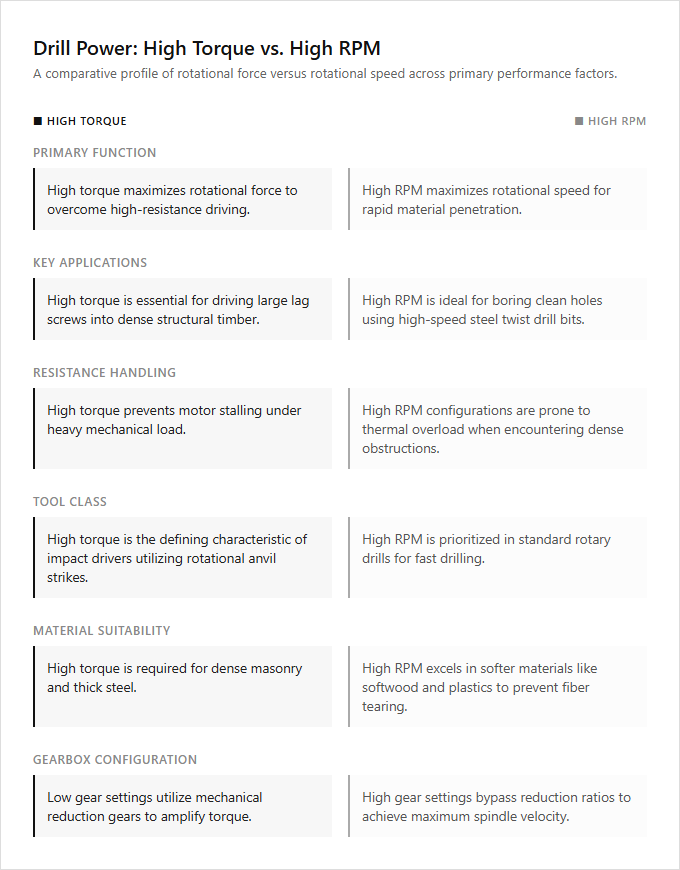
| Factor | Summary |
|---|---|
| Primary Function | High torque maximizes rotational force to overcome high-resistance driving, whereas high RPM maximizes rotational speed for rapid material penetration. |
| Key Applications | High torque is essential for driving large lag screws into dense structural timber, while high RPM is ideal for boring clean holes using high-speed steel twist drill bits. |
| Resistance Handling | High torque prevents motor stalling under heavy mechanical load, whereas high RPM configurations are prone to thermal overload when encountering dense obstructions. |
| Tool Class | High torque is the defining characteristic of impact drivers utilizing rotational anvil strikes, whereas high RPM is prioritized in standard rotary drills for fast drilling. |
| Material Suitability | High torque is required for dense masonry and thick steel, whereas high RPM excels in softer materials like softwood and plastics to prevent fiber tearing. |
| Gearbox Configuration | Low gear settings utilize mechanical reduction gears to amplify torque, while high gear settings bypass reduction ratios to achieve maximum spindle velocity. |
Torque Demands for Large-Diameter High-Tensile Drilling
Selecting the correct drill configuration depends on balancing rotational force against speed. High torque is required to overcome the shear resistance of high-tensile strength materials when using large-diameter drill bits, ensuring the cutting edge continues to shear material without stalling the motor. In contrast, high RPM configurations prioritize velocity over raw power, enabling clean, rapid material removal in lower-density substrates.
Operating parameters must align with both the workpiece composition and the cutter dimensions to prevent premature tool wear. Structural steel fabricators, industrial millwrights, and heavy-duty contractors require high-torque drills for demanding metalwork, while finish carpenters, electricians, and product assembly technicians are best suited for high-RPM models.
High RPM Optimizes Small-Diameter and Ductile Cutting
In professional drilling applications, selecting between high torque and high RPM determines project efficiency and tool longevity. A high RPM configuration optimizes the surface feet per minute (SFM), which is essential for achieving efficient cutting in ductile materials and executing small-diameter hole applications. This elevated rotational speed ensures clean material removal and minimizes burring when working with softer metals, plastics, or light woodwork.
High torque delivers the necessary rotational force to drive large fasteners and penetrate dense, hard substrates without stalling the motor. Heavy-duty construction workers and structural installers require high-torque drills for demanding framing and masonry tasks, while precision fabricators and electronics technicians rely on high-RPM tools for delicate, high-speed detailed work.
Low-Speed, High-Torque Machining for Tough Alloys
When configuring a drill power tool, understanding the relationship between torque and rotational speed is critical for material integrity. High-torque, low-speed settings are essential when machining demanding metals such as stainless steel and titanium alloys. Maintaining a low rotational speed prevents rapid heat generation, avoiding the work hardening that dulls cutting edges and compromises the workpiece. This high-torque delivery ensures steady, powerful cutting action without stalling under load.
In contrast, high-RPM configurations excel in softer materials where rapid material removal and clean entry holes are the primary objectives. Matching the correct mechanical output to the application ensures maximum tool longevity and superior finish quality. Heavy-duty fabricators and metallurgists require high-torque precision for dense metal penetration, whereas woodworkers and general contractors rely on high-RPM tools for swift, repetitive fastening tasks.
Excessive Speed Causes Thermal Damage to Cutting Edges
Selecting the optimal balance between high torque and high RPM is critical for maintaining tool longevity and work quality. While high rotational speeds facilitate fast drilling in softer materials, excessive RPM generates intense frictional heat at the contact zone. This thermal buildup leads to rapid thermal degradation of carbide or high-speed steel (HSS) cutting edges, softening the material and causing premature tool failure.
High-torque configurations mitigate this risk by delivering substantial cutting force at lower rotational speeds, preserving the integrity of the drill bit. High-torque drills are suited for heavy-duty metalworkers and structural contractors drilling through dense steel, while high-RPM drills are best for woodworkers and electricians requiring swift, clean holes in lighter materials.
How Proper RPM Prevents Drill Clogging
When selecting a drill, understanding the balance between high torque and high rotational speed (RPM) is essential for operational efficiency. High RPM is particularly critical when drilling into softer materials or using smaller bits, as the velocity facilitates rapid material removal. Sufficient RPM ensures effective chip evacuation along the drill flutes to prevent clogging and binding, protecting both the workpiece and the cutting edge.
High torque provides the rotational force necessary to drive large fasteners or penetrate dense metals and hardwoods at lower speeds. Heavy-duty structural builders require high-torque drills for dense materials, while precision craftsmen and electronics technicians are best suited for high-RPM tools.
Managing Spindle Torque to Prevent Drill Breakage
When selecting a drill power tool, balancing spindle torque and rotational speed is critical for structural integrity. In high-torque configurations, the spindle torque must be carefully calibrated to remain within the torsional stress limits of the drill shank, preventing catastrophic tool breakage during deep-hole penetration. Delivering high torque allows the tool to overcome resistance in dense materials, maintaining steady progress without stalling under heavy loads.
High RPM tools prioritize velocity over raw power, facilitating clean, rapid cuts in softer materials where heat dissipation is the primary concern. High-torque models are essential for heavy-duty structural contractors drilling deep into steel or timber, while high-RPM models are ideal for precision woodworkers and electronics technicians performing delicate, high-speed boring.
Balancing Feed and Speed for Optimal Material Removal
In drilling applications, selecting between high torque and high RPM depends entirely on the workpiece material and hole diameter. High-torque drills excel at driving large bits through dense materials at lower speeds, while high-RPM models are ideal for rapid, clean cuts in lighter materials. Maximizing the material removal rate relies on balancing the feed rate with the spindle speed. This precise calibration optimizes the chip load per tooth, preventing tool deflection and ensuring efficient waste evacuation.
Maintaining this operational balance prevents premature wear on both the cutting edges and the power tool motor. High-torque drills are best suited for structural contractors and metalworkers tackling heavy-duty boring, while high-RPM drills are ideal for woodworkers and precision fabricators requiring fast, splinter-free finishes.
Leave a comment