
Contractors and workshop professionals frequently struggle with the deafening, high-frequency clamor of standard impact drivers, which causes rapid ear fatigue and disrupts occupied residential jobsites. Traditionally, operators have relied on standard mechanical impact drivers paired with bulky hearing protection, or they have compromised on fastening speed by reverting to traditional drill-drivers to keep the peace.
However, adopting hydraulic oil pulse technology grants tradespeople a massive decibel reduction while maintaining rapid fastening performance. As a necessary stipulation, users must note that hydraulic fluid-coupling mechanisms are susceptible to thermal buildup, which can slightly alter torque consistency during continuous, high-volume production runs.
For instance, finish carpenters utilizing Makita's oil-pulse "Soft Impact" drivers successfully install cabinetry in noise-sensitive environments without sacrificing driving power. Below, we provide an executive analysis of these competing rotary mechanisms, directly comparing their decibel outputs, mechanical torque delivery curves, and optimal application environments.
| Factor | Summary |
|---|---|
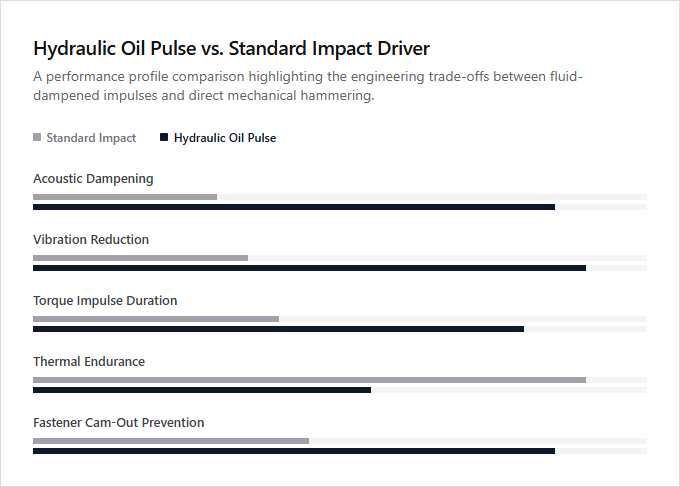
| Mechanism of Action | Standard impact drivers rely on a mechanical metal-on-metal hammer and anvil system, whereas hydraulic pulse drivers utilize a sealed, pressurized fluid-coupling unit to transfer rotational energy. |
| Acoustic Output | Hydraulic oil pulse tools operate at a significantly reduced decibel level because the hydraulic medium dampens the high-frequency vibrations common in traditional impacting. |
| Torque Delivery | Standard impact drivers deliver a sharp, high-peak impact force, while hydraulic pulse tools provide a longer, sustained impulse duration that minimizes the risk of fastener cam-out. |
| Vibration Transmission | The fluid-dampened system of a hydraulic pulse driver drastically reduces tri-axial vibration levels, thereby lowering the risk of hand-arm vibration syndrome for the operator. |
| Thermal Management | Prolonged heavy-duty fastening causes thermal dissipation issues in hydraulic models due to oil viscosity breakdown, unlike standard impact drivers which are limited primarily by mechanical wear. |
Fluid Coupling Reduces Hydraulic Pulse Unit Noise
Standard impact drivers rely on direct metal-on-metal contact between the internal anvil and hammer to generate torque. While highly effective, this mechanical action produces harsh vibrations and loud, high-pitched noise. In contrast, hydraulic oil pulse drivers utilize a viscous fluid coupling to damp the anvil impact. This fluid medium absorbs the violent physical shocks, which significantly lowers peak decibel emissions and creates a smoother fastening operation.
The reduction in noise and vibration makes hydraulic pulse units highly advantageous for indoor remodeling and occupied commercial properties. Standard impact drivers remain dominant in open-air construction where maximum raw speed is the primary requirement. Contractors working in noise-sensitive environments like schools or hospitals will find the quiet hydraulic pulse driver indispensable, whereas heavy-duty framing carpenters requiring sustained maximum torque are better served by a standard impact driver.
How Standard Impact Drivers Generate High-Frequency Noise
Standard impact drivers rely on a mechanical metal-on-metal hammer-and-anvil system to generate torque. While highly efficient at transferring rotational force, this continuous mechanical engagement produces sharp, high-frequency acoustic signatures and intense vibrations that can lead to rapid operator fatigue. Hydraulic oil pulse drivers mitigate these drawbacks by utilizing a sealed fluid-coupling mechanism to cushion the internal impact, which substantially dampens the peak decibel output and smooths out the overall torque delivery.
Choosing between these technologies depends largely on the operational environment and user requirements. Standard impact drivers are ideal for heavy-duty construction workers who require maximum, sustained fastening power, whereas hydraulic pulse drivers are best suited for finish carpenters, cabinet installers, and service technicians working in occupied residential or noise-sensitive commercial spaces.
Smoother Torque Through Hydraulic Fluid Compression
The primary distinction between a hydraulic oil pulse driver and a standard impact driver lies in how they deliver fastening force. Standard impact drivers rely on a metal-on-metal anvil mechanism that produces harsh, rapid blows. In contrast, hydraulic oil pulse technology utilizes a fluid compression cycle. This hydraulic system increases the duration of each rotational impulse, delivering a significantly smoother torque curve than traditional mechanical impact mechanisms.
This dampening effect reduces both peak noise levels and reactionary vibration during operation. Standard impact drivers deliver high raw fastening speed, whereas oil pulse drivers maintain consistent torque with minimal decibel output. Standard impact drivers are ideal for heavy-duty framing contractors needing maximum speed, while hydraulic oil pulse drivers suit cabinet installers and finish carpenters who require quiet operation and precise control.
Thermal Expansion Causes Torque Fade in Hydraulic Pulse Drivers
Standard impact drivers utilize a mechanical metal-on-metal anvil mechanism to deliver high torque. In contrast, hydraulic oil pulse drivers employ a fluid coupling to cushion the impact, which significantly reduces operating noise and user fatigue.
During continuous, heavy-duty fastening cycles, the rapid friction within hydraulic pulse mechanisms generates substantial heat. This thermal expansion of the internal oil reduces its viscosity, causing temporary torque fade until the fluid cools. Mechanical impact drivers bypass this fluid-based limitation, maintaining consistent power delivery under prolonged, high-demand loads.
Standard impact drivers are ideal for structural carpenters requiring relentless power for dense materials, whereas hydraulic pulse drivers are best suited for cabinet makers and interior installers prioritizing low-noise precision in occupied spaces.
How Steel Anvils Cause High Impact Driver Vibration
Standard impact drivers rely on a metal-on-metal mechanism where a steel hammer strikes an anvil to deliver torque. This direct kinetic energy transfer generates significant mechanical force, but it also emits elevated tri-axial vibration values. Over extended periods, this intense vibrational feedback increases user fatigue and physical strain.
Hydraulic oil pulse drivers mitigate this issue by utilizing a fluid-coupling mechanism to transfer energy. The pressurized oil dampens the impact, drastically reducing peak vibration levels and operating noise while maintaining consistent fastening power. This technology provides a smoother, more controlled fastening experience.
Standard impact drivers are ideal for heavy-duty construction workers needing maximum torque for dense materials, whereas hydraulic pulse drivers are suited for finish carpenters and assembly technicians who require quiet, low-vibration operation during prolonged shifts.
Why Hydraulic Drivers Are So Quiet
While standard impact drivers rely on a mechanical metal-on-metal anvil mechanism to deliver rotational force, hydraulic oil pulse drivers utilize a different approach. Hydraulic drivers maintain lower decibel levels by eliminating metal-on-metal contact via a sealed, pressurized fluid chamber. This fluid cushion dampens the harsh vibrations and sharp acoustic peaks typical of traditional impacts, resulting in a quieter and smoother fastening experience.
The choice between these two fastening technologies depends on the specific work environment and performance requirements. Standard impact drivers are ideal for heavy-duty framing contractors who require maximum raw torque, whereas hydraulic oil pulse drivers are best suited for indoor finish carpenters and cabinet installers who prioritize noise reduction and precise control in occupied spaces.
Hydraulic Relief Valves Ensure Precise Torque Control
Standard impact drivers rely on rapid metal-on-metal impacts to deliver torque, which often results in aggressive vibration and unpredictable force spikes. In contrast, hydraulic oil pulse tools utilize a sealed fluid-coupling mechanism to transfer rotational energy. This design significantly reduces operating noise and dampens the harsh vibrations common in traditional fastening tools.
The engineering highlight of the hydraulic mechanism is the inclusion of internal pressure relief valves. These specialized valves automatically bypass fluid once a specific pressure threshold is reached, facilitating precise torque repeatability and preventing fastener over-tightening. This fluid regulation ensures consistent depth and protects delicate materials from damage.
Standard impact drivers are ideal for heavy-duty construction workers requiring raw power and speed, while hydraulic pulse drivers are best suited for cabinet installers and precision assembly technicians who demand quiet operation and strict torque control.
Leave a comment