
Woodworkers and trim carpenters often face the frustrating challenge of split delicate moldings or loose cabinet backings caused by choosing the incorrect fastener. While standard brad nailers and traditional wood glues are common shop standbys for assembly, they often lack the specific shear strength or minimal footprint required for precise trim work.
Selecting the precise wire gauge grants your projects the ultimate advantage: an optimal balance of structural holding power and clean, easily-concealed entry wounds. However, as a key stipulation, maximizing a pneumatic stapler's utility requires matching the tool to your compressor's PSI limits and the wood's density-whether you are securing dense cherry cabinet backs or fastening soft pine scribe molding.
In this guide, we will break down the critical technical differences between 18-gauge and 20-gauge crown staplers, evaluate their performance across various wood species, and help you determine which pneumatic tool best serves your specific woodworking needs.
| Factor | Summary |
|---|---|
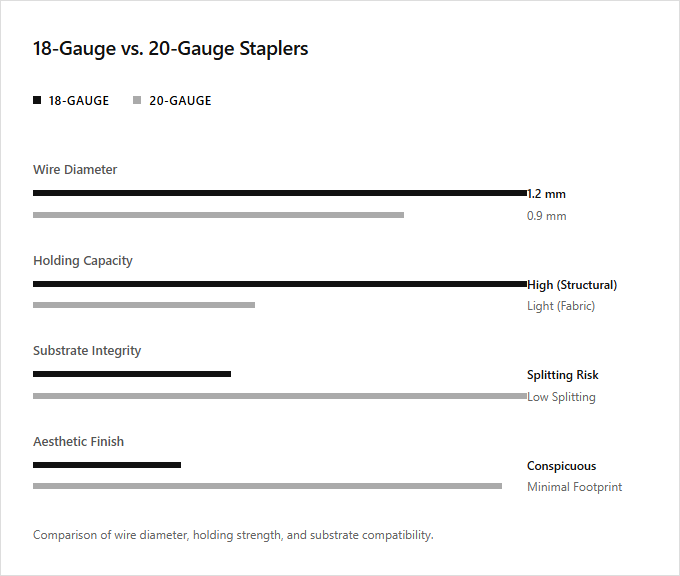
| Wire Diameter | Eighteen-gauge staplers utilize a thicker wire diameter of approximately 1.2 mm, whereas twenty-gauge models utilize a thinner 0.9 mm wire for delicate materials. |
| Holding Capacity | The 18-gauge staple offers higher shear resistance and tensile strength for structural joints, while the 20-gauge staple provides lighter holding power suited for securing fabrics. |
| Primary Applications | 18-gauge staplers are ideal for heavy-duty cabinetry and engineered flooring, whereas 20-gauge staplers excel in automotive upholstery and trim carpentry. |
| Substrate Integrity | Thicker 18-gauge fasteners increase the risk of splitting thin softwood profiles, while 20-gauge fasteners minimize wood splitting due to their smaller displacement volume. |
| Aesthetic Finish | Twenty-gauge staples leave a minimal fastener footprint that requires little to no wood filler, unlike the more conspicuous holes left by eighteen-gauge crown staples. |
How Wire Gauge Affects Joint Strength
The wire diameter of a pneumatic stapler directly dictates the mechanical integrity of the fastened joint. Eighteen-gauge staplers utilize a thicker wire, which provides superior shear strength and greater resistance to withdrawal forces. This thicker profile yields substantial holding power, making it highly effective for securing heavier materials where structural movement or load-bearing capacity is a factor.
In contrast, twenty-gauge staplers feature a thinner wire diameter, resulting in lower shear strength but significantly reducing the risk of splitting delicate or thin materials. The smaller puncture profile leaves minimal surface disruption, preserving the aesthetic quality of the workpiece. Eighteen-gauge models are ideal for construction professionals undertaking heavy-duty framing or cabinetry, whereas twenty-gauge staplers are best suited for upholstery specialists and trim carpenters performing intricate finishing work.
Crown Width and Softwood Pull-Through Prevention
Selecting the correct wire gauge and crown width is critical when fastening softwoods, which are highly susceptible to fastener pull-through. Eighteen-gauge staplers typically feature narrower crowns that penetrate deeply but risk tearing through soft wood fibers under tension. Twenty-gauge staplers often utilize wider crowns to distribute clamping force over a larger surface area, preventing the staple head from pulling through fragile softwood grains.
The relationship between crown width and material density dictates overall joint integrity. While the heavier 18-gauge wire offers superior structural shear strength, the wider footprint of the 20-gauge staple prevents surface damage on delicate materials. General contractors and subfloor installers require the heavy-duty holding power of the 18-gauge stapler, while furniture upholsterers and finish carpenters find the delicate, pull-through prevention of the 20-gauge model more suitable for their detailed tasks.
Preventing Trim Splitting with 20-Gauge Fasteners
When fastening delicate trim moldings, selecting the correct fastener gauge is critical to preserving material integrity. While eighteen-gauge staplers offer superior holding power for thicker wood species and structural casing, their larger cross-section introduces a higher displacement volume. This increased displacement often results in substrate splitting when applied to fragile, narrow, or brittle profiles.
In contrast, twenty-gauge staplers utilize a significantly thinner wire that minimizes fiber disruption. This lower-displacement fastener mitigates the risk of splitting delicate materials, ensuring clean, flush countersinks without compromising the intricate molding. Heavy-duty carpenters and exterior trim installers typically rely on eighteen-gauge staplers for structural rigidity, whereas furniture restorers and finish carpenters specializing in highly detailed ornamentation favor twenty-gauge models.
PSI Calibration for Timber Janka Hardness
Selecting between eighteen-gauge and twenty-gauge pneumatic staplers requires precise calibration of operating pressure (PSI) relative to the Janka hardness of the timber. Eighteen-gauge staplers, engineered for structural holding power, typically demand a pressure range of 80 to 120 PSI when fastening high-Janka hardwoods like oak or maple to ensure complete staple seating. In contrast, twenty-gauge staplers utilize a lower operating window of 60 to 100 PSI, protecting softer, low-Janka woods like pine or cedar from fiber crushing and over-penetration.
Accurate pressure regulation prevents tool wear and material damage. Insufficient PSI in dense timber leads to proud fasteners, while excessive pressure in softer timber splits the grain. Eighteen-gauge units are ideal for cabinet makers and trim carpenters requiring robust fastening in hardwoods, whereas twenty-gauge models are suited for upholsterers and detail finish woodworkers manipulating delicate materials and softwoods.
Air Consumption for Rapid-Cycling Pneumatic Cylinders
In high-volume manufacturing, the pneumatic demands of stapling tools directly impact production efficiency. Eighteen-gauge staplers employ larger cylinders to drive thicker wire, requiring a substantial volume of air per cycle. To sustain rapid-cycling speeds without experiencing pressure drops, these tools typically demand between 1.5 to 2.0 CFM per unit, necessitating a robust, high-capacity compressor system in continuous-use environments.
Twenty-gauge pneumatic staplers feature smaller internal cylinders, significantly reducing overall air consumption. These tools cycle rapidly with minimal CFM requirements, allowing facilities to run multiple stations off standard air lines without compromising tool performance. Industrial furniture manufacturers and crate builders require the high-holding strength of eighteen-gauge systems, whereas automotive trimmers and precision cabinet assembly technicians are best suited for the agile, low-CFM performance of twenty-gauge staplers.
Adjustable Fastener Countersink Depth Control
Eighteen-gauge and twenty-gauge pneumatic staplers serve distinct roles in woodworking, where managing fastener countersink depth is critical. Precise depth-of-drive adjustment systems allow operators to control how far the staple crown sinks beneath the wood surface, preventing aesthetic defects and ensuring structural integrity.
The eighteen-gauge stapler requires robust depth adjustment to drive thicker wires into dense hardwoods without leaving the staple proud. Conversely, the twenty-gauge stapler utilizes a finer wire, demanding highly sensitive, tool-free depth calibration to prevent the fastener from blowing completely through delicate materials or thin underlayment.
Heavy-duty eighteen-gauge models are best suited for professional carpenters installing subfloors and exterior sheathing, while lightweight twenty-gauge staplers are ideal for upholstery specialists and furniture restorers working with delicate fabrics and trim.
Adhesive Staple Compatibility with Magazine and Feed Mechanism
Eighteen-gauge and twenty-gauge pneumatic staplers differ significantly in how their feed mechanisms interact with adhesive-collated staple strips. The heavier 18-gauge staplers feature robust, high-tension spring-loaded pusher systems designed to feed thick, rigid strips without fracturing the adhesive bond. By comparison, 20-gauge staplers utilize a lighter, more sensitive feed mechanism tailored to the delicate nature of thinner wire staples, preventing the feed pawl from crushing the fragile adhesive collation.
Magazine capacity also varies, as 20-gauge channels often accommodate higher quantities of these finer strips. Heavy-duty construction professionals favor the robust 18-gauge stapler for structural fastening and subflooring, whereas upholstery specialists and fine woodworkers benefit most from the delicate precision of the 20-gauge model.
Leave a comment