
Few things disrupt a metalworking project faster than mounting a new abrasive wheel only to find a sloppy, dangerous wobble or a thread mismatch. For tradespeople and DIYers alike, navigating the subtle differences between 5/8-inch and 7/8-inch spindle fitments is a persistent headache that compromises both safety and precision.
While standard industry supply channels and manufacturer spec sheets offer baseline guidance, they often overlook how these dimensions interact under high-vibration loads. Mastering this structural distinction is crucial, as selecting the exact interface grants operators maximum torque transfer and eliminates catastrophic wheel failure. However, a key safety stipulation remains: adapter bushings must never compromise the flange seating area on high-RPM tools, such as a heavy-duty Type 27 grinding wheel.
This article breaks down the physical differences between 5/8-inch and 7/8-inch configurations, details critical safety precautions, and provides a clear roadmap for selecting the perfect disc match for your tool.
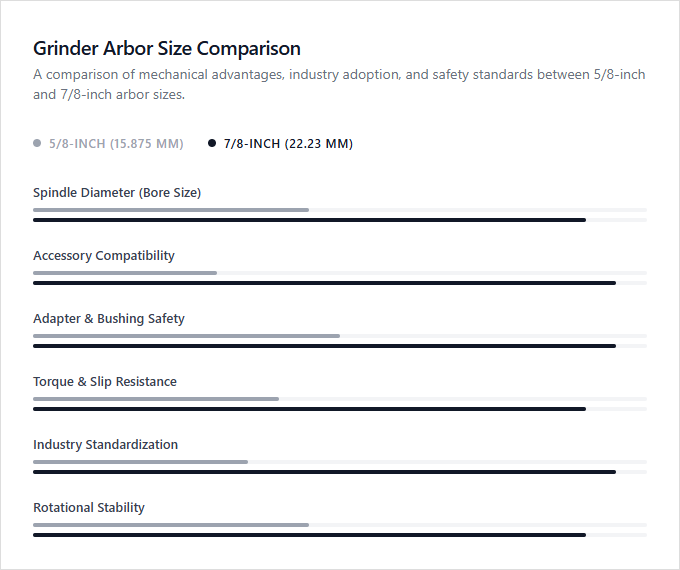
| Factor | Summary |
|---|---|
| Spindle Diameter | The 5/8-inch arbor fits smaller angle grinders utilizing a standard 5/8"-11 threaded spindle, while the 7/8-inch arbor is the standard non-threaded bore diameter for larger, industrial-grade grinding discs. |
| Accessory Compatibility | Wheels with a 7/8-inch arbor hole are the industry standard for high-performance cutting and grinding consumables, whereas 5/8-inch arbors are typically found on smaller, specialized wheels or vintage tooling. |
| Adapter and Bushing Integration | Operators can safely use brass or steel reducer bushings to downsize a 7/8-inch accessory bore to a 5/8-inch spindle, but attempting to enlarge a 5/8-inch bore compromises structural integrity. |
| Torque and Power Output | The larger surface contact area of a 7/8-inch interface facilitates superior torque transfer and prevents disc slippage under high-amperage, heavy-duty load conditions. |
| Industry Standardizations | The 7/8-inch arbor (equivalent to 22.23 mm) represents the international standard for professional metalworking consumables, while the 5/8-inch (15.875 mm) remains common in consumer-grade DIY power tools. |
| Rotational Stability and Safety | Larger 7/8-inch inner flanges distribute clamping force more effectively across the wheel hub, reducing axial runout and mitigating the risk of catastrophic wheel explosion. |
5/8-Inch Spindle vs. 7/8-Inch Arbor Sizes
When selecting accessories for an angle grinder, understanding the distinction between arbor measurements is essential for safety and compatibility. The 5/8-inch-11 UNC designation represents the threaded spindle shaft of the tool, designed to accept threaded wheels that spin directly onto the grinder. In contrast, the 7/8-inch size denotes the center arbor hole of unthreaded discs, which require a backing flange and lock nut for secure installation.
Choosing between these configurations depends largely on the specific application and workflow efficiency. Threaded 5/8-inch accessories are ideal for high-volume professionals requiring rapid, tool-free wheel changes, whereas 7/8-inch unthreaded discs are best suited for general fabricators and DIY users seeking cost-effective, widely available consumable options.
7/8-Inch Pilot Flange for Type 27/29 Wheels
When selecting angle grinder accessories, understanding the distinction between 5/8-inch and 7/8-inch arbor configurations is essential for operational safety and precision. Standard angle grinders typically feature a 5/8-inch-11 threaded spindle, yet they frequently run 7/8-inch arbor wheels. To bridge this gap safely, the inner backing flange features a raised 7/8-inch pilot shoulder designed to center Type 27 and Type 29 abrasive wheels, preventing dangerous runout and vibration during high-speed rotation.
This flange system allows operators to utilize more common, non-threaded wheels on a standard spindle. Heavy-duty fabrication professionals requiring maximum stability for aggressive material removal benefit most from the robust 7/8-inch flange system, whereas light-duty contractors and DIY enthusiasts often prefer the straightforward, direct thread-on convenience of 5/8-inch wheels for quick accessory changes.
Direct-Mount Threaded Discs for 5/8-Inch Spindles
Angle grinders typically feature either a 5/8-inch threaded spindle or a 7/8-inch smooth arbor. The primary advantage of the 5/8-inch spindle is its compatibility with threaded hub discs. These specialized accessories screw directly onto the 5/8-inch spindle without requiring an outer lock nut, simplifying the mounting process and ensuring a secure, flush fit.
Standard 7/8-inch arbor wheels are unthreaded and require a backing flange and an outer lock nut to clamp the disc. This traditional setup remains highly secure but requires manual tool adjustments during changes. The 5/8-inch threaded system is ideal for fabricators requiring rapid accessory transitions, while the 7/8-inch option suits heavy-duty industrial operators who prioritize cost-effective, standard unthreaded wheels.
Mismatched Spindle Fitment Causes Catastrophic Wheel Failure
Angle grinder spindles and grinding wheel arbor sizes must match precisely to ensure operational safety. Standard grinders typically feature a 5/8-inch threaded spindle, while accessory wheels are manufactured with either 5/8-inch or 7/8-inch center bores. Improper fitment of a 7/8-inch bore on a bare 5/8-inch spindle causes severe wheel eccentricity and catastrophic failure due to the lack of concentric alignment during high-speed rotation.
To mitigate these risks, operators must utilize compatible adapter flanges that securely center the larger bore on the shaft. General DIY home users typically prefer the plug-and-play simplicity of 5/8-inch threaded wheels, while professional fabricators and industrial welders require the heavy-duty versatility of 7/8-inch non-threaded wheels utilized with standard adapter kits.
Lock Nut Orientation Based on Disc Thickness
Angle grinders typically utilize either a 5/8-inch or a 7/8-inch arbor size to mount various abrasive wheels. A critical factor in operating both configurations safely is the correct orientation of the reversible lock nut. When mounting thin cutting wheels, the raised pilot of the nut must face outward to ensure the clamping flange applies adequate pressure directly to the thin blade. For thicker grinding discs, the raised pilot must face inward, nesting into the center hole of the disc to ensure proper alignment and a secure grip.
Mishandling this orientation compromises tool safety and can lead to dangerous wheel slippage. While the 5/8-inch arbor is ideal for occasional DIY users performing light, precision cutting, the 7/8-inch system is the industry standard for professional fabricators and industrial welders undertaking heavy-duty material removal.
Adapter Bushings Cause Dangerous Runout and Vibration
Selecting the correct arbor size for angle grinders-typically 5/8-inch or 7/8-inch-is critical for operational safety and tool performance. While some operators attempt to mount 7/8-inch wheels on 5/8-inch spindles using aftermarket adapter bushings, this practice introduces severe mechanical risks. These non-standard adapters often fail to align perfectly, inducing dangerous axial runout and high-frequency vibration that can cause catastrophic wheel disintegration.
Maintaining native compatibility between the grinder spindle and the accessory ensures secure flange engagement and optimal torque transfer. Heavy-duty industrial metalworkers requiring maximum torque and heavy material removal are best suited for the robust stability of 7/8-inch native systems, whereas light-duty DIY hobbyists performing detail work are ideal candidates for the smaller 5/8-inch configurations.
Spindle-Arbor Concentricity: Key to Maximum Tool RPM
In high-speed grinding operations, selecting the correct arbor size-typically 5/8-inch or 7/8-inch-is essential for operational safety and tool efficiency. Maintaining precise concentricity between the grinder spindle and the disc arbor is critical to match the tool's maximum rated RPM safely. Any minor deviation or misalignment at high rotational speeds induces severe vibration, which accelerates tool wear and risks catastrophic disc failure.
While the 5/8-inch arbor is common on smaller, compact grinders, the larger 7/8-inch arbor is standard for heavy-duty industrial applications requiring greater torque. Ensuring a perfect mechanical fit without relying on loose adapters preserves the exact centerline alignment needed for smooth, vibration-free rotation. Standard 5/8-inch configurations suit DIY enthusiasts and light contractors performing routine metalwork, whereas the robust 7/8-inch interface is designed for industrial fabricators and heavy masonry professionals requiring maximum stability under continuous, high-load conditions.
Leave a comment