
Every woodworker knows the frustration of a workshop constantly buried in fine sawdust, which compromises both respiratory health and tool performance. While many hobbyists initially rely on basic cleanup investments-such as standard shop vacs or simple broom-and-dustpan routines-these entry-level methods quickly fail under heavy workloads.
Stepping up to a dedicated High-Volume Low-Pressure (HVLP) dust collector grants woodworkers a pristine, breathable workspace and prevents premature tool wear. However, it is important to stipulate that these systems are engineered specifically for high-volume bulk extraction rather than the high-velocity suction required by small-port hand tools. Instead, they excel at pulling heavy waste from stationary machinery like 15-inch planers, jointers, and cabinet table saws.
Below, we will compare the airflow mechanics, capacity differences, and filtration capabilities of dust collectors versus shop vacs to help you choose the optimal clean-up solution for your workshop.
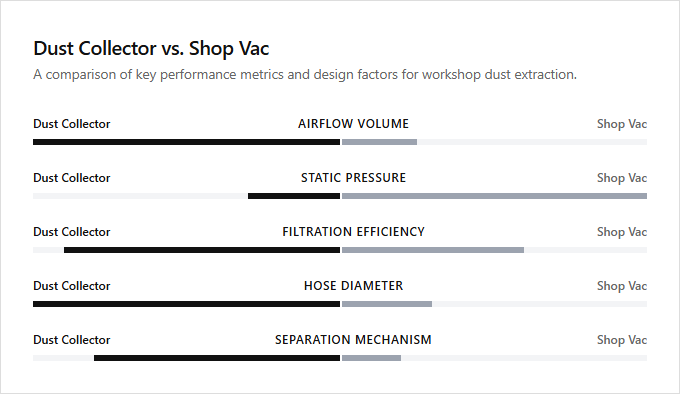
| Factor | Summary |
|---|---|
| Airflow Volume | Dedicated dust collectors generate much higher CFM (Cubic Feet per Minute) compared to shop vacs, making them ideal for capturing large volumes of airborne wood dust. |
| Static Pressure | Shop vacs excel at high static pressure, which allows them to pull heavy debris through narrow hoses, whereas dust collectors operate on low static pressure designed for wide pipes. |
| Filtration Efficiency | Dust collectors often utilize specialized canister filters to capture sub-micron particles, while standard shop vacs require upgraded HEPA filters to safely contain fine dust. |
| Hose Diameter | Dust collectors require large-diameter ducting to maintain optimal air velocity, while shop vacs utilize small, flexible hoses that restrict high-volume airflow. |
| Separation Mechanism | Many advanced dust collectors incorporate a two-stage cyclonic separator to precipitate heavy chips before they reach the impeller, whereas shop vacs collect all waste in a single chamber. |
High-CFM Dust Collectors Capture Fine Dust
In woodworking and industrial environments, managing airborne particulates requires selecting the appropriate extraction system. High-volume low-pressure (HVLP) dust collectors rely on high CFM (Cubic Feet per Minute) to capture fine dust at the source, drawing large volumes of air through wide hoses to keep workshop air clean. In contrast, shop vacuums operate as low-volume high-pressure (LVHP) systems, utilizing high static pressure and narrow hoses to pull heavier debris from concentrated areas.
While shop vacuums excel at localized cleanup and handling larger wood chips, they lack the airflow volume required to capture the microscopic dust generated by major machinery. Dedicated dust collectors are ideal for stationary woodworkers operating large machinery like table saws and planers, whereas shop vacuums are best suited for hobbyists and mobile contractors requiring portable cleanup for hand-held power tools.
Shop Vacuum Principles: High Pressure and Water Lift
Shop vacuums and dedicated dust collectors serve distinct roles in workshop debris management due to their differing airflow mechanics. A shop vacuum operates on a low-volume, high-pressure principle, moving smaller quantities of air at extremely high speeds. This system utilizes high static pressure, typically measured in inches of water lift, which allows it to overcome the resistance of narrow hoses and lift heavy debris effectively.
In contrast, dust collectors rely on high-volume, low-pressure systems to pull massive amounts of air through large ducts, capturing fine airborne particles from stationary machinery. Shop vacuums are ideal for hobbyists requiring versatile, targeted cleanup of heavy spills and hand tool debris, whereas dust collectors are suited for professional woodworkers seeking to maintain breathable air quality around large, stationary shop equipment.
Why HVLP Dust Collectors Require 4-Inch Hoses
When managing workshop debris, understanding the operational differences between a dedicated dust collector and a standard shop vac is essential. Dust collectors operate on a High Volume, Low Pressure (HVLP) system designed to move massive amounts of air. To function efficiently, these HVLP systems require large four-inch or wider hoses. Restricting the hose size causes severe static pressure loss and a dramatic reduction in CFM (Cubic Feet per Minute), which renders the system ineffective.
Shop vacs utilize Low Volume, High Pressure (LVHP) systems, relying on high suction through narrow hoses to pull heavy debris over short distances. Shop vacs are ideal for hobbyists needing portable cleanup for small handheld tools, while dust collectors are suited for professional woodworkers operating large stationary machinery.
How Two-Stage Cyclonic Dust Collectors Work
A standard shop vacuum relies on high static pressure to pull small debris through a narrow hose directly into a canister, which can quickly clog the filter during heavy woodworking. Dedicated dust collectors instead move a high volume of air through larger hoses to capture fine dust at the source, preventing airborne hazards in the workshop.
Advanced two-stage dust collectors utilize cyclonic separation to spin the incoming airstream. This centrifugal force deposits heavy wood chips and large debris into a primary collection bin before the air ever reaches the pleated filter, maintaining consistent suction and extending filter life.
Shop vacuums are best suited for hobbyists needing portable cleanup of small spills, while two-stage dust collectors are ideal for professional woodworkers operating stationary machinery that generates high volumes of waste.
HEPA Canister Filters Essential for Fine Dust Mitigation
When comparing a dust collector to a shop vac for workshop waste management, the primary differentiator lies in air volume and velocity. Standard shop vacs utilize high static pressure to pull small volumes of air through narrow hoses, while dust collectors move massive volumes of air at lower speeds through wider ducts. For effective fine dust mitigation, both systems require pleated canister filters with a one-micron or HEPA filtration rating to prevent hazardous micro-particles from bypassing the collection bin and recirculating into the breathing zone.
Standard paper bags and cloth filters fail to capture these microscopic threats, making specialized canister upgrades essential for true respiratory protection. Shop vacs paired with HEPA filtration are highly suitable for DIY hobbyists requiring portable cleanup for hand power tools, whereas dedicated dust collectors with one-micron canisters are ideal for professional woodworkers operating heavy stationary machinery like planers and table saws.
Impeller Diameter and Speed Drive Dust Collector Efficiency
While both shop vacuums and dedicated dust collectors maintain workshop cleanliness, their internal mechanics serve distinct operational functions. A dust collector relies on high-volume, low-pressure airflow to capture fine wood dust before it airborne. The diameter and spin speed of the curved impeller determine the dust collector's overall efficiency, dictating how effectively the system moves massive volumes of air through wide ductwork.
In contrast, a shop vacuum utilizes high static pressure and lower air volume, making it highly effective at pulling heavier debris through narrow hoses. Shop vacuums are best suited for general contractors and DIY hobbyists requiring portable, multi-surface cleanup, whereas dedicated dust collectors are designed for stationary woodworkers operating large machinery like planers and table saws.
Optimizing Ductwork Air Velocity to Prevent Dust Settlement
When designing a workshop extraction system, choosing between a dedicated dust collector and a shop vacuum depends heavily on your ductwork strategy. Optimizing airflow in rigid ductwork layouts requires calculating air velocity in feet per minute (FPM) to prevent dust settlement within the lines. Dedicated dust collectors move high volumes of air (CFM) at lower static pressure, which is essential for maintaining the minimum 3,500 to 4,000 FPM velocity required to keep wood chips suspended in main lines. Shop vacuums operate on high static pressure and low volume, making them inefficient for rigid, large-diameter duct networks due to rapid velocity drops.
Selecting the correct system ensures safety and efficiency. High-volume dust collectors are ideal for professional woodworkers operating large, stationary machinery, whereas portable shop vacuums are best suited for hobbyists utilizing hand-held power tools with small-diameter extraction ports.
Leave a comment