
Achieving consistent CFM performance is a constant struggle for shop managers who routinely face sudden suction drops and clogged lines during heavy operations. While standard funding sources for shop upgrades typically prioritize primary machinery, the electrical infrastructure supporting your dust collector is equally critical.
Selecting the correct motor phase is a game-changer; choosing wisely grants your extraction system sustained static pressure and peak thermal efficiency under continuous loads. However, a key stipulation is that true three-phase power requires specific facility utility access or external phase conversion-a setup already proven vital in high-volume commercial cabinet shops.
In this guide, we will compare single-phase and three-phase motors, analyzing their direct impact on dust collector CFM delivery, energy draw, and long-term operational costs to help you optimize your workshop's air quality.
| Factor | Summary |
|---|---|
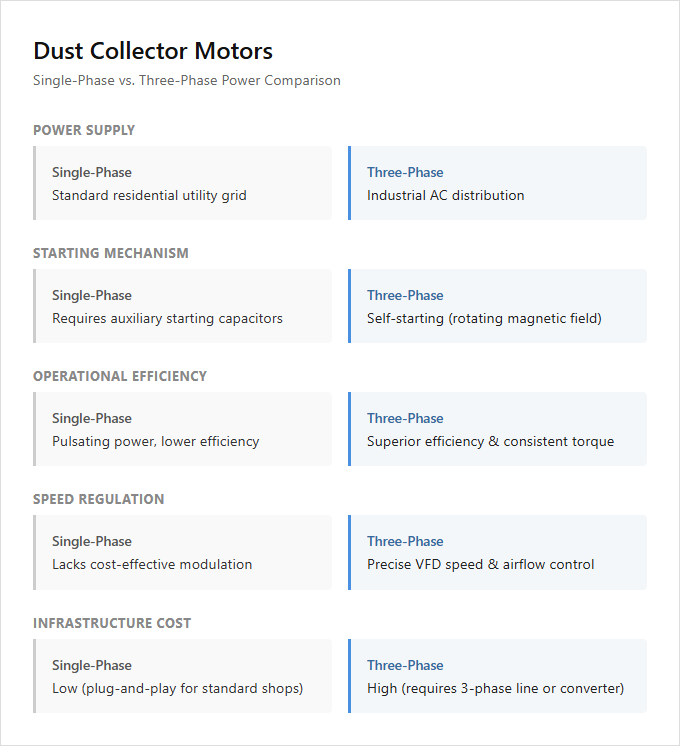
| Power Supply Requirement | Single-phase motors run on standard residential utility grids, whereas three-phase motors require industrial alternating current distribution systems. |
| Starting Mechanism | Single-phase motors rely on auxiliary components like starting capacitors to initiate rotation, while three-phase motors generate a naturally rotating magnetic field to self-start. |
| Operational Efficiency | Three-phase motors provide superior electrical efficiency and consistent torque because they eliminate the pulsating power delivery common in single-phase circuits. |
| Speed Regulation | Three-phase systems can utilize a Variable Frequency Drive for precise control over airflow and static pressure, whereas single-phase induction motors lack cost-effective speed modulation options. |
| Infrastructure Cost | Single-phase setups are plug-and-play for standard workshops, while three-phase equipment requires either utility-provided three-phase service or a rotary phase converter. |
High Starting Torque Delivers Peak CFM Instantly
Selecting the right motor for a workshop dust collector involves evaluating the electrical phase requirements. Three-phase motors deliver a distinct operational advantage due to their high starting torque. This immediate power quickly overcomes the heavy rotational inertia of large impellers, allowing the system to establish peak Cubic Feet per Minute (CFM) performance almost instantly upon activation. Single-phase motors, while reliable, require more time and startup current to ramp up to their full operational velocity.
Single-phase dust collectors are ideal for hobbyists and small workshops with standard residential electrical setups, whereas three-phase systems are best suited for high-volume industrial facilities requiring continuous-duty cycle efficiency and maximum air filtration capacity.
Lower Amps Enable Larger Dust Collector Blowers
When selecting a dust collection system, the choice between single-phase and three-phase motors significantly impacts performance and efficiency. Three-phase motors excel in high-demand environments due to their superior electrical design. Because they distribute the electrical load across three distinct power lines, these motors operate with a much lower amperage draw compared to their single-phase counterparts at equivalent power ratings.
This reduced current draw enables higher horsepower configurations that can drive larger, more powerful dust collector blowers without overloading electrical systems. These high-capacity blowers move greater volumes of air to maintain the necessary static pressure across complex ductwork networks. Single-phase units are ideal for hobbyists and small-scale woodworkers operating in residential spaces, while three-phase systems are suited for commercial manufacturers and industrial operators requiring continuous, high-volume air filtration.
VFD Motor Control: Matching CFM to Static Pressure
Single-phase motors are the standard choice for smaller workshops, offering straightforward plug-and-play operation on common electrical grids. However, larger industrial environments benefit significantly from three-phase motors, which provide superior energy efficiency and constant torque under heavy, continuous loads.
Integrating a Variable Frequency Drive (VFD) with a three-phase motor allows for precise speed modulation. This capability enables operators to dynamically match airflow (CFM) with the system's varying static pressure, optimizing dust extraction efficiency while reducing overall energy consumption and noise levels.
Single-phase models are ideal for hobbyists and small-scale craftsmen seeking simplicity and low installation costs, whereas three-phase systems are suited for high-production facilities requiring robust, highly customizable air filtration control.
Voltage Drop Reduces Single-Phase Motor RPM and CFM
When selecting a dust collector, the motor phase significantly impacts performance consistency. Single-phase motors experience higher voltage drop under load, which directly degrades impeller RPM and reduces CFM output during heavy collection cycles. Three-phase motors distribute the electrical load more evenly across three alternating currents, maintaining stable impeller speeds and consistent airflow under demanding conditions.
Although three-phase motors offer superior operating efficiency, they require specialized utility service, whereas single-phase units operate on standard electrical panels. Single-phase units are ideal for hobbyists and small workshops seeking straightforward installation, whereas three-phase systems are best suited for industrial operators requiring continuous, high-volume dust extraction.
Efficient Three-Phase Motors: Continuous Duty Without Overheating
When selecting a dust collection system, the choice between single-phase and three-phase motors significantly impacts long-term operational efficiency. Three-phase motors possess a superior power factor and balanced winding design, which minimizes energy waste and internal heat generation. This electrical efficiency allows the motor to maintain continuous duty cycles under heavy filtration loads without experiencing thermal degradation, ensuring consistent static pressure over extended runtimes.
Single-phase motors, while highly accessible, experience greater thermal stress and lower efficiency during prolonged operation. Single-phase models are ideal for small-scale woodworkers requiring intermittent dust extraction, whereas three-phase systems are suited for high-production industrial facility managers who demand continuous, heavy-duty air filtration.
Magnetic Starters Protect CFM Delivery From Voltage Fluctuations
When selecting a dust collection system, the choice between single-phase and three-phase motors determines the machine's reliability under continuous load. Single-phase motors are standard for smaller workshops, but they often experience power drops during heavy-volume demands.
In contrast, three-phase motors utilize heavy-duty magnetic starters to maintain consistent electrical performance. These starters protect the system against voltage fluctuations, preventing drops in cubic feet per minute (CFM) delivery even during periods of heavy dust loading and high static pressure.
This stable power delivery ensures that fine particulates are continuously captured without the risk of motor stall. Single-phase collectors suit hobbyists and small shops with intermittent usage, whereas three-phase systems are ideal for industrial operators requiring non-stop, high-capacity air filtration.
Rotary Phase Converters for 3-Phase Dust Extraction
Three-phase motors offer superior efficiency, longevity, and consistent torque for heavy-duty dust collection compared to single-phase alternatives. While industrial facilities naturally supply three-phase power, standard workshops typically only have access to single-phase utility lines. Rotary phase converters bridge this infrastructure gap by converting single-phase electricity into high-quality three-phase power, enabling smaller shops to run industrial-grade dust extraction systems without costly utility upgrades.
Operating three-phase equipment via a converter eliminates the voltage drops and high maintenance costs associated with large single-phase motors. This setup ensures continuous, high-volume particulate extraction during demanding production cycles. Single-phase dust collectors suit hobbyists and small garage workshops requiring simple plug-and-play operation, whereas three-phase systems powered by rotary converters are ideal for professional woodworkers and commercial fabricators demanding maximum uptime and continuous-duty performance.
Leave a comment