
Achieving a perfectly profiled concrete surface is notoriously difficult. Contractors and DIYers often struggle with premature diamond cup wheel wear, gouged slabs, and hazardous silica dust when prepping a substrate for coatings. While standard equipment budgets typically default to utilizing existing, general-purpose fleet assets, relying solely on basic workshop inventory can lead to costly project delays and subpar finishes.
Investing in task-specific tooling, however, grants operators unmatched dust containment, precise depth control, and optimal torque transfer. Of course, this efficiency gains traction under one vital stipulation: the selected grinding setup must be paired with a certified, high-CFM dust extractor to ensure workplace safety. For instance, choosing between a hand-held Makita 7-Inch Angle Grinder configured with a dust shroud and a dedicated, walk-behind Husqvarna concrete grinder represents the critical threshold between small-scale detail work and high-production surface preparation.
Below, we analyze concrete grinders versus angle grinders across power output, ergonomics, and dust collection efficiency to help you select the ideal tool for your next diamond cup wheel application.
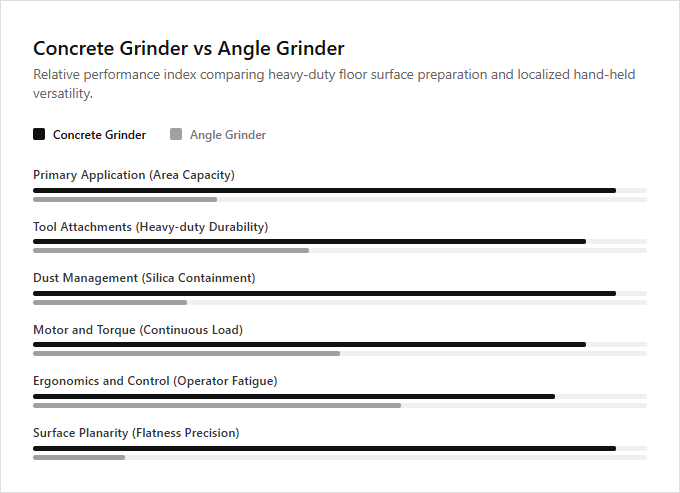
| Factor | Summary |
|---|---|
| Primary Application | Concrete grinders are engineered for large-scale horizontal surface leveling, whereas angle grinders are highly versatile handheld tools designed for localized cutting and weld-blending. |
| Tool Attachments | Concrete grinders utilize heavy-duty diamond cup wheels or planetary plates, while angle grinders typically spin thinner bonded abrasive discs or wire cups. |
| Dust Management | Dedicated concrete grinders feature integrated, sealed dust shrouds for high-volume containment, whereas standard angle grinders require aftermarket attachments to mitigate hazardous respirable crystalline silica. |
| Motor and Torque | Concrete grinders are built with high-torque motors to maintain rotational speed under heavy axial load, while angle grinders prioritize high-RPM speed with lower overall torque density. |
| Ergonomics and Control | Dedicated floor grinders utilize upright frames or dual-handle designs to reduce operator fatigue during continuous floor preparation, whereas angle grinders employ a compact, barrel-grip configuration for multi-positional maneuverability. |
| Surface Planarity | The wide footprint of a concrete grinder ensures excellent flat surface planarity, while the smaller, angled contact point of an angle grinder is highly prone to creating gouges and uneven micro-textures. |
Dedicated integrated dust shroud vs aftermarket shroud compatibility
Dedicated concrete grinders feature an integrated dust shroud engineered specifically for high-volume concrete dust extraction. This built-in design ensures a seamless seal, optimal airflow, and maximum durability under heavy-duty site conditions. In contrast, standard angle grinders rely on aftermarket shroud compatibility. While this setup offers excellent tool versatility, fitting an external shroud can result in minor suction leaks and requires manual adjustment to maintain proper surface contact.
Selecting the appropriate equipment depends on your operational scale and frequency of use. Dedicated concrete grinders are best suited for specialized flooring contractors requiring daily, high-volume dust containment, whereas adaptable angle grinders with aftermarket shrouds are ideal for general contractors and remodelers who need a single, multi-purpose tool for occasional masonry tasks.
Motor amperage and torque capacity for continuous load grinding
Concrete grinders and angle grinders differ significantly in their power delivery under continuous load. Dedicated concrete grinders typically feature high-amperage motors, often ranging from 12 to 15 amps, paired with high-torque gearboxes engineered to maintain constant RPM under heavy resistance. In contrast, standard angle grinders generally operate at lower amperage and prioritize high speed over raw torque, making them prone to stalling or overheating during prolonged concrete resurfacing.
The robust construction of a concrete grinder ensures sustained power and efficient dust extraction during intensive surface preparation. Industrial contractors requiring high-production floor restoration will benefit most from a dedicated concrete grinder, whereas general tradespeople performing occasional masonry cutting or detail work will find the versatility of an angle grinder more suitable.
Spindle thread compatibility using standard 5/8-inch-11 arbor mounts
Both dedicated concrete grinders and standard angle grinders frequently share the industry-standard 5/8-inch-11 spindle thread. This common arbor size allows both power tools to accommodate a wide variety of surface preparation attachments, such as diamond cup wheels and threaded wire cups. While the thread compatibility is identical, the mechanical design of each tool dictates how these accessories are utilized under heavy loads.
A standard angle grinder offers high-speed versatility for cutting and grinding various materials, but it often lacks the specialized dust shroud and sealed bearings necessary to withstand highly abrasive masonry dust. Angle grinders are ideal for general contractors needing a highly portable, multi-purpose tool for occasional metal and masonry work, whereas specialized concrete grinders are best suited for flooring installers and remediation specialists who require continuous, dust-free surface preparation.
Optimal RPM ranges to prevent diamond segment glazing
Preventing diamond segment glazing requires matching the tool's rotational speed to the hardness of the concrete. Dedicated concrete grinders typically operate at a controlled, lower speed range of 3,000 to 6,000 RPM, maintaining the high torque necessary to keep diamond abrasives exposed and cutting effectively. Conversely, standard angle grinders run at much higher speeds, often between 10,000 and 11,000 RPM. This excessive speed heats the metal bond too quickly without sufficient torque, causing the diamonds to glaze over and lose their cutting efficiency.
Selecting the correct tool depends entirely on the scale of the project and the operator's expertise. Dedicated concrete grinders are ideal for professional flooring contractors requiring precise, dust-controlled leveling on large slabs, while versatile angle grinders are best suited for DIY enthusiasts and general contractors handling quick, small-scale edge work.
Thermal overload protection systems to prevent motor burnout
Concrete grinders and angle grinders manage thermal stress differently to prevent motor burnout during demanding masonry work. Dedicated concrete grinders feature sophisticated electronic thermal overload protection systems. These integrated sensors actively monitor motor temperature during prolonged, high-friction surface preparation, automatically shutting down the unit or reducing power before critical heat thresholds are reached.
Standard angle grinders are designed for versatile, intermittent tasks and often rely on airflow cooling, though premium models include basic thermal cut-offs. Because their compact bodies dissipate heat less efficiently, they are more susceptible to burnout during continuous, heavy resurfacing. Professional flooring contractors requiring sustained dust-free grinding are suited for concrete grinders, whereas general fabricators needing versatile, short-duration cutting and finishing are ideal candidates for angle grinders.
Vacuum CFM requirements for crystalline silica dust extraction
To comply with OSHA regulations regarding crystalline silica dust, selecting the correct vacuum CFM (cubic feet per minute) is critical for both concrete grinders and angle grinders. Standard angle grinders retrofitted with dust shrouds typically require a minimum of 25 CFM per inch of wheel diameter, meaning a common 5-inch blade needs at least 125 CFM. Dedicated concrete grinders, which feature larger, more aggressive grinding heads, demand significantly higher airflow-frequently exceeding 200 to 300 CFM-to safely capture the heavy volume of respirable dust generated during operation.
Proper dust extraction ensures regulatory compliance, protects worker health, and extends tool longevity. Handheld angle grinders equipped with dust shrouds are ideal for light-duty contractors performing edge work or detail repairs, while heavy-duty walk-behind concrete grinders are best suited for industrial flooring specialists managing large-scale surface preparation.
Ergonomic D-handle configuration for managing downward grinding pressure
While standard angle grinders are versatile cutting and grinding tools, dedicated concrete grinders are specifically engineered for surface preparation. The primary distinction lies in the ergonomic D-handle configuration found on concrete grinders. This design positions the operator's hands directly over the grinding head, allowing for even distribution of downward pressure. The side-handle layout of a traditional angle grinder makes managing continuous downward force over large areas physically taxing and less precise.
The D-handle design reduces fatigue and ensures consistent contact between the diamond cup wheel and the concrete substrate. Heavy-duty concrete grinders with D-handles are ideal for commercial flooring contractors requiring uniform finishes, whereas standard angle grinders remain best suited for DIY enthusiasts and metalworkers needing maneuverability for vertical or overhead tasks.
Leave a comment