
Achieving perfect concrete consolidation without honeycombing or structural voids is a constant battle for concrete contractors, often leading to costly structural failures and rework. Typically, crews rely on standard mechanical vibrators or legacy site equipment, treating consolidation as a one-size-fits-all process. However, precisely matching your vibrator to the concrete mix design guarantees optimal aggregate suspension, dramatically reducing finishing labor and ensuring long-term structural integrity.
Under the stipulation that tool performance is strictly dependent on slump profiles, pour volume, and rebar density, operators must carefully evaluate their power tool options. For example, high-frequency internal motor vibrators (like Wacker Neuson's IRFU series) excel in low-slump, heavily reinforced commercial pours, while versatile flexible shaft units (such as Oztec systems) remain the industry standard for variable, mid-slump residential jobs.
In this article, we will compare the mechanics, efficiency, and application limits of high-frequency versus flexible shaft vibrators, providing a definitive roadmap to selecting the right power tool for your project.
| Factor | Summary |
|---|---|
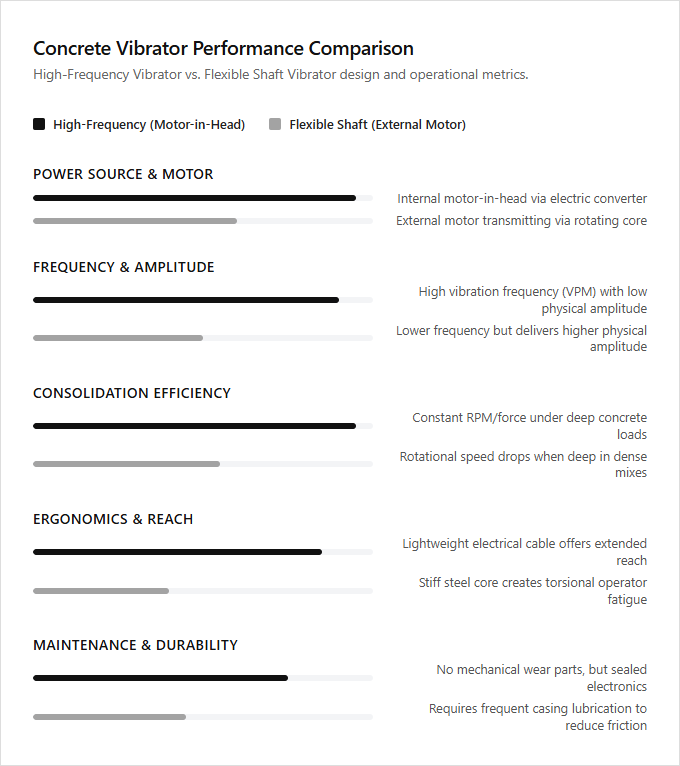
| Power Source and Motor Design | High-frequency vibrators utilize an internal motor-in-head design powered by an electronic frequency converter, whereas flexible shaft vibrators rely on an external drive motor transmitting mechanical energy through a rotating inner core. |
| Vibration Frequency and Amplitude | High-frequency units operate at high vibrations per minute (VPM) with lower amplitude, while flexible shaft models offer lower frequency but higher physical amplitude to consolidate stiff concrete mixes. |
| Consolidation Efficiency | High-frequency vibrators maintain consistent centrifugal force and RPM under load, whereas flexible shaft models often experience a drop in rotational speed when inserted deep into dense concrete. |
| Ergonomics and Reach | The lightweight electrical cable of a high-frequency system minimizes operator fatigue and allows for extended reach, while the stiff steel core of a flexible shaft vibrator creates high torsional load and limits maneuverability. |
| Maintenance and Durability | Flexible shaft vibrators require frequent lubrication to prevent rotational friction within the casing, whereas high-frequency models have fewer mechanical wear-and-tear components but require robust sealed housing to protect internal electronics. |
Motor-in-Head vs. Flexible Shaft Vibrators
High-frequency concrete vibrators feature an innovative motor-in-head design, placing the electric motor directly inside the vibrating casing. This engineering eliminates the need for a flexible shaft, delivering consistent high-frequency vibrations directly to the wet concrete with minimal energy loss and reduced wear on mechanical components.
In contrast, flexible shaft vibrators utilize an external drive motor connected to the head via a rotating internal core protected by a flexible casing. While this configuration keeps the vibrating head lighter and highly maneuverable around dense rebar, the physical friction along the shaft can slightly decrease overall power efficiency during extended operations.
High-frequency models are best suited for large-scale commercial contractors requiring rapid, high-volume consolidation, while flexible shaft systems are ideal for residential concrete workers seeking a highly portable and versatile solution for varied job sites.
Electronic vs. Mechanical Vibrators: 12,000 vs. 9,000 VPM
High-frequency concrete vibrators utilize electronic frequency converters to achieve motor-in-head speeds of approximately 12,000 vibrations per minute (VPM). This rapid rate ensures efficient air release and exceptional consolidation in dense concrete mixes, as the electrical system maintains consistent power directly at the vibrator head under heavy loads.
Flexible shaft vibrators rely on a mechanical pendulum system powered by an external drive unit, typically operating at a lower frequency of around 9,000 VPM. This mechanical design offers reduced vibration speeds but provides high torque and dependable performance without requiring specialized electrical conversion equipment on site.
High-frequency systems are best suited for commercial contractors executing large-scale, high-specification pours, whereas flexible shaft models are ideal for residential builders seeking a versatile, low-maintenance tool for standard foundations.
High-Frequency Excitation vs. Flexible Shaft Displacement
High-frequency internal vibrators utilize an electric motor built directly into the vibrator head to generate rapid, low-amplitude excitation. This method relies on high-velocity micro-vibrations to liquefy the concrete mix, effectively releasing trapped air without causing aggregate segregation. It is highly efficient for fluid, high-slump concrete and dense rebar configurations where precise fluidization is required.
Flexible shaft vibrators transmit mechanical energy from an external motor through a rotating cable to an eccentric weight in the head. This mechanism produces high-amplitude, lower-frequency mechanical displacement, which physically forces stiffer, low-slump concrete mixes to consolidate through raw displacement force rather than resonance.
Commercial contractors working on large-scale, high-specification structural projects benefit most from the precision of high-frequency units, while residential builders and general contractors dealing with versatile, stiff mixes find the robust, cost-effective flexible shaft design ideal.
Electrical Cables vs. Flexible Shafts: Power Transmission
High-frequency concrete vibrators utilize an internal motor located directly within the vibrator head. Power is delivered via electrical cables, transmitting high-frequency current from a specialized generator or converter. This electrical transmission design minimizes mechanical energy loss and maintains consistent amplitude under heavy concrete loads, ensuring rapid air release over extended distances.
Conversely, flexible shaft vibrators rely on an external drive motor that transmits rotational torque through a steel flexible shaft to an eccentric weight in the poker head. This mechanical system is robust but subjects the internal steel core to friction and physical wear, requiring routine lubrication and maintenance to prevent shaft binding.
High-frequency models are ideal for large-scale commercial contractors requiring continuous, high-efficiency consolidation, while flexible shaft systems suit residential concrete specialists and rental yards seeking versatile, cost-effective equipment for diverse job sites.
Flexible Shaft Friction vs. Brushless Motor-in-Head Efficiency
Flexible shaft concrete vibrators rely on a mechanical core rotating within a protective casing, a design that inherently generates significant friction-induced power loss. As the shaft bends to navigate reinforcement steel, this internal friction increases, reducing torque at the vibrator head and accelerating component wear. Conversely, high-frequency vibrators utilize a brushless motor-in-head system. By housing the motor directly inside the vibrating head, these systems eliminate mechanical transmission losses and deliver highly efficient, consistent electrical power directly to the consolidation point.
This direct-drive engineering minimizes thermal strain and maintains high amplitude under heavy loads. Mechanical flexible shaft systems are ideal for budget-conscious operators handling occasional, residential concrete pours, whereas high-frequency motor-in-head systems are best suited for high-production commercial contractors requiring maximum efficiency and continuous, heavy-duty consolidation.
Safety and Power: 42V Inverters vs. Standard Motors
High-frequency internal concrete vibrators utilize an integrated motor powered by a 42V/200Hz low-voltage inverter. This low-voltage configuration provides superior operator safety in wet, highly conductive environments, maintaining consistent consolidation performance under heavy loads. In contrast, traditional flexible shaft vibrators rely on a separate 115V or 230V universal drive motor connected to a flexible transmission shaft. While these standard-voltage motors deliver reliable torque without requiring specialized inverters, they demand strict adherence to ground-fault protection due to the elevated electrical shock risks on active jobsites.
The high-frequency system is ideal for specialized commercial contractors requiring maximum safety on large-scale infrastructure projects, whereas the flexible shaft vibrator is best suited for general builders seeking a versatile, cost-effective solution for diverse, smaller-scale pours.
Centrifugal vs. Manual Constraints in Deep Pour Consolidation
High-frequency concrete vibrators excel in deep pour consolidation due to their motor-in-head design. By housing the motor directly in the vibrator head, these tools maintain a highly consistent centrifugal force and frequency even under heavy concrete loads, resulting in a wider radius of action that ensures thorough compaction throughout the depth of the pour.
In contrast, flexible shaft vibrators offer superior manual maneuverability in tight, highly reinforced spaces where rigid assemblies fail to penetrate. However, the mechanical friction within the flexible shaft can cause energy loss and fluctuating centrifugal forces at greater depths, limiting their effective radius of action. High-frequency models are ideal for industrial contractors executing massive, deep-slab structural pours, while flexible shaft units best suit residential builders navigating complex, congested rebar forms.
Leave a comment