
Fabricators and metalworkers frequently battle material scorching, premature abrasive wear, and gouged finishes during precision tasks. Operating at a fixed, high RPM often ruins sensitive workpieces, leading to costly scrap and reworks.
While standard shop procurement budgets typically default to traditional, single-speed angle grinders as the baseline standard, upgrading to variable-speed machinery is a strategic shift. This transition effectively grants operators the exact thermal control needed to handle diverse materials without sacrificing consumable longevity.
However, this advanced capability comes with the stipulation that operators must understand specific material thresholds; adjustable speed is only as effective as the technician's application knowledge. For example, reducing RPM is critical when polishing stainless steel to prevent heat tinting, or when working with delicate masonry.
Below, we will compare variable and single-speed grinders, map optimal RPM ranges for key materials, and outline how to select the right tool to maximize your workshop's efficiency and precision.
| Factor | Summary |
|---|---|
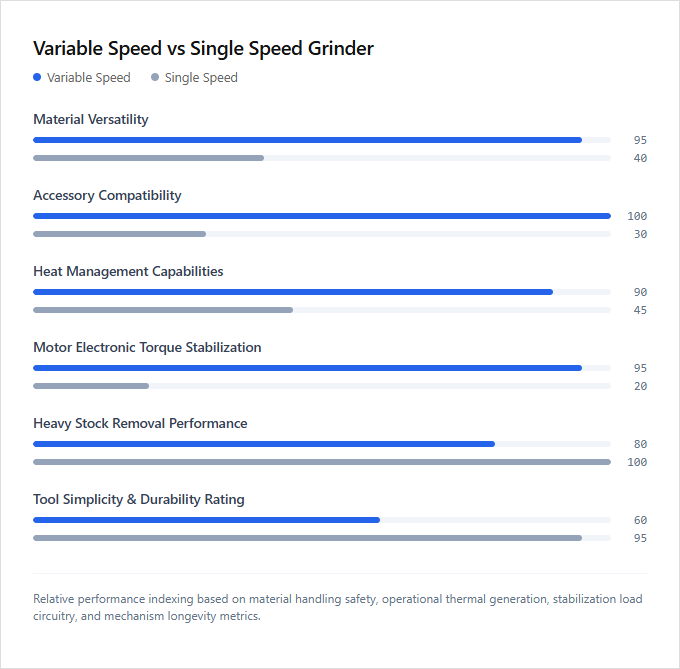
| Material Versatility | Variable speed grinders allow operators to modulate RPM to prevent thermal degradation on sensitive substrates like stainless steel, whereas single-speed models operate at a fixed maximum velocity optimal only for carbon steel. |
| Accessory Compatibility | Variable speed units safely accommodate delicate accessories like wire cup brushes and polishing pads that have lower maximum rated RPMs, while single-speed grinders risk exceeding the rotational tolerance of these consumables. |
| Heat Management | Adjusting to a lower velocity on a variable speed grinder reduces frictional heat buildup, preventing workpiece warping and extending the lifespan of abrasive discs compared to the continuous high-heat output of single-speed tools. |
| Motor Electronics | Variable speed grinders incorporate sophisticated electronic speed stabilization to maintain constant torque under load at lower speeds, whereas single-speed grinders rely on a simpler direct-drive configuration operating constantly at peak power. |
| Task Specificity | Single-speed grinders excel at high-intensity stock removal and aggressive cutting, while variable speed models offer the torque modulation required for delicate tasks like weld blending, buffing, and stone polishing. |
| Cost and Durability | Single-speed grinders feature a streamlined electrical pathway with fewer failure points, making them more cost-effective and rugged than variable-speed counterparts which contain sensitive electronic speed control modules. |
Maintaining Optimal SFPM Across Varying Diameters
Maintaining the optimal surface feet per minute (SFPM) is critical for grinding efficiency and safety. As grinding wheels wear down or when switching accessory diameters, the effective SFPM changes. A single-speed grinder runs at a fixed RPM, meaning the SFPM decreases as the wheel diameter shrinks, reducing cutting efficiency and increasing heat generation on the workpiece.
Variable-speed grinders solve this issue by allowing operators to adjust the RPM to match the accessory's current diameter, consistently maintaining the ideal SFPM. This adaptability ensures optimal material removal rates and prolongs accessory life across various wheel sizes. Single-speed models are best suited for high-volume, single-task industrial operators, while variable-speed units are ideal for precision fabricators and multi-material craftsmen who require meticulous thermal control and versatility.
Preventing Workpiece Degradation Through Precise Heat Control
When working with heat-sensitive materials like stainless steel or thin-gauge alloys, thermal management is critical to preserving structural integrity. Single-speed grinders operate at a constant, maximum RPM, which often generates rapid friction and excessive heat. This uncontrolled thermal buildup can lead to workpiece discoloration, warping, and localized metallurgical degradation.
Variable-speed grinders prevent this damage by allowing operators to match the rotational speed to the specific material. Lowering the RPM directly reduces the thermal energy transferred to the substrate, preventing surface burning and maintaining the alloy's original properties. Single-speed models are best suited for heavy-duty fabrication workers focusing on rapid material removal on thick steel, while variable-speed grinders are ideal for precision metalworkers, finishers, and restoration specialists working with delicate or heat-sensitive metals.
Constant-Speed Electronics for High-Load Torque Maintenance
When selecting an angle grinder, the choice between single-speed and variable-speed models dictates project efficiency. Single-speed grinders operate at a fixed, high RPM, which is highly effective for rapid material removal but lacks adaptability. In contrast, premium variable-speed grinders incorporate advanced constant-speed electronics. This specialized circuitry actively monitors motor performance and automatically increases power input under high mechanical loads, successfully maintaining consistent torque and preventing stalling during challenging tasks.
This electronic speed stabilization ensures that lower-speed operations do not compromise power delivery, offering superior control across diverse materials. Single-speed grinders are ideal for demolition workers and heavy-duty welders focused on repetitive cutting, while variable-speed units are best suited for fabricators and restoration specialists who require precise control for polishing, finishing, and working with heat-sensitive materials.
Control of abrasive grain micro-fracturing rates to optimize self-sharpening cycles
In industrial grinding, the self-sharpening cycle of an abrasive wheel relies on controlled micro-fracturing of individual grains. If the rotational speed is too high for the workpiece hardness, the abrasive grains dull rather than fracture; if the speed is too low, the grains shed prematurely before performing useful work. Single-speed grinders operate at a fixed RPM, offering a static micro-fracturing rate optimized for a highly specific range of materials and wheel diameters.
Variable-speed grinders allow operators to precisely modulate the RPM to match the abrasive grade and material properties. This adjustment regulates the exact thermal and mechanical stress exerted on the wheel, ensuring the abrasive fractures at the optimal rate to continuously expose fresh, sharp cutting edges. Single-speed units are ideal for production-line operators performing repetitive, high-volume tasks on a single material, while variable-speed models are suited for custom fabricators who work with diverse metals and require precise surface finishes.
Precision Ra Adjustment in Fine Finishing
Achieving a precise surface roughness average (Ra) during fine finishing stages requires meticulous control over rotational speed and thermal generation. Variable-speed grinders excel in this domain by allowing operators to lower the RPM, which reduces friction and accommodates delicate polishing abrasives. This fine-tuning capability prevents localized overheating and micro-scratching, ensuring a consistent, ultra-smooth Ra on sensitive materials like stainless steel or aluminum.
In contrast, single-speed grinders operate at a fixed, maximum RPM. While highly efficient for rapid material removal, the lack of velocity adjustment makes managing the final surface profile challenging, as high speeds can easily compromise the targeted Ra values during delicate finishing steps.
Single-speed units are ideal for general construction workers and welders focused on heavy-duty material removal, whereas variable-speed models are suited for precision machinists and detail-oriented metal finishers requiring exacting surface specifications.
Adhere to Brush and Backing Pad Speed Limits
When operating angle grinders, strict adherence to the maximum rated peripheral speed of accessories is critical for workshop safety. Fragile attachments, such as wire cup brushes and flexible backing pads, possess low maximum RPM thresholds. Exceeding these limits on high-speed machinery risks catastrophic accessory disintegration, projectile wire shedding, and severe operator injury.
Variable-speed grinders allow users to precisely calibrate the rotation speed to match the specific tolerances of delicate finishing tools. In contrast, single-speed grinders run continuously at maximum velocity, which optimizes material removal but limits compatibility with speed-sensitive attachments.
Single-speed models are best suited for industrial fabricators dedicated to heavy-duty cutting and grinding, whereas variable-speed units are ideal for multi-disciplinary restorers and detailers requiring precise control over diverse surface finishing applications.
Mitigation of reduced motor ventilation efficiency at lower rotational velocities
In angle grinders, motor cooling relies heavily on an internal fan attached directly to the armature. Operating a variable speed grinder at lower rotational velocities reduces the fan's speed, significantly diminishing airflow and increasing the risk of thermal overload. Operators must mitigate this reduced ventilation efficiency by avoiding prolonged heavy loads at low RPMs and periodically running the tool completely unloaded at maximum speed to draw cooling air through the motor housing.
Single-speed grinders bypass this thermal management concern by consistently operating at maximum RPM, ensuring the fan maintains peak ventilation efficiency throughout operation. High-volume industrial fabricators prioritizing raw power and continuous cutting benefit most from robust single-speed models, while specialized artisans working with diverse materials like stainless steel, stone, or glass require the thermal-mindful precision of variable-speed units.
Leave a comment