
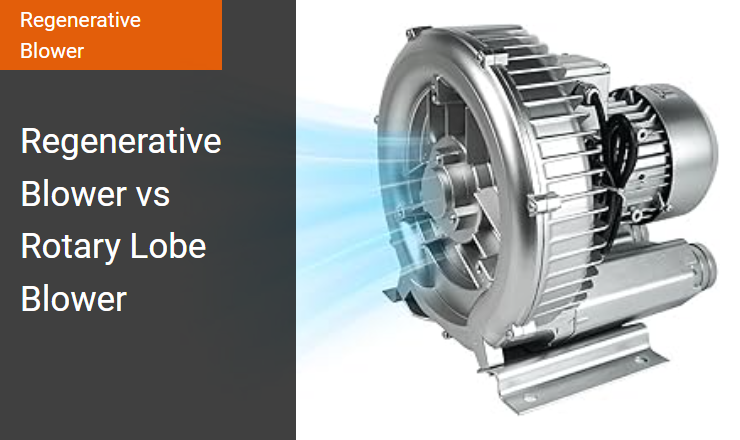
Selecting the right low-pressure aeration system often leaves plant engineers grappling with excessive energy overhead and frequent maintenance downtime. Traditionally, facilities rely on standard capital expenditure budgets and conventional utility rebates to offset these high initial procurement costs. However, choosing side channel blower technology over traditional options grants an immediate, compounding reduction in lifecycle costs.
It is important to stipulate, however, that regenerative blowers are not a universal cure-all; their efficiency gains are highly dependent on specific pressure thresholds and flow demands, particularly in applications like shallow aquaculture tanks and municipal wastewater basins.
To help guide your procurement strategy, this article provides a comprehensive comparison of regenerative and rotary lobe blowers. We will analyze their mechanical differences, evaluate their performance curves under varying depths, and deliver a clear decision framework for optimizing your aeration efficiency.
| Factor | Summary |
|---|---|
| Operating Principle | Regenerative blowers utilize non-displacement dynamic compression via a spinning impeller, whereas rotary lobe blowers rely on positive displacement using synchronized meshing lobes. |
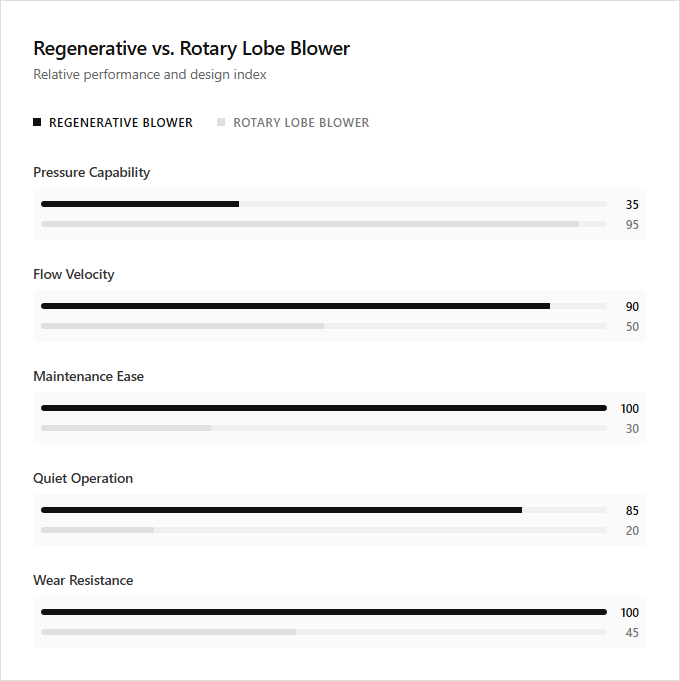
| Pressure and Flow | Rotary lobe blowers deliver a constant displacement volume at much higher differential pressures, while regenerative blowers excel at generating high flow velocities at lower discharge pressures. |
| Maintenance Needs | Regenerative blowers feature a wear-free, contact-less design requiring no lubrication, unlike rotary lobe blowers which require routine oil changes for their timing gears and bearings. |
| Noise Level | Regenerative blowers operate quietly due to continuous dynamic airflow, whereas rotary lobe blowers produce significant pressure pulsation noise that necessitates external silencers. |
| Frictional Wear | The single-stage impeller of a regenerative blower experiences zero frictional contact within the housing, while rotary lobe blowers rely on tight lobe-to-lobe tolerances that can degrade over time. |
Dynamic displacement versus positive displacement operational principles
Regenerative blowers operate on the principle of dynamic displacement, utilizing a non-contact, rapidly spinning impeller to accelerate air through centrifugal force. This continuous movement increases pressure as the air regenerates through the blades. In contrast, rotary lobe blowers employ positive displacement. These units trap a fixed volume of air between two counter-rotating, interlocking lobes and mechanically force it through the discharge port, delivering a constant volume regardless of pressure changes.
While regenerative models excel in high-volume, low-to-medium pressure applications with quiet operation, rotary lobe designs are engineered for heavy-duty, high-pressure environments. Facilities managers requiring maintenance-free, continuous low-pressure air for vacuum packaging or soil remediation will find regenerative blowers ideal, whereas industrial operators managing heavy-duty wastewater aeration or pneumatic conveying systems require the robust, pressure-stable performance of rotary lobe technology.
Continuous pulsation-free flow reducing system vibration and piping fatigue
Regenerative blowers and rotary lobe blowers differ significantly in their discharge dynamics and impact on system infrastructure. A regenerative blower utilizes non-positive displacement to generate a continuous, pulsation-free airflow. This steady stream minimizes system vibration and prevents piping fatigue, safeguarding downstream joints and instrumentation from structural wear. In contrast, rotary lobe blowers operate via positive displacement, which inherently produces cyclic pressure pulses that require heavy dampening.
By eliminating these pressure fluctuations, regenerative technology reduces the need for inline silencers and robust piping supports. Plant engineers seeking quiet, maintenance-free air delivery for sensitive medical or packaging processes will benefit most from regenerative blowers, whereas heavy-duty industrial operators requiring high-pressure bulk material transport are better suited for rotary lobe systems.
Guaranteed 100% oil-free compression preventing contamination of aeration diffusers
In wastewater treatment and industrial aeration, choosing between a regenerative blower and a rotary lobe blower often depends on air purity requirements. Regenerative blowers feature a dynamic, non-contact design that guarantees 100% oil-free compression. By eliminating internal lubricants within the compression chamber, these units prevent oil aerosols from contaminating sensitive aeration diffusers, preserving system efficiency and preventing costly clogging.
In contrast, rotary lobe blowers rely on external gear lubrication, introducing a risk of oil carryover if seals degrade over time. Regenerative blowers are best suited for environmental technicians seeking maintenance-free, clean-air aeration, whereas rotary lobe blowers are ideal for heavy-duty operators requiring high-volume displacement at higher pressures.
Optimized isentropic efficiency in low-pressure regimes under 10 PSI
In low-pressure regimes under 10 PSI, selecting the correct blower technology significantly impacts system efficiency. Regenerative blowers utilize a dynamic, non-displacement design that excels in these lower pressure ranges. Their optimized isentropic efficiency stems from continuous, non-pulsating airflow and minimal internal friction, which often outperforms rotary lobe blowers. Rotary lobe blowers, as positive displacement machines, experience greater mechanical and thermal losses when operated far below their peak pressure capabilities.
Regenerative units are ideal for facility managers seeking quiet, oil-free operation for light aeration and vacuum packaging, while rotary lobe systems best serve industrial engineers managing heavy-duty, high-volume wastewater treatment or dense pneumatic conveying.
Steep performance curve characteristics matching stable hydrostatic head pressures
Regenerative blowers and rotary lobe blowers manage system pressure variations through distinct mechanical principles. Regenerative blowers feature a steep performance curve, which ensures that flow rates remain remarkably stable even when encountering fluctuating system resistance. This specific characteristic makes them highly efficient for applications governed by stable hydrostatic head pressures, such as deep-tank wastewater aeration, where consistent airflow must overcome a constant liquid column.
Rotary lobe blowers operate as positive displacement machines, delivering a constant volume of air regardless of pressure changes. While they excel in higher pressure ranges, they require more robust monitoring to match the self-limiting pressure characteristics of regenerative systems. Engineers seeking low-maintenance, continuous flow at constant depths benefit most from regenerative blowers, whereas operators managing high-resistance, fluctuating process pressures should select rotary lobe blowers.
Virtually maintenance-free monoblock design eliminating drive belts and oil reservoirs
When selecting industrial air-moving equipment, comparing regenerative blowers to rotary lobe blowers reveals distinct engineering philosophies. Regenerative blowers feature a compact monoblock design that integrates the impeller directly with the motor shaft. This innovative configuration completely eliminates the high-maintenance components typically found in rotary lobe systems, such as drive belts, pulleys, and oil reservoirs, resulting in a virtually maintenance-free operation.
While rotary lobe blowers require routine oil changes and belt tension adjustments to prevent mechanical failure, regenerative blowers deliver clean, oil-free airflow through contact-free rotation. Regenerative blowers are ideal for facility managers seeking low-maintenance, continuous-duty pressure or vacuum applications, whereas rotary lobe blowers best serve heavy-duty industrial operators requiring high-volume, high-pressure performance.
Aerodynamic Impellers Reduce Noise Over Rotary Lobes
When selecting industrial air-moving equipment, acoustic performance remains a primary operational consideration. Regenerative blowers offer significantly lower acoustic emissions compared to rotary lobe blowers. This decibel reduction is achieved through the regenerative blower's aerodynamic impeller velocity, which continuously accelerates air without physical contact. Conversely, rotary lobe blowers generate substantial mechanical noise and pressure pulsations through the physical shearing action of interlocking lobes.
This fundamental difference in design dictates the ideal application environment for each technology. Facilities seeking quiet, vibration-free operation for wastewater aeration or medical vacuums should select regenerative blowers, while industrial managers requiring high-volume, high-pressure bulk material transport are better served by rotary lobe blowers.
Leave a comment