
For field technicians and fleet managers alike, selecting the wrong cordless inflator often results in melted seals, depleted batteries, and costly project delays on the job site. When planning annual equipment procurement, decision-makers typically rely on standard tool-acquisition budgets or general capital funding sources, operating under the assumption that all inflation devices are interchangeable utility tools. However, precisely matching the technology to your specific application grants operators optimized runtime, superior speed, and significantly reduced equipment wear.
As a vital educational stipulation, users must recognize that high-pressure (PSI) and high-volume (CFM) requirements rely on entirely different mechanical designs. For instance, attempting to use a high-pressure specialty tool like the Milwaukee M18 Compact Inflator for massive, high-volume, low-pressure tasks will trigger thermal overload. Below, we break down the engineering differences between PSI and CFM, compare leading cordless units, and establish a clear selection framework for your team's pneumatic needs.
| Factor | Summary |
|---|---|
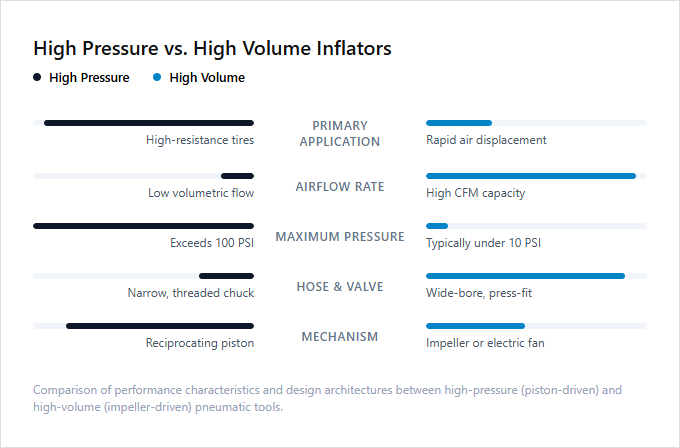
| Primary Application | High-pressure units target high-resistance pneumatic applications like vehicle tires, while high-volume units are optimized for rapid air displacement in large inflatables. |
| Airflow Rate | High-volume inflators deliver a high Cubic Feet per Minute (CFM) rating to fill spaces quickly, whereas high-pressure inflators operate at a much lower volumetric flow rate. |
| Maximum Pressure | High-pressure tools can easily exceed one hundred Pounds per Square Inch (PSI) to overcome resistance, while high-volume tools typically operate at under ten PSI. |
| Hose and Valve Design | High-volume systems utilize wide-bore hoses to maximize airflow, whereas high-pressure systems use narrow, reinforced hoses with secure threaded chuck connectors. |
| Internal Mechanism | High-pressure tools utilize a reciprocating piston compressor to compress air, while high-volume tools often employ an impeller or electric fan blower to move air rapidly. |
How PSI Overcomes High Vessel Resistance
When selecting an inflator power tool, understanding the distinction between high-pressure and high-volume performance is essential. High-pressure applications rely on PSI metrics to overcome resistance in high-resistance vessels like vehicle tires. These tools deliver a concentrated force of air capable of pushing against existing internal pressure, making them indispensable for automotive maintenance and heavy-duty equipment.
Conversely, high-volume inflators prioritize airflow rate to quickly fill large, low-resistance items such as air mattresses and pool rafts. This mechanism moves a vast amount of air at low pressure, prioritizing speed over force. High-pressure units are ideal for motorists and trade professionals requiring precise tire maintenance, while high-volume models best serve outdoor enthusiasts and homeowners managing recreational inflatables.
High CFM for Rapid, High-Volume Inflation
When selecting an inflator power tool, understanding the operational distinction between high-volume and high-pressure systems is essential for optimal performance. High-volume applications require elevated CFM (cubic feet per minute) ratings to rapidly fill high-capacity items like inflatable boats, large rafts, and air mattresses. These tools prioritize the rapid movement of massive air quantities at relatively low pressure levels to maximize efficiency.
In contrast, high-pressure inflators focus on delivering high PSI (pounds per square inch) to overcome resistance in smaller-volume applications. High-volume units are best suited for campers and water sports enthusiasts who need quick recreational setups, while high-pressure models are essential for motorists and cyclists requiring precise tire maintenance and roadside preparedness.
Dual-Function Inflators: Piston and Impeller Mechanics
Selecting the right inflator requires understanding the distinction between high-pressure and high-volume applications. Dual-function inflators address both needs by integrating two distinct internal mechanisms. For high-pressure tasks, the tool utilizes a reciprocating piston to compress air efficiently to precise levels. Conversely, for high-volume demands, a high-speed impeller rapidly moves large quantities of air at lower pressure to fill spacious cavities quickly.
Having both mechanisms in a single power tool offers maximum versatility on the job site or at home. High-pressure settings are essential for roadside emergencies and sports equipment, while high-volume settings save time when preparing recreational gear. Automotive technicians and cyclists typically require the precision of high-pressure systems, whereas campers and beachgoers benefit most from the rapid air movement of high-volume units.
How Battery Specs Determine Tool Runtime and Torque
When selecting a cordless inflator, understanding the distinction between high-pressure and high-volume output is essential. High-pressure models are engineered to overcome resistance in applications like vehicle tires, whereas high-volume units rapidly move large quantities of air at low pressure. The performance of both systems relies heavily on the battery platform, where voltage and Amp-hour (Ah) capacity determine the tool's runtime and torque under pneumatic load.
Opting for a robust battery configuration ensures consistent pressure delivery and prevents thermal overload during extended operation. High-pressure inflators are ideal for automotive technicians requiring roadside tire maintenance, whereas high-volume units are best suited for recreation enthusiasts inflating large leisure gear.
Pressure Transducers Enable Auto-Shutoff via Backpressure
Selecting the correct inflator power tool depends entirely on the specific application's flow and pressure requirements. High-pressure inflators are engineered to deliver low air volume at high PSI, whereas high-volume inflators are designed to move large quantities of air at low pressure. Modern professional units feature integrated pressure transducers that continuously monitor real-time system backpressure. This technology enables an automatic shutoff functionality, halting operation precisely when the target level is reached to protect both the tool and the inflatable from damage.
Choosing the right technology optimizes job site efficiency and ensures safety during operation. High-pressure models are best suited for automotive technicians and cyclists requiring precise inflation for tires, while high-volume units are ideal for recreation outfitters and utility workers who frequently inflate large-scale air mattresses, rafts, or tents.
Duty Cycle: Continuous Run Time Limits
When selecting an inflator power tool, understanding the distinction between high-pressure and high-volume models is essential for operational efficiency. High-pressure inflators are engineered for tasks requiring significant force, such as servicing vehicle tires, whereas high-volume units excel at rapidly moving air to fill large, low-pressure items. A critical specification governing both types is the duty cycle rating. This rating dictates the continuous run time allowed before thermal overload protection engages to prevent motor damage.
Exceeding the recommended duty cycle triggers internal thermal sensors, forcing the tool to shut down until it cools sufficiently. Properly managing this run time ensures tool longevity and prevents premature failure during demanding applications. High-pressure units are best suited for roadside motorists and mechanics needing precision force, while high-volume inflators are ideal for outdoor enthusiasts and recreation coordinators requiring rapid, low-resistance deployment.
How Hose and Valve Fittings Impact Air Efficiency
Understanding the distinction between high-pressure and high-volume inflators requires an analysis of fluid dynamics. High-volume inflators utilize wide-diameter hoses and large valve fittings to maximize free-air delivery while minimizing friction loss, allowing low-pressure air to move rapidly. Conversely, high-pressure inflators employ narrow, reinforced hoses to withstand extreme force, sacrificing volumetric flow to generate the resistance necessary for high-PSI applications. The restriction in narrow hoses increases friction loss, which is inefficient for large volumes but essential for reaching high pressures.
Selecting the correct tool depends entirely on the application's physical requirements. High-volume models excel at inflating large, low-pressure items like rafts, whereas high-pressure units are designed for vehicle tires and sports equipment. High-volume inflators are ideal for outdoor recreationists requiring rapid setup, while high-pressure models are essential for drivers and cyclists prioritizing roadside safety and precise tire maintenance.
Leave a comment