
Operators frequently struggle with physical fatigue and inconsistent media flow when relying on manual trigger guns in abrasive blasting cabinets, leading to uneven finishes and costly production downtime. While facilities often look to standard funding sources-such as annual capital equipment budgets-to resolve these inefficiencies by replacing entire blast systems, simply upgrading the foot control actuator grants immediate, micro-targeted flow precision and ergonomic relief at a fraction of the cost.
As a key stipulation, however, the ultimate success of this upgrade hinges on matching the pedal mechanism to your cabinet's existing air plumbing and valve configuration. For instance, high-volume industrial operations utilizing heavy-duty Clemco cabinets rely on specific pedal setups to maintain continuous, high-speed throughput. Below, we provide an objective comparison of pneumatic and electric foot pedals, evaluating their responsiveness, durability, and installation requirements to help you optimize your media flow control.
| Factor | Summary |
|---|---|
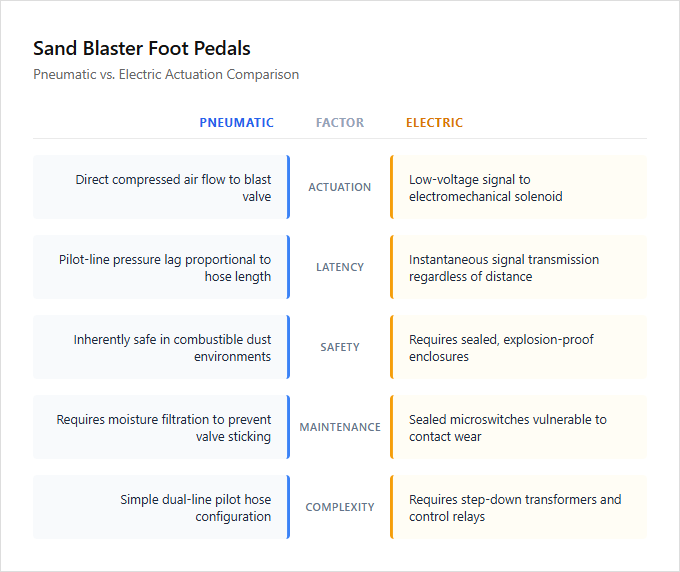
| Actuation Mechanism | Pneumatic pedals utilize direct compressed air flow to actuate the blast valve, whereas electric pedals rely on low-voltage control signals to trigger an electromechanical solenoid valve. |
| Response Latency | Electric pedals offer instantaneous signal transmission regardless of distance, while pneumatic pedals experience pilot-line pressure lag proportional to hose length. |
| Hazardous Environment Safety | Pneumatic pedals are inherently intrinsically safe in combustible dust environments, whereas electric pedals require sealed, explosion-proof enclosures to eliminate the risk of spark ignition. |
| Maintenance & Wear | Pneumatic units require moisture filtration to prevent spool valve sticking, while electric units depend on sealed microswitches that are vulnerable to electrical contact degradation over time. |
| System Complexity | Electric systems involve complex integration of step-down transformers and control relays, whereas pneumatic setups utilize a simpler dual-line pilot hose configuration directly connected to the blast pot. |
Safe Pneumatic Pedals for Combustible Dust Environments
In industrial sandblasting, selecting the appropriate foot pedal control is a critical decision that directly impacts operational safety. Electric foot pedals provide highly responsive control but carry an inherent risk of electrical arcing. In contrast, pneumatic foot pedals utilize compressed air to actuate the blast valve, eliminating electrical components at the point of operation. This pneumatic design offers intrinsic safety in combustible dust-laden environments, where a single electrical spark could otherwise trigger a catastrophic ignition of airborne media and fine debris.
By removing the ignition hazard entirely, pneumatic systems ensure compliance with strict safety standards in hazardous locations. Pneumatic pedals are ideal for heavy-duty industrial operators working in high-volume, dust-heavy blasting enclosures, whereas electric pedals are best suited for precision technicians operating in clean, well-ventilated laboratories where arcing risks are negligible.
Instant Flow Control via Electric Solenoid Pedals
When selecting a control mechanism for industrial sandblasting, operators must evaluate the distinct operational differences between pneumatic and electric foot pedals. Electric foot pedals utilize solenoid valve actuation to achieve instantaneous media flow control without pneumatic line lag. By transmitting an immediate electrical signal to the solenoid, these systems eliminate the physical delay of compressed air traveling through pilot lines, resulting in highly responsive and precise blasting cycles.
Pneumatic foot pedals route the compressed air directly through the pedal valve. While this design is robust and requires no electrical power, it inherently introduces a slight delay in both start-up and shut-off times due to pressure propagation. Standard pneumatic setups are highly suitable for general maintenance shops seeking simple, spark-free reliability, while electric pedal systems are preferred by high-volume manufacturing professionals who require rapid cycle times and precise media metering.
Pneumatic Pedal Control of Mixing and Pinch Valves
In industrial sandblasting, foot pedals serve as the primary control mechanism for media flow. Pneumatic foot pedals operate on a purely mechanical-pneumatic principle, directly managing air pilot signals to actuate the abrasive mixing valve or pinch valve. This direct control eliminates the need for electrical components near the blasting enclosure, reducing ignition risks in volatile environments and ensuring reliable valve modulation.
Electric foot pedals utilize electrical microswitches to send signals to an intermediate solenoid valve, which then manages the air supply. This configuration offers rapid response times and reduces operator physical fatigue during prolonged operations. Pneumatic pedals are ideal for industrial operators working in hazardous, spark-free environments, whereas electric pedals are best suited for high-production technicians requiring effortless, high-frequency actuation.
Preventing Foot Switch Failure with IP-Rated Enclosures
In industrial abrasive blasting, selecting the appropriate foot control system between pneumatic and electric designs impacts both operational reliability and safety. Pneumatic pedals utilize air pressure directly to actuate the blast valve, offering a robust, non-electrical solution ideal for wet or volatile environments.
Electric foot pedals offer highly responsive control but introduce vulnerability to harsh blasting environments. Conductive abrasive media and fine metallic dust can easily penetrate standard enclosures, leading to short circuits and premature microswitch failure. To mitigate this risk, electric switches require high IP-rated enclosures-typically IP65 or higher-to ensure complete dust exclusion and maintain electrical integrity under heavy use.
Pneumatic pedals are best suited for operators seeking maximum reliability in rugged, heavy-duty industrial yards, while electric systems are ideal for technicians requiring precise, responsive control in controlled cabinet environments.
Air Filtration Protects Pneumatic Pedal Seals
In abrasive blasting, choosing between pneumatic and electric foot pedals dictates system reliability and maintenance protocols. Pneumatic pedals operate via pilot air lines, directing pressure to actuate the main blast valve. Because air flows directly through the pedal, these control loops require high-efficiency coalescing filtration to deliver clean, dry air. Without this protection, microscopic abrasive dust causes rapid particulate wear on internal spool seals, leading to system pressure leaks and pedal failure.
Electric foot pedals isolate the control signal from the air supply, sending a low-voltage electrical signal to a remote solenoid valve instead. This design eliminates the need for specialized filtration at the pedal interface and minimizes mechanical wear points. Pneumatic pedals are suited for facility managers prioritizing simple, spark-free mechanical setups in hazardous environments, whereas electric pedals are ideal for high-production operators demanding low-maintenance setups and instant trigger response.
PLC-Integrated Electric Pedals for Automated Blasting
In industrial abrasive blasting, the choice between pneumatic and electric foot pedals dictates system control and efficiency. Pneumatic pedals operate via direct air displacement to open and close valves, providing a reliable, purely mechanical interface for standard manual cabinets. Electric foot pedals instead transmit low-voltage signals to actuate solenoids, minimizing physical operator fatigue and modernizing the blasting process.
The primary advantage of electric systems is their capability for advanced system control. Electric pedals allow for precise integration with a programmable logic controller (PLC) for automated blasting cycle sequence configuration. This connectivity enables facilities to program exact blast durations, pressure transitions, and media reclamation cycles within an automated production line.
Pneumatic pedals are best suited for independent workshop technicians requiring simple, utility-free setups, whereas electric pedals are ideal for industrial manufacturing engineers seeking automated, repeatable blasting sequences.
Electric Pedals Outperform Pneumatic Over Long Distances
When selecting a foot pedal control for a sandblasting system, physical distance is a critical engineering factor. Pneumatic foot pedals rely on pressurized air to actuate the system, which often leads to significant pressure drops and sluggish response times over extended hose runs. In contrast, electric foot pedals utilize wiring to transmit signals instantly, maintaining absolute signal integrity and system responsiveness across long distances without any performance degradation.
This difference in signal delivery directly impacts workspace layout flexibility and overall operational efficiency. Simple pneumatic pedals are best suited for hobbyists and small-shop operators with compact, localized cabinet setups, whereas electric pedals are ideal for industrial professionals managing large-scale, high-production facilities that require remote equipment placement.
Leave a comment