
Achieving perfectly uniform board thickness remains a frustrating challenge for woodworkers, where a discrepancy of just a fraction of a millimeter can ruin complex joinery or cause severe tear-out. While standard shop funding sources and equipment budgets are traditionally allocated toward maximizing raw motor horsepower, the true bottleneck to precision lies in cutterhead control. Prioritizing refined depth control grants operators the ability to make predictable, micro-incremental passes, virtually eliminating snipe and wasted material.
As an important educational stipulation, however, users must recognize that advanced micro-adjustments are only as reliable as the rigidity of the planer's overall carriage lock. For example, dialing in a final 1/128-inch pass on highly figured curly maple using a benchmark machine like the DeWalt DW735 requires both a calibrated gauge and a stabilized cutterhead.
This article provides a comparative analysis of manual versus micro-depth adjustments, evaluating how each system impacts dimensioning tolerances, setup speed, and overall output quality.
| Factor | Summary |
|---|---|
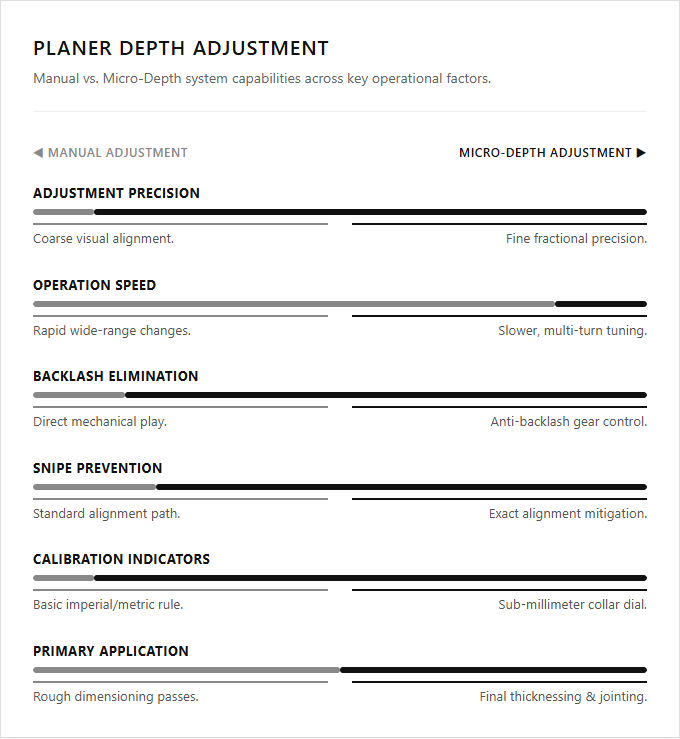
| Adjustment Precision | Micro-depth adjustment utilizes a fine-threaded leadscrew to achieve precise, fractional depth of cut increments, whereas manual adjustment relies on coarse visual alignment. |
| Operation Speed | Manual adjustment allows for rapid stock removal changes across a broad range, while micro-adjustment requires multiple dial rotations to alter the cutting plane. |
| Backlash Elimination | Micro-depth systems often incorporate anti-backlash gears to eliminate thread play, ensuring high repeatability compared to the direct mechanical play of manual levers. |
| Snipe Prevention | Fine-tuning the cutterhead height with micro-adjustment helps establish the exact feed-path alignment needed to mitigate snipe on the workpiece ends. |
| Calibration Indicators | Micro-depth mechanisms feature graduated collar dials or digital readouts for sub-millimeter calibration, whereas manual systems rely on basic imperial or metric rule scales. |
| Primary Application | Manual adjustment is optimized for rough dimensioning passes, while micro-depth adjustment is critical for final thickness calibration and seamless jointing. |
Rapid Material Removal via High-Pitch Leadscrews
Planer depth adjustment mechanisms dictate both the speed and precision of stock removal. Coarse manual adjustment relies on a high leadscrew thread pitch, which facilitates rapid vertical movement of the cutter head. This high-pitch design is engineered specifically for bulk material removal, allowing operators to quickly dimension rough timber in fewer passes.
In contrast, micro-depth adjustment systems employ a much finer thread pitch to achieve incremental, precise calibration. This level of control is essential for final finishing passes where minor fractions of a millimeter prevent grain tear-out and ensure a perfectly level surface. Standard manual adjustment is suited for construction carpenters prioritizing rapid stock dimensioning, while micro-adjustment is ideal for fine furniture makers requiring precise, close-tolerance finishing.
Precision Micro-Depth Adjustment via Worm Gear
In woodworking, selecting the right depth adjustment mechanism on a thickness planer significantly impacts the final workpiece quality. Manual depth adjustment relies on a standard lead screw, offering rapid but coarse height modifications. In contrast, micro-depth adjustment utilizes a fine-pitch worm gear mechanism to achieve precise thousandths-of-an-inch resolution. This mechanical advantage allows operators to execute minute incremental passes, eliminating snipe and perfecting critical dimensions on figured timbers.
Manual systems excel in rough milling operations where fast stock removal is prioritized over tight tolerances. Micro-adjustment systems provide the extreme control necessary for high-end cabinetry, instrument making, and precision joinery. Standard manual adjustment suits construction carpenters and general DIYers seeking rapid material preparation, while the micro-depth system is ideal for professional luthiers and fine furniture makers requiring absolute dimensional accuracy.
Eliminating Backlash During Cutterhead Transitions
Thickness planers utilize either manual depth adjustment or high-precision micro-depth adjustment to position the cutterhead. When transitioning from manually raising the cutterhead to micro-lowering it for fine cuts, eliminating mechanical backlash within the lead screw assembly is critical. Because thread tolerance creates a small amount of play, operators must bypass this slack to ensure the cutterhead remains stable under cutting pressure. Making the final adjustment in an upward direction or engaging a carriage lock neutralizes this tolerance, guaranteeing consistent cutting depth.
Selecting the right mechanism depends on your production requirements and tolerance thresholds. High-volume carpenters who prioritize rapid bulk stock removal favor manual adjustment, whereas precision furniture makers requiring sub-millimeter accuracy for seamless joinery are best suited for micro-depth systems.
Indexing Turret Stops for Repeatable Thickness Presets
When selecting a thickness planer, the choice between manual and micro-depth adjustment dictates the machine's precision. Manual systems rely on basic crank handles and visual scales, requiring operators to estimate depth changes. Conversely, micro-depth adjustment mechanisms offer ultra-fine control, often incorporating integrated indexing turret stops. These stops provide repeatable thicknessing presets at standard dimensions, allowing woodworkers to bypass manual estimation and return to exact heights instantly.
Achieving consistent results across multiple batches is difficult with manual estimation, where small variances easily accumulate. Micro-adjustment planers eliminate this guesswork, maintaining precise thickness across separate production runs. Manual depth adjustment is ideal for general construction carpenters prioritizing rapid material removal, while micro-depth adjustment is best suited for precision cabinetmakers requiring exact, repeatable tolerances.
Digital Readout Calibration for Real-Time Precision
Planer depth adjustment mechanisms generally fall into two categories: manual and micro-depth adjustment systems. While manual adjustments rely on traditional hand cranks and visual scale alignment, micro-depth adjustment systems offer superior precision. These advanced systems often feature digital readout calibration that ensures real-time accuracy tracking down to decimal millimeter increments during micro-adjustments, eliminating guesswork during critical dimensioning phases.
Manual depth adjustment provides rapid, coarse stock removal, making it highly efficient for initial dimensioning where speed is prioritized over extreme tolerances. Micro-adjustment mechanisms allow woodworkers to make minuscule, highly controlled cuts for flawless surface finishes and tight joinery. Manual systems are ideal for framing carpenters processing rough lumber quickly, whereas micro-adjustment models are best suited for custom furniture makers requiring absolute dimensional control.
Prevent Figured Wood Tear-Out with Micro-Adjustments
Choosing between manual and micro-depth adjustment mechanisms on a thickness planer dictates the level of control over the cutterhead. Manual depth adjustments are ideal for rapid, bulk material removal, allowing operators to make quick, coarse height changes. However, when working with premium lumber, micro-depth adjustment systems offer a distinct mechanical advantage.
Fine-threaded micro-adjustments minimize cutterhead deflection by securing the carriage assembly under precise tension. This structural rigidity prevents the blades from lifting or dipping, which is critical for preventing grain tear-out on highly figured wood with interlocking grain patterns. Manual adjustment planers suit general carpenters focusing on high-volume construction lumber, while micro-depth adjustment models are essential for fine furniture makers working with figured hardwoods.
Set Zero-Datum Before Engaging Micro-Feed
In thickness planers, the choice between manual and micro-depth adjustment dictates the overall speed and accuracy of your milling workflow. Manual depth adjustment allows for rapid, coarse movement of the cutterhead during bulk material removal. For high-precision finishing, the micro-depth adjustment system provides ultra-fine calibration. Utilizing the micro-feed wheel effectively requires establishing a precise zero-datum reference point where the cutterhead first contacts the workpiece, ensuring subsequent incremental adjustments are perfectly calibrated.
Manual adjustment mechanisms are best suited for construction carpenters processing rough-sawn lumber quickly, whereas micro-depth adjustment is ideal for precision woodworkers and instrument makers who require highly exact tolerances.
Leave a comment