
Achieving a glass-smooth finish on rough lumber is a constant struggle for woodworkers, who frequently battle planer bog-down, tear-out, and deafening workshop noise. Traditionally, buyers rely on standard equipment budget allocations-balancing initial machinery costs against immediate tooling needs-to resolve these performance bottlenecks. However, understanding the core drive system is what truly grants operators ultimate control over torque consistency and machine longevity.
Under the stipulation that most residential workshops must operate within standard 15-amp or 20-amp electrical circuit limits, maximizing motor efficiency becomes critical. For example, deep-planing dense, eight-quarter rough-sawn white oak quickly exposes the thermal and mechanical limits of lesser drive configurations.
In this analysis, we will contrast the characteristics of universal and induction motors, evaluating their torque delivery, noise profiles, maintenance requirements, and overall duty cycles to help you choose the optimal drive system for your thickness planer.
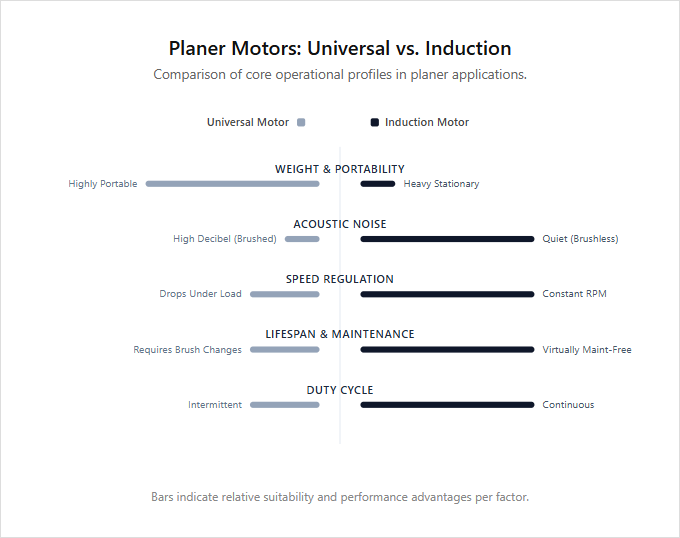
| Factor | Summary |
|---|---|
| Weight and Portability | Universal motors offer a high power-to-weight ratio suitable for portable benchtop planers, whereas induction motors are much heavier, making them better suited for stationary cast-iron machinery. |
| Acoustic Noise | Induction motors operate at a much lower decibel level due to their brushless design, while universal motors produce high-frequency noise from carbon brushes contacting the commutator. |
| Speed Regulation | Induction motors maintain a constant synchronous speed under load, whereas universal motors experience a significant drop in revolutions per minute when encountering dense wood. |
| Maintenance and Lifespan | Universal motors require periodic replacement of wearing carbon brushes, while induction motors feature a brushless design that operates via electromagnetic induction, requiring virtually no maintenance. |
| Duty Cycle | Induction motors are rated for a continuous duty cycle, allowing them to run indefinitely without overheating, whereas universal motors are designed for intermittent duty cycles to prevent thermal overload. |
Power-to-Weight in Portable vs. Stationary Planer Chassis
Universal motors deliver a remarkably high power-to-weight ratio, making them the standard choice for portable benchtop planers. This high power output from a compact, lightweight unit allows manufacturers to design minimalist aluminum and plastic chassis that operators can easily transport directly to job sites.
In contrast, induction motors exhibit a much lower power-to-weight ratio, requiring a larger physical footprint to generate equivalent torque. This weight necessitates heavy, cast-iron stationary chassis designs that stabilize the machine, absorb vibrations, and ensure precise, flat cuts over prolonged periods.
Portable universal-motor planers suit mobile contractors requiring on-site flexibility, while heavy induction-motor models are best for dedicated woodworkers prioritizing workshop stability, quiet operation, and long-term durability.
Load-Dependent vs. Constant Speed in Heavy Stock Removal
Universal motors in portable thickness planers operate with load-dependent speed regulation. When performing heavy stock removal, these motors experience a noticeable drop in rotational speed as cutting resistance increases, requiring operators to carefully manage feed rates to prevent stalling and maintain a clean finish.
In contrast, stationary planers utilize induction motors that maintain a nearly constant synchronous speed regardless of the workload. During heavy cuts, the induction motor draws additional electrical current to sustain its rotational velocity, delivering consistent cuts per inch and a superior surface finish without bogging down.
Universal motor models are ideal for jobsite contractors requiring lightweight portability, while induction motor planers best serve dedicated workshop professionals prioritizing continuous, high-volume production.
Carbon brush wear and commutator arcing versus brushless induction longevity
Planers equipped with universal motors offer high power-to-weight ratios but rely on carbon brushes contacting a spinning commutator. This physical interaction creates friction and electrical arcing, which leads to inevitable brush wear and requires periodic maintenance to avoid tool failure.
By comparison, induction motors feature a brushless design that eliminates these mechanical contact points. Without brushes, there is no arcing or friction-induced degradation, resulting in superior tool longevity, quieter operation, and virtually maintenance-free performance over years of heavy use.
Portable universal motor planers are ideal for jobsite contractors prioritizing mobility and high speed, while heavy induction models are best suited for stationary workshop professionals requiring quiet, continuous workshop production.
Acoustic Noise: Armature Rotation vs. Electromagnetic Fields
Universal motors in planers operate at high rotational speeds, often exceeding 20,000 RPM. This rapid armature rotation, combined with carbon brush friction and high-velocity cooling fans, generates substantial acoustic noise, typically ranging from 95 to over 100 decibels (dB). This high-frequency pitch requires mandatory hearing protection during operation.
Induction motors rely on electromagnetic fields to rotate the rotor at a lower, synchronized speed, usually around 3,450 RPM. By eliminating brushes and mechanical commutators, these motors run significantly quieter, producing a low-frequency hum of approximately 70 to 80 dB, where the primary noise source is the cutting contact rather than the motor itself.
Universal-motor planers are ideal for jobsite contractors requiring lightweight portability, whereas induction-motor models are suited for stationary workshop professionals who prioritize continuous duty and a quieter working environment.
Starting Torque vs. Continuous Running Efficiency
Universal motors drive portable benchtop planers by delivering exceptional initial starting torque, rapidly bringing the cutterhead to operating speed even under immediate load. These high-speed, brush-equipped motors excel at handling sudden, demanding cuts, though they generate significant noise and experience thermal stress during extended run times.
In contrast, induction motors prioritize run torque efficiency during continuous duty cycles, making them the standard for stationary cabinet planers. By maintaining a constant, synchronous speed under load without overheating, these brushless systems ensure quiet operation and superior longevity during prolonged, heavy-duty surfacing.
Portable universal-motor planers suit mobile contractors requiring lightweight tool mobility for quick jobsite tasks, whereas heavy induction-motor models are ideal for dedicated workshop professionals demanding sustained, high-volume timber processing.
Direct-drive high-velocity cutterhead engagement versus belt-driven torque multiplication
Universal motors in benchtop planers typically utilize a direct-drive configuration to achieve high-velocity cutterhead engagement. This design spins the cutterhead at extremely high rotational speeds, maximizing the cuts per inch to deliver an exceptionally smooth surface finish. The direct coupling eliminates belt slippage, resulting in a compact, highly responsive, and lightweight tool housing.
In contrast, stationary workshop planers rely on heavy-duty induction motors paired with belt-driven systems. This arrangement facilitates torque multiplication, allowing the machine to maintain a constant cutterhead speed under heavy loads without stalling. The belt drive also dampens operational vibrations and protects the motor from sudden shock loads when processing figured hardwoods.
Portable universal motor planers are ideal for mobile contractors prioritizing onsite portability and fine finishes, whereas robust induction motor models best suit dedicated woodworkers requiring quiet, continuous, and heavy-duty material thicknessing.
Thermal overload protection requirements during extended feed rate operations
Planers equipped with universal motors are highly portable and powerful but prone to rapid heat buildup during extended feed operations. These motors rely on basic thermal fuses, requiring operators to monitor duty cycles closely and allow frequent cooling periods to avoid damaging the motor windings under sustained workloads.
Induction motor planers excel in continuous-duty applications. Their brushless design generates less internal friction, allowing them to utilize robust thermal overload protection systems that support prolonged, heavy-duty stock removal without triggering frequent, disruptive thermal shutdowns.
Portable jobsite contractors who prioritize tool mobility find universal motors ideal, whereas stationary workshop professionals requiring quiet, nonstop lumber processing are best suited for induction motor planers.
Leave a comment