
Achieving perfectly flat faces and square, seamless edges is a persistent struggle for woodworkers aiming for professional-grade joinery. While many shops rely on standard tool investments-such as table saw jigs or manual hand planes-to correct warped lumber, these traditional methods often consume valuable time and yield inconsistent results.
Integrating a dedicated jointer into your workflow grants you the ability to prep rough stock with absolute precision, ensuring flawless glue-line joints. However, a key educational stipulation must be made: a jointer is designed solely to flatten one face and square one adjacent edge, not to thickness-plane opposing sides. Utilizing a robust machine, such as an 8-inch cast-iron jointer, serves as a proven path to achieving flat stock efficiently.
To help you make an informed purchase, this article compares open stand and closed stand jointers, analyzing critical differences in stability, dust extraction, footprint, and cost so you can choose the best machine for your workshop.
| Factor | Summary |
|---|---|
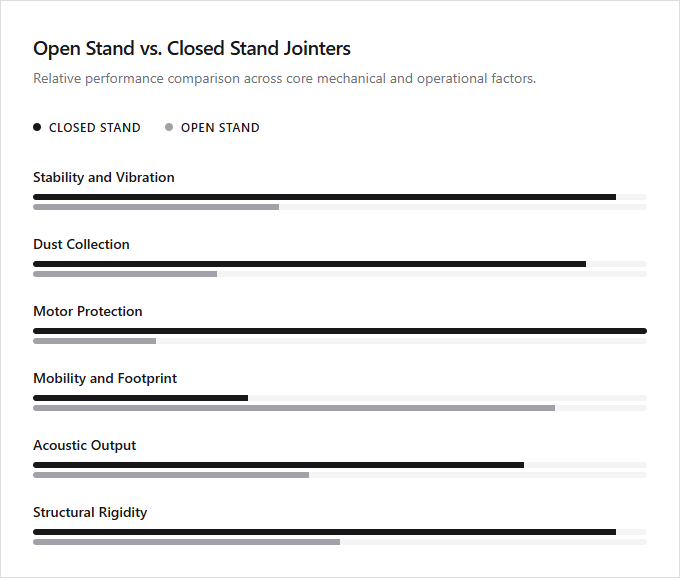
| Stability and Vibration | Closed stand jointers leverage heavy cast-iron cabinets to maximize mass and dampen harmonic vibrations during operation, unlike lighter open stands. |
| Dust Collection | Closed stands feature integrated dust chutes that optimize static pressure for efficient particulate extraction, while open stands require aftermarket shrouds. |
| Motor Protection | The induction motor in a closed stand is shielded from ambient debris within the cabinet, preventing premature wear on internal components. |
| Mobility and Footprint | Open stand jointers typically have a smaller footprint and lower center of gravity, making them easier to equip with mobile casters for small shops. |
| Acoustic Output | The fully enclosed cabinet of a closed stand acts as a sound dampener, significantly reducing the decibel levels produced by the drive belt and cutterhead. |
| Structural Rigidity | Closed stand designs offer superior torsional rigidity to support longer cast-iron infeed and outfeed tables without flexing under heavy stock. |
How Machine Base Design Affects Cutterhead Scallop Pitch
The structural design of a jointer's base directly influences its machining precision. Closed stand jointers feature heavy, cast-iron cabinet bases that offer superior mass and rigidity. This substantial weight dampens motor and cutterhead vibrations, maintaining a consistent cutterhead-to-workpiece relationship. Conversely, open stands utilize lighter steel leg frames, which are more susceptible to harmonic vibrations that introduce subtle oscillations during operation.
These vibration differentials directly affect the finished surface quality, specifically the cutterhead scallop pitch. The stability of a closed cabinet minimizes microscopic deflection, yielding a highly uniform scallop pattern. Open steel frames can produce slight irregularities in scallop spacing due to frame flex under load. Mobile hobbyists prioritizing portability and budget benefit from open stands, while production woodworkers demanding flawless surface finishes and continuous operation require closed cabinet models.
Jointer Table Coplanarity: Parallelogram vs. Dovetail Ways
Closed stand jointers frequently employ parallelogram adjustment mechanisms, which allow the tables to travel in a tight arc. This design maintains precise coplanarity between the infeed and outfeed tables over years of heavy use, as adjustments can be made along four separate pivot points. In contrast, open stand jointers typically utilize traditional dovetail ways. While dovetail ways move the tables diagonally on a linear path, they can develop play over time, requiring periodic gib adjustment to prevent table sag.
Parallelogram beds offer superior long-term alignment and easier calibration, whereas dovetail beds provide a simpler, more compact setup. Professional furniture makers requiring industrial-grade, long-term accuracy typically choose closed-stand parallelogram models, while recreational woodworkers and space-constrained hobbyists favor the straightforward maintenance and affordability of open-stand dovetail units.
Enclosed Dust Chutes vs. Open Gravity Disposal
Closed stand jointers feature fully enclosed bases housing integrated dust collection chutes. These systems utilize dedicated CFM ports that connect directly to workshop extraction vacuums, drawing fine dust and heavy shavings away from the cutterhead to maintain a pristine workspace and superior air quality.
Open stand jointers utilize an open-bottom design where waste dispersal occurs via a simple gravity-drop system. Wood chips fall directly onto the floor beneath the machine, requiring manual clean-up and allowing more airborne particulates to escape. Dedicated professionals prioritizing air quality and high-volume workshop production require the closed stand design, whereas hobbyists operating in well-ventilated garages or on tight budgets find the open stand option highly sufficient.
Enclosed Induction Motors vs. Open Universal Motors
Closed-stand jointers feature Totally Enclosed Fan Cooled (TEFC) induction motors housed securely inside a sealed cabinet. This design protects the motor from fine wood dust, dampens operating noise, and provides a stable, heavy base that minimizes vibration. In contrast, open-stand jointers utilize exposed, belt-driven universal motors mounted on open steel frames. While these open setups offer easier maintenance access and greater portability, they expose the mechanical components to airborne debris and produce significantly more high-pitched noise during operation.
The choice between these configurations depends on your workspace demands and production volume. Open-stand models suit budget-conscious hobbyists seeking lightweight, portable machinery for occasional projects, whereas closed-stand units are ideal for professional woodworkers requiring maximum dust containment, quiet operation, and heavy-duty reliability.
High-Torque Compatibility: Helical vs. Straight Cutterheads
Closed stand jointers feature fully enclosed bases that house larger, high-torque motors. This robust design is ideal for driving heavy helical spiral cutterheads with indexable carbide inserts, which require consistent power to shear through dense hardwoods without losing RPMs. Conversely, open stand jointers typically utilize lighter-weight, exposed motors suited for standard straight-knife cutterheads, where rotational mass and torque demands are significantly lower.
The enclosed cabinet of a closed stand dampens vibration and provides the rigid structural foundation necessary to maintain precision during high-torque operations. While open stands offer excellent portability and affordability for lighter tasks, they lack the mass required to absorb the forces of heavy-duty spiral cutting. Budget-conscious hobbyists working on occasional light-duty projects benefit most from the portable open stand, whereas professional woodworkers requiring maximum precision and continuous material removal should invest in a closed stand model.
Extended Bed Prevents Long Stock Deflection
When selecting between an open stand and a closed stand jointer, the structural design directly impacts workpiece support. Closed stand models typically feature longer, heavier cast-iron beds. This extended bed length capacity is crucial for preventing cantilever deflection-the slight downward bending of the infeed or outfeed tables-when feeding long, heavy stock. The robust cabinet base of a closed stand jointer provides the necessary rigidity to support these extended tables under heavy loads, ensuring flat, accurate faces.
In contrast, open stand jointers offer a more compact footprint and lighter weight, but their shorter beds are more susceptible to deflection when processing oversized lumber. The lighter frame lacks the mass required to stabilize extreme board lengths during jointing operations. Open stand units are ideal for hobbyists with limited workshop space working on smaller projects, while closed stand models suit professional woodworkers who regularly joint long, structural timber.
Preventing Jointer Tipping During Heavy Lumber Jointing
When processing heavy lumber, machine mass and center of gravity are critical factors in preventing fulcrum tipping. Closed stand jointers house their heavy motors inside a fully enclosed, wide steel base. This design significantly lowers the center of gravity and maximizes overall machine mass, anchoring the tool firmly against the downward and lateral forces exerted when feeding long, dense timber across the tables.
In contrast, open stand jointers feature a flared, skeletal frame with an exposed motor, resulting in a higher center of gravity and reduced mass. While this makes the machine easier to transport, it offers less resistance to tipping when the weight of a heavy board acts as a lever on the outfeed table. Open stand models are best suited for hobbyists working with shorter, lighter stock in space-constrained workshops, whereas closed stand jointers are ideal for professional woodworkers requiring maximum stability for heavy-duty, high-volume milling operations.
Leave a comment