
Woodworkers and shop professionals constantly struggle to maintain pristine air quality, often finding that fine, suspended airborne dust compromises both respiratory health and project finish quality despite running standard filtration systems. Typically, operators look to standard workshop capital budgets or costly overhead ductwork installations to resolve these persistent ventilation deficits.
However, repurposing a cordless blower as a targeted air-clearing accelerator grants operators an immediate, high-CFM airflow boost directly at the source of emission. Under the stipulation that overall runtime and continuous volumetric flow are heavily dependent on motor architecture, understanding your tool's internal design is paramount. For example, implementing a high-efficiency 20V brushless blower setup has proven to maintain consistent static pressure and particulate movement far better than legacy brushed utility tools.
Below, we compare brushless and brushed cordless blowers, analyzing CFM efficiency, thermal thresholds, and battery optimization to help you streamline your workshop's air management strategy.
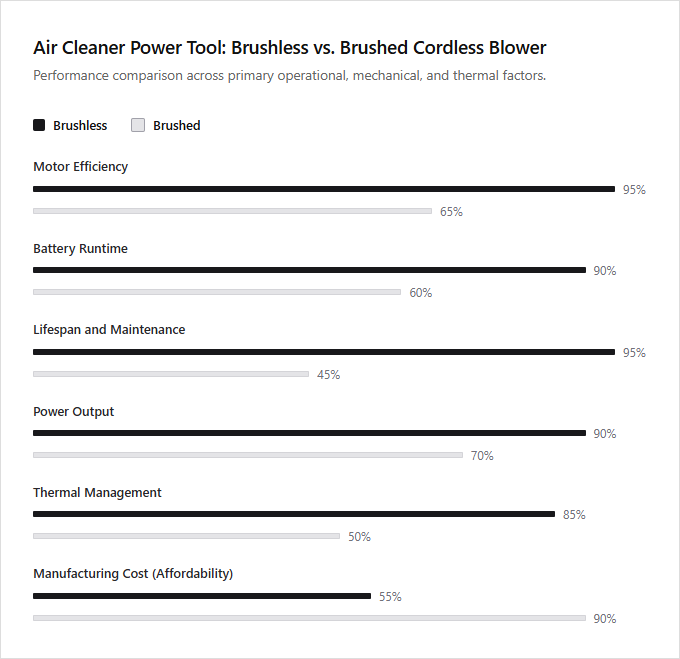
| Factor | Summary |
|---|---|
| Motor Efficiency | Brushless blowers utilize electronic commutation to minimize energy loss, whereas brushed motors rely on physical contact that creates mechanical friction and reduces thermodynamic efficiency. |
| Battery Runtime | The lack of friction in brushless designs optimizes the current draw from the lithium-ion battery, resulting in significantly longer runtimes per charge cycle. |
| Lifespan and Maintenance | Brushed blowers require periodic replacement of carbon brushes due to wear, whereas brushless models eliminate these components to vastly improve the tool's mean time between failures. |
| Power Output | Brushless cordless blowers achieve a superior torque-to-weight ratio and higher CFM (cubic feet per minute) by using digital microprocessors to continuously adjust the stator's magnetic field. |
| Thermal Management | Brushed motors generate high joule heating at the commutator interface, while brushless motors exhibit superior thermal dissipation because the copper windings are located on the stationary stator. |
| Manufacturing Cost | Brushed blowers are more budget-friendly due to their simple analog circuitry, whereas brushless blowers command a premium price driven by the complexity of their integrated electronic speed controllers. |
Brushless Motors Maximize Blower Efficiency
When selecting a cordless air blower for surface preparation or dust clearance, the choice between brushless and brushed motor technologies dictates tool performance. Brushless motors utilize electronic commutation to eliminate mechanical friction, significantly increasing the overall energy transfer efficiency of the blower. By bypassing physical carbon brushes, these advanced motors reduce heat generation and maximize battery runtime, delivering sustained high-velocity airflow for demanding clean-up tasks.
Brushed cordless blowers rely on physical contact to deliver power, which introduces mechanical wear and slightly lower energy efficiency over time. While brushed models offer a cost-effective solution for light, intermittent clearing, brushless alternatives provide superior longevity and torque. Professionals requiring continuous, high-volume air output benefit most from brushless blowers, whereas occasional DIY users seeking budget-friendly debris removal will find brushed models perfectly adequate.
Brushless Motors Maintain Consistent CFM as Voltage Drops
When selecting a cordless blower for dust and debris removal, the motor technology directly impacts performance consistency. Brushed cordless blowers experience a gradual decline in volumetric airflow rate (CFM) as the battery depletes, resulting in diminishing clearing power. Brushless cordless blowers utilize electronic controllers to actively manage energy draw. This precise regulation maintains a highly consistent CFM even as battery voltage drops, ensuring uniform air velocity throughout the entire runtime.
Beyond power stability, brushless models offer superior energy efficiency and a longer overall tool lifespan. Brushed blowers are ideal for budget-conscious homeowners seeking a simple tool for occasional driveway clearing, while brushless blowers are best suited for commercial landscapers and professionals who require sustained, high-performance debris management.
Brushless Blowers Power High-Pressure Workshop Filtration
When selecting a cordless blower for workshop air filtration, motor technology directly impacts performance. Brushless cordless blowers utilize electronic controllers rather than physical brushes, resulting in higher efficiency and significantly greater torque. This mechanical advantage allows brushless motors to generate the superior static pressure necessary to force air through dense, restrictive MERV or HEPA filtration media, maintaining clean workshop air.
Standard brushed cordless blowers offer a more traditional, cost-effective design. While they struggle to overcome the resistance of high-efficiency filters due to lower static pressure, they remain highly functional for unrestricted, open-air sweeping tasks. Professional woodworkers requiring active workshop filtration benefit most from advanced brushless models, whereas casual DIY hobbyists performing basic cleanups find reliable value in simpler brushed options.
How Brushless Design Extends Tool Lifespan
When selecting a cordless blower for air-cleaning applications, the motor design dictates both performance and longevity. Brushless cordless blowers represent a significant advancement over traditional brushed models. The absence of carbon brushes in brushless models prevents premature wear, dramatically extending the tool's duty cycle during continuous air-clearing operations. By eliminating friction and heat buildup, brushless motors deliver superior energy efficiency and a longer overall service life.
Brushed cordless blowers rely on physical contact to transfer electrical current, which leads to gradual component degradation and more frequent maintenance. While brushed models are highly accessible, they are less suited for prolonged heavy-duty use. Professional landscapers and industrial operators requiring maximum uptime and durability should invest in brushless blowers, whereas homeowners seeking a cost-effective tool for brief, occasional driveway or patio clearing will find brushed models highly suitable.
Maximizing Workspace ACH with Brushless Technology
When selecting a cordless blower for workspace air filtration, the motor technology significantly impacts overall performance. Brushless cordless blowers leverage an electronic controller rather than mechanical brushes, achieving a much higher torque-to-weight ratio. This efficiency enables the integration of larger, more aggressive impeller designs that maximize the Air Changes Per Hour (ACH) within a confined workshop. Conversely, brushed cordless blowers rely on physical carbon brushes, which generate friction and heat, limiting both the impeller size and continuous airflow capability.
While brushed models remain a cost-effective choice for weekend hobbyists requiring occasional, light-duty dust clearance, brushless blowers are the definitive standard for commercial contractors needing continuous, high-volume air purification in demanding work environments.
Smart ESCs Prevent Thermal Overload in Brushless Tools
When selecting a cordless blower for air cleaning applications, the motor technology significantly impacts performance and longevity under load. Brushless cordless blowers utilize smart electronic speed controllers (ESCs) that actively monitor and optimize the battery's Ampere-hour (Ah) draw. This intelligent regulation prevents thermal overload when the blower encounters high-resistance filtration loads, ensuring continuous operation and protecting the tool's internal circuitry from heat damage.
In contrast, brushed cordless blowers lack these advanced electronics, drawing current at a less regulated rate that can lead to rapid overheating when airflow is restricted. Industrial technicians requiring sustained, heavy-duty filtration and precise power management benefit most from the advanced brushless design, whereas occasional DIY users seeking a straightforward, budget-friendly tool for light clearing tasks will find brushed models sufficient.
High-RPM Brushless Motors Maximize Workshop Dust Capture
Selecting the right cordless blower for workshop air filtration requires a close examination of motor efficiency. Brushless systems excel in this application due to their electronically controlled power delivery. Higher sustained RPMs in brushless systems maintain the necessary dust-capture velocity to pull fine suspended particulate matter out of the workshop breathing zone, ensuring consistent and reliable air exchange rates during heavy sanding or cutting operations.
Standard brushed alternatives experience mechanical friction and voltage drops that cause RPM fluctuations under continuous loads, which can allow hazardous microscopic particles to remain airborne. High-demand professionals requiring continuous, high-efficiency particulate extraction benefit most from brushless models, while hobbyists with intermittent, light-duty cleanup tasks find brushed blowers to be a practical, budget-friendly option.
Leave a comment