
For precision machinists and woodworkers, few workshop frustrations match the sudden loss of spindle speed and subsequent stalling when forcing a tool through dense material. Traditionally, operators have relied on heavy-duty, belt-driven induction motors to supply the raw mechanical force required for these demanding operations.
However, integrating modern brushless technology grants workshops an unprecedented level of dynamic, electronic speed control and energy efficiency. Under the stipulation that brushless systems require sophisticated electronic controllers that can introduce diagnostic complexity, traditional induction units still retain the crown for pure, long-term mechanical reliability. For instance, when boring a three-inch Forstner bit into seasoned white oak, the distinct torque delivery curves of these two motor types determine whether your machine stalls or cuts seamlessly.
Below, we provide an analytical breakdown of induction versus brushless power, evaluating their thermal management, torque-to-weight ratios, and long-term operating costs to help you select the optimal drive system for your shop.
| Factor | Summary |
|---|---|
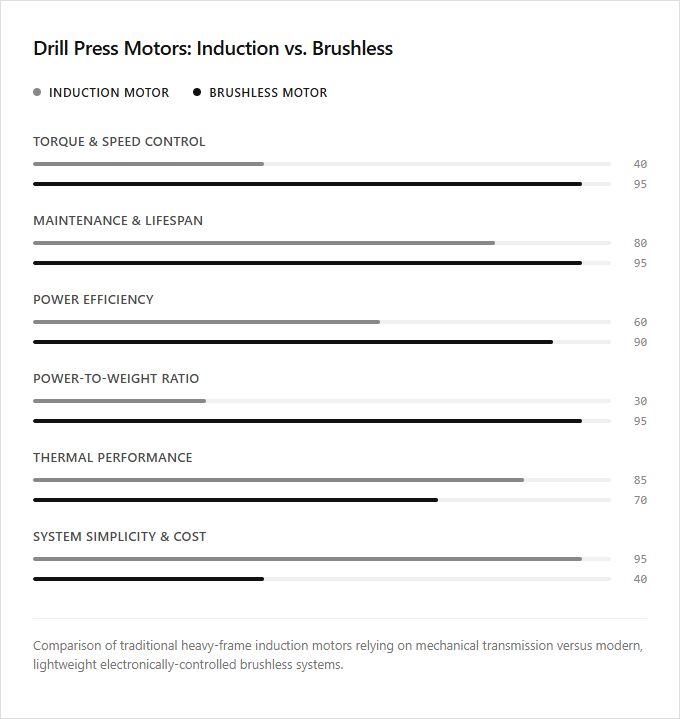
| Torque and Speed Control | While induction motors rely on mechanical pulleys or external variable frequency drives to alter speed, brushless motors utilize integrated electronic speed controllers to maintain constant torque across a wide range of RPMs. |
| Maintenance and Lifespan | Both designs eliminate wearing carbon brushes, but brushless motors feature a commutator-free design that reduces internal friction and electromagnetic interference, extending the overall service life of the drill press. |
| Power Efficiency | Brushless motors achieve higher energy efficiency by using permanent magnets that eliminate the rotor copper losses and slip inherent to induction motor designs. |
| Power-to-Weight Ratio | Brushless motors deliver exceptional power density, allowing for a significantly lighter and more compact drill press head compared to equivalent horsepower induction motors encased in heavy cast-iron frames. |
| Thermal Performance | Induction motors efficiently shed heat through stator-fins during continuous duty cycles, whereas brushless motors generate less heat overall but require sophisticated thermal management to protect their sensitive drive electronics. |
| System Complexity and Cost | Induction motors feature a highly durable, cost-effective direct-on-line starting design, while brushless systems require expensive microcontrollers and hall-effect sensors that increase the initial purchase price. |
Brushless Motors Eliminate Slip to Prevent Spindle Stall
When selecting a drill press, the choice between induction and brushless motors significantly impacts performance under load. Traditional induction motors rely on rotor slip to generate torque, which can cause spindle speed to drop and lead to stalling during heavy-duty drilling. In contrast, brushless motors utilize electronic controllers to maintain synchronous speed, effectively eliminating slip and preventing spindle stall even under extreme resistance.
This constant torque delivery ensures maximum efficiency and clean holes through dense materials, while induction motors offer quieter, simpler operation. Traditional induction drill presses are ideal for weekend hobbyists seeking dependable, budget-friendly performance for woodworking, whereas advanced brushless models are best suited for industrial fabricators requiring uninterrupted precision and high torque during heavy metalworking.
FOC: Maximizing Low-Speed Torque in Brushless Motors
Traditional drill presses rely on induction motors, which require physical belt and pulley adjustments to alter speeds and maintain cutting power. Modern brushless motors replace this mechanical setup with advanced electronic control. Specifically, Field-Oriented Control (FOC) in brushless motors continuously optimizes magnetic flux to maximize low-speed torque electronically, eliminating the need for manual gear changes while maintaining high drilling force.
Induction motors offer simplicity and reliable, continuous-duty operation in traditional workshop settings. Traditional induction models suit hobbyists and general woodworkers seeking straightforward, cost-effective reliability, while advanced brushless drill presses are ideal for precision metal fabricators and industrial professionals who require dynamic speed adjustments and maximum torque at low RPMs.
Brushless Motors: Higher Torque, Lighter Drill Presses
In stationary drill presses, the choice between induction and brushless motors significantly impacts overall tool performance and ergonomics. Brushless motors exhibit superior power density, allowing them to deliver substantially higher torque output within a lighter, more compact drill press head. This reduction in overhead weight improves machine stability and minimizes vibration during heavy-duty drilling operations.
Traditional induction motors rely on heavy copper windings and iron cores to provide reliable, quiet operation, though they require a much larger physical footprint. Industrial workshops requiring continuous, single-speed operation benefit from the heavy-duty endurance of induction models, while high-precision fabricators and commercial users needing adaptable torque and variable speed control are better suited for modern brushless systems.
Back-EMF Speed Control for Constant Drilling Torque
Traditional induction motor drill presses offer exceptional reliability and quiet operation, yet they inherently experience rotational speed drops when transitioning from free-spinning states into workpiece engagement. These motors rely on passive slip to generate torque, which often leads to inconsistent finishes under sudden, heavy loads.
Modern brushless motors employ sophisticated electronic controllers utilizing Back-EMF (electromotive force) sensing. This technology provides continuous, closed-loop speed regulation by measuring the voltage generated by the spinning rotor. When the drill bit transitions from air into dense material, the controller instantly detects the minor deceleration and increases power, maintaining constant torque and stable RPM throughout the cut.
Heavy-duty industrial machinists requiring precise, adaptive speed control benefit most from brushless technology, whereas hobbyists seeking budget-friendly, low-maintenance machinery are better served by traditional induction models.
Brushless PM Motors Beat Induction Motors in Efficiency
When selecting a drill press, the choice between induction and brushless motor technologies heavily impacts operational efficiency and thermal management. Traditional induction motors rely on induced electrical currents to create the rotor's magnetic field, a process that inherently generates rotor copper losses and dissipates energy as heat. Brushless permanent magnet designs eliminate these rotor copper losses entirely by utilizing fixed magnets. This fundamental design difference yields much higher overall electrical efficiency, allowing brushless drill presses to deliver superior torque and maintain cooler operating temperatures under heavy loads.
While induction motors offer dependable, time-tested performance in heavy stationary setups, brushless systems provide greater power density and sophisticated speed control in a lighter package. Traditional induction models are ideal for budget-conscious hobbyists who value simple, heavy-duty stationary machinery, whereas brushless drill presses are best suited for industrial fabricators and high-volume professionals who require continuous duty cycles and precise speed adjustments.
Brushless Motors: Superior Torque-to-Weight Ratio
When selecting a drill press, the motor technology directly influences both performance and physical footprint. Traditional drill presses rely on heavy, single-phase induction motors, which are highly reliable but inherently bulky. In contrast, modern brushless motors deliver a substantially higher torque-to-weight ratio, enabling compact tool designs that deliver exceptional drilling power without the unnecessary physical mass.
Brushless systems utilize electronic controllers instead of mechanical brushes, which minimizes friction, reduces heat generation, and optimizes energy efficiency during operation. Induction motors remain favored for stationary workshop setups where weight is not a critical constraint. Traditional woodworkers and heavy-duty fabricators requiring continuous stationary operation benefit most from induction motors, whereas mobile tradespeople and precision-focused operators will find brushless models more suitable.
Electronic Speed Controllers Prevent Low-Frequency Torque Loss
Traditional induction motors in drill presses often rely on mechanical pulleys or Variable Frequency Drives (VFDs) for speed regulation. However, VFD-controlled induction motors frequently suffer from significant torque degradation at lower frequencies, which compromises drilling performance on dense materials. Modern brushless motors resolve this issue by utilizing advanced electronic speed controllers. These digital controllers continuously monitor load conditions and adjust current dynamically, maintaining maximum torque even at low-frequency operations.
This steady power delivery eliminates the stall risks common in traditional systems while improving energy efficiency. Heavy-duty industrial machinists requiring constant low-speed torque for large-diameter drilling benefit most from brushless models, while DIY hobbyists performing standard woodworking tasks are well-served by the simplicity and reliability of induction-driven presses.
Leave a comment