
Selecting the incorrect power tool for high-demand tasks frequently leads to stripped fasteners, stalled motors, and costly project delays-a frustrating bottleneck for both contractors and dedicated DIYers. While standard equipment procurement typically favors a single, traditional rotary drill to cover all workshop bases, relying solely on this legacy approach limits operational efficiency.
Strategically deploying task-specific tools yields a substantial value-add, drastically reducing labor hours and material wear. It is crucial to stipulate, however, that neither tool serves as a universal substitute for the other. For example, while a standard drill driver is unmatched for boring clean holes with spade bits, driving heavy-duty three-inch lag screws demands the concussive, high-torque rotational force of an impact driver to prevent cam-out.
This article provides a technical comparison of these essential tools. We will analyze their distinct mechanical designs, compare torque delivery systems, and outline key application guidelines to help you select the optimal tool for your fastening and drilling needs.
| Factor | Summary |
|---|---|
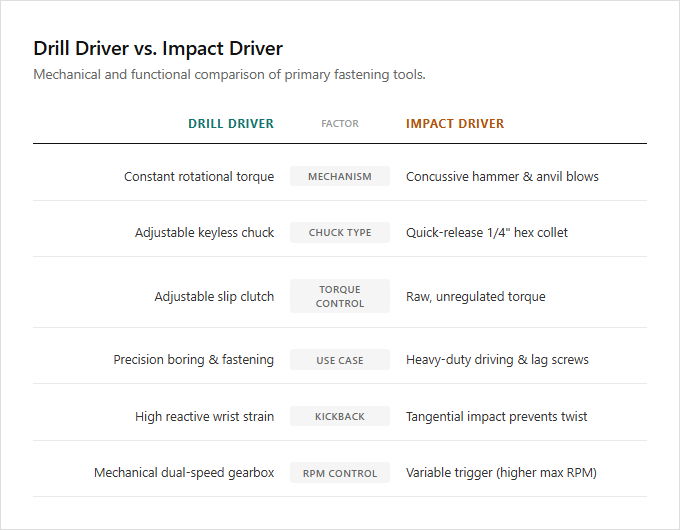
| Rotational Mechanism | While a drill driver relies on constant rotational torque, an impact driver utilizes an internal hammer and anvil mechanism to deliver rapid, concussive downward and rotational blows. |
| Chuck Configuration | Drill drivers feature an adjustable keyless chuck to accept various shank shapes, whereas impact drivers employ a quick-release quarter-inch hex collet designed strictly for hex-shank bits. |
| Torque and Clutch Control | Drill drivers utilize an adjustable slip clutch to limit torque and prevent over-driving, while impact drivers deliver raw, unregulated torque measured in high inch-pounds. |
| Primary Application | Drill drivers excel at hole-boring and precision fastening in delicate materials, whereas impact drivers are optimized for driving large fasteners and lag screws into dense lumber. |
| User Kickback | A drill driver can transfer high reactive torque to the user's wrist when a bit binds, but the tangential impact force of an impact driver virtually eliminates this kickback. |
| Rotational Speed (RPM) | Drill drivers typically offer mechanical dual-speed gearboxes to balance speed and power, whereas impact drivers achieve higher maximum RPMs through variable-speed triggers. |
How Impact Drivers Deliver Superior Torque
While both tools are essential in any workshop, understanding the mechanical distinctions between a drill driver and an impact driver is crucial for optimal project execution. The impact driver is engineered specifically for high-torque applications. It delivers superior rotational torque by utilizing an internal hammer-and-anvil mechanism that compresses and releases rapidly, applying downward force alongside rotational power to prevent screw stripping.
A standard drill driver relies on a slip clutch system to deliver constant rotational force, making it highly precise for creating holes and driving smaller fasteners into delicate materials. Professionals requiring rapid, high-torque fastening in heavy construction benefit most from the impact driver, while general DIYers and woodworkers focused on precision drilling and delicate assembly will find the versatile drill driver more suitable.
Drill Driver Slip Clutches Prevent Stripped Fasteners
When selecting between an impact driver and a drill driver, understanding their mechanical differences is essential for project success. A primary distinction lies in the drill driver's adjustable slip clutch. This mechanism allows users to precisely control torque delivery, automatically disengaging the drive when a preset resistance is met to prevent over-driving fasteners and stripping threads.
In contrast, an impact driver utilizes a quick-release hex chuck and concussive rotational blows to deliver massive torque, making it highly efficient for driving long screws into dense timber. Drill drivers are ideal for furniture assemblers and DIYers requiring precision control, while impact drivers are suited for deck builders and construction professionals performing heavy-duty fastening.
Impact Drivers: Hex Collets vs. Traditional Chucks
When selecting between an impact driver and a drill driver, the primary mechanical distinction lies in how they secure bits. Standard drill drivers feature a keyless three-jaw chuck capable of gripping a wide variety of round or hexagonal shank accessories. In contrast, impact drivers utilize a quarter-inch quick-release hex collet, which strictly accepts hex-shank bits and allows for rapid, one-handed changes during repetitive fastening tasks.
Beyond the chuck design, these tools differ in their power delivery, as impact drivers employ a rotational hammering mechanism to prevent slipping under heavy loads. General DIY enthusiasts and woodworkers requiring precision drilling benefit most from the versatile drill driver, whereas professional contractors and deck builders benefit from the high-torque, fatigue-reducing performance of an impact driver.
Drill Drivers for High-Precision Rotary Drilling
When choosing between an impact driver and a drill driver, understanding their mechanical differences is essential for achieving professional results. Drill drivers are engineered with a secure, adjustable chuck that aligns bits perfectly along the spindle axis. This design offers significantly higher concentricity and lower runout than the quick-change collet of an impact driver, making it the superior choice for precise rotary drilling applications where wobble must be minimized to prevent wood splitting or bit breakage.
In contrast, impact drivers utilize rotational blows to deliver high torque for driving fasteners, sacrificing rotational precision in the process. Cabinetmakers and detailed woodworkers requiring exact hole tolerances will find the drill driver indispensable, whereas framing carpenters and deck builders will achieve maximum efficiency using the high-torque fastening power of an impact driver.
How Impact Drivers Reduce Fastener Cam-Out
While both tools are essential in woodworking and construction, their mechanical operations differ significantly. An impact driver is engineered specifically for heavy-duty fastening, generating high impacts per minute (IPM) to apply downward force alongside rotation. This concussive action keeps the driver bit firmly engaged in the screw head, which dramatically reduces fastener cam-out and prevents stripped screws under high resistance.
A standard drill driver delivers constant, controlled rotational torque, making it the ideal choice for precise hole boring and delicate fastening tasks. Professionals requiring rapid, high-torque fastening for structural framing benefit most from an impact driver, whereas cabinetry makers and general DIYers performing detailed drilling are better suited to a versatile drill driver.
How Drill Gearboxes Optimize Speed for Materials
Choosing between an impact driver and a drill driver requires an understanding of their mechanical configurations. Drill drivers employ a multi-speed mechanical gearbox to optimize RPM for varying material densities, allowing for precise control when boring holes or driving delicate fasteners. This adjustable clutch system prevents material damage by disengaging the drive when reaching a selected torque threshold.
Impact drivers utilize a rotational hammer and anvil mechanism to deliver high-torque downward blows, which efficiently drives large fasteners into dense timber. Drill drivers are ideal for cabinetmakers and hobbyists requiring precise speed control for varied materials, whereas impact drivers are best suited for construction professionals and deck builders performing heavy-duty, high-volume fastening tasks.
How Impact Drivers Reduce Reactionary Torque
When selecting between an impact driver and a standard drill driver, the primary difference lies in torque delivery. Drill drivers apply constant rotational force, which often transfers significant reactionary torque to the operator's wrist during high-resistance fastening. Conversely, impact drivers utilize a rapid hammer-and-anvil mechanism that delivers downward force and rotation simultaneously. This mechanical design minimizes reactionary torque, allowing users to drive large fasteners safely and with minimal physical strain.
Drill drivers offer adjustable clutches and precise speed control, making them highly versatile for drilling holes and delicate fastening. Standard drill drivers are best suited for hobbyists and woodworkers requiring precision drilling and light assembly, whereas impact drivers are ideal for construction professionals and heavy DIYers who frequently install large lag bolts and long deck screws.
Leave a comment