
Selecting the right sander often presents a frustrating challenge for professionals: balancing upfront acquisition costs against the risk of premature tool failure and costly project downtime. When planning equipment upgrades, workshop managers typically rely on standard capital allocation and basic amperage ratings to guide their purchases. However, analyzing the underlying motor technology is what truly grants operators a decisive advantage in thermal efficiency and long-term tool longevity.
To manage expectations, it is important to stipulate that while brushless systems deliver superior energy conversion, their return on investment is most pronounced in high-volume, continuous-use environments rather than occasional light-duty tasks. High-production cabinetry shops, for example, report significant reductions in maintenance cycles when deploying brushless random orbital sanders for heavy surface preparation.
This article will analyze the mechanical distinctions between brushed and brushless sanders, evaluate their power-to-weight ratios, and provide a consultative framework to help you select the most efficient motor for your specific operational requirements.
| Factor | Summary |
|---|---|
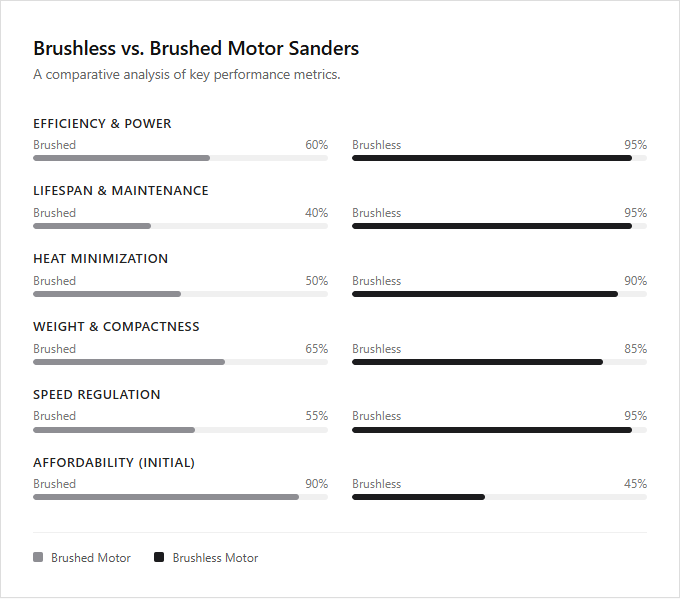
| Efficiency and Power | Brushless sanders utilize smart electronic controllers instead of physical commutators to optimize power transfer and maximize energy efficiency. |
| Lifespan and Maintenance | Brushed sanders require periodic replacement of carbon brushes, whereas brushless models eliminate internal friction for a much longer operational lifespan. |
| Heat Generation | The absence of physical contact in brushless motors minimizes thermal dissipation, preventing the tool from overheating during heavy-duty sanding. |
| Size and Weight | Brushless sanders feature a more compact stator and rotor design, resulting in a lighter tool that significantly improves ergonomics. |
| Speed Regulation | Brushless motors employ electronic feedback loops to maintain constant torque and speed under varying load conditions. |
| Initial Cost | Brushed sanders have a lower price point due to simpler analog circuitry, while brushless models cost more upfront due to integrated microprocessors. |
Eliminating Brushes and Commutators to Reduce Friction and EMI
When selecting a power sander, the choice between brushless and brushed motor technology significantly impacts performance and durability. Traditional brushed sanders rely on physical carbon brushes and mechanical commutators to transfer current, which inherently generates friction, heat, and electromagnetic interference. Brushless sanders eliminate these wear-prone components, utilizing electronic circuitry to manage power delivery instead.
By removing mechanical contact, brushless motors dramatically reduce thermal stress and electrical noise, ensuring smoother operation and a longer tool lifespan. Budget-conscious DIY hobbyists will find brushed sanders highly suitable for occasional home projects, while trade professionals demanding continuous, maintenance-free operation will benefit most from the advanced efficiency of brushless models.
ESC Integration for Dynamic Stator Field Control
In the evolution of sanding power tools, the transition from brushed to brushless motors represents a significant technological leap. Traditional brushed sanders rely on physical carbon brushes to transfer electrical current, resulting in friction, heat, and energy loss. In contrast, brushless sanders integrate an advanced electronic speed controller to dynamically adjust the stator magnetic fields. By continuously monitoring load feedback, this controller regulates the electromagnetic field strength to maintain consistent rotational speed and torque, ensuring optimal material removal even under heavy pressure.
Eliminating mechanical wear extends the tool's operational lifespan and reduces maintenance overhead. Brushed sanders remain a cost-effective choice for DIY enthusiasts undertaking occasional home improvements, whereas high-efficiency brushless sanders are best suited for professional woodworkers and refinishers requiring prolonged, heavy-duty operation.
Superior torque-to-weight ratio and power density under heavy sanding loads
When selecting a sander, the underlying motor technology directly impacts performance under demanding conditions. Brushless motors deliver a superior torque-to-weight ratio compared to traditional brushed designs. By eliminating physical brushes, these motors minimize friction and heat, allowing the tool to maintain consistent speed and high power density even under heavy, continuous sanding loads where brushed motors typically bog down or lose efficiency.
While brushed sanders remain a reliable and cost-effective option, they experience greater energy loss and wear during intense applications. High-demand professionals requiring maximum endurance and consistent material removal will benefit most from the advanced performance of brushless sanders, whereas DIY enthusiasts undertaking occasional, light-duty home improvements are well-suited for the simplicity and lower upfront cost of brushed models.
Enhanced Thermal Dissipation via Outer-Housing Windings
When selecting a power sander, the choice between brushless and brushed motors significantly impacts performance and tool longevity. Brushless sanders offer a distinct engineering advantage in thermal management. By positioning the stator windings directly against the outer motor housing, heat dissipates rapidly into the surrounding air rather than trapping inside the tool. This design minimizes thermal stress on internal components, maintaining consistent torque and extending the overall lifespan of the sander during demanding operations.
Traditional brushed motors rely on carbon brushes that generate friction and internal heat, limiting their continuous run time. While brushed models remain a cost-effective option for occasional DIY enthusiasts performing light surface preparation, brushless sanders are the ideal choice for professional woodworkers and contractors who require a durable, high-endurance tool for prolonged, heavy-duty sanding.
Maximum electrical efficiency preventing energy loss as waste heat
When selecting a power sander, the underlying motor technology directly impacts energy consumption and tool longevity. Brushless sanders represent the pinnacle of electrical efficiency by utilizing electronic controllers rather than physical carbon brushes. This design eliminates mechanical friction, preventing valuable energy from dissipating as waste heat. The result is a highly efficient tool that stays cool during prolonged operation and delivers consistent torque under load.
Conversely, traditional brushed sanders rely on physical contact to transfer electrical current, which inherently generates friction and thermal energy loss. Professional woodworkers and high-volume contractors who require continuous, intensive sanding are best suited for the durable, energy-efficient brushless models, whereas budget-conscious DIY hobbyists will find the lower initial investment of a brushed sander adequate for infrequent, light-duty tasks.
Prolonged duty cycle and service life by eliminating electrical arcing
When selecting a power sander, the choice between brushed and brushless motors directly impacts tool longevity and operational efficiency. Traditional brushed motors rely on physical carbon brushes contacting a spinning commutator, a design that inherently generates friction, heat, and electrical arcing. Over time, this constant sparking degrades the internal components and accelerates wear, which limits the tool's continuous duty cycle and requires regular maintenance.
Brushless sanders eliminate these physical contact points by using an electronic controller to manage the motor's magnetic field. Removing the brushes completely prevents electrical arcing, resulting in significantly cooler operation, reduced energy waste, and a substantially extended service life. Brushed models remain suitable for hobbyists and occasional DIY users seeking a cost-effective tool for light projects, while brushless sanders are ideal for professional woodworkers and contractors requiring maximum durability for daily, high-volume surface preparation.
Closed-Loop Orbital Velocity Control Under Variable Resistance
Brushless and brushed sanders differ significantly in how they handle load variation. Brushless motor sanders integrate electronic closed-loop feedback sensors that continuously monitor and adjust power output. This technology maintains a constant orbital velocity even under heavy, variable downward resistance, preventing the tool from stalling or slowing down during demanding surface preparation.
Brushed sanders lack this advanced sensory feedback, meaning their rotational speed naturally decreases when additional pressure is applied to the workpiece. This difference in velocity regulation directly impacts finish uniformity and overall project efficiency. Traditional brushed sanders are ideal for occasional DIY enthusiasts seeking budget-friendly tools for light utility work, whereas advanced brushless models are best suited for high-production woodworking professionals requiring consistent material removal and flawless finishes.
Leave a comment