
Achieving a flawless Level 5 finish on gypsum board is notoriously labor-intensive, often causing severe physical fatigue and overwhelming plaster dust. Traditionally, finishing professionals rely on standard manual sanding blocks or basic rental equipment to manage these demanding preparation phases within tight project budgets.
However, utilizing a dedicated power drywall sander grants operators unmatched speed and near-total dust extraction, transforming the efficiency of any job site. To set realistic expectations, it must be stipulated that while power sanders excel on expansive walls, their success still depends on proper technique and grit selection to prevent paper damage. Industry-standard models like the Festool Planex highlight how advanced ergonomic engineering can dramatically reduce labor hours.
In this guide, we will compare drywall sanders versus hand sanders across key criteria-efficiency, dust control, and finish quality-to help you choose the ultimate tool for your surface preparation needs.
| Factor | Summary |
|---|---|
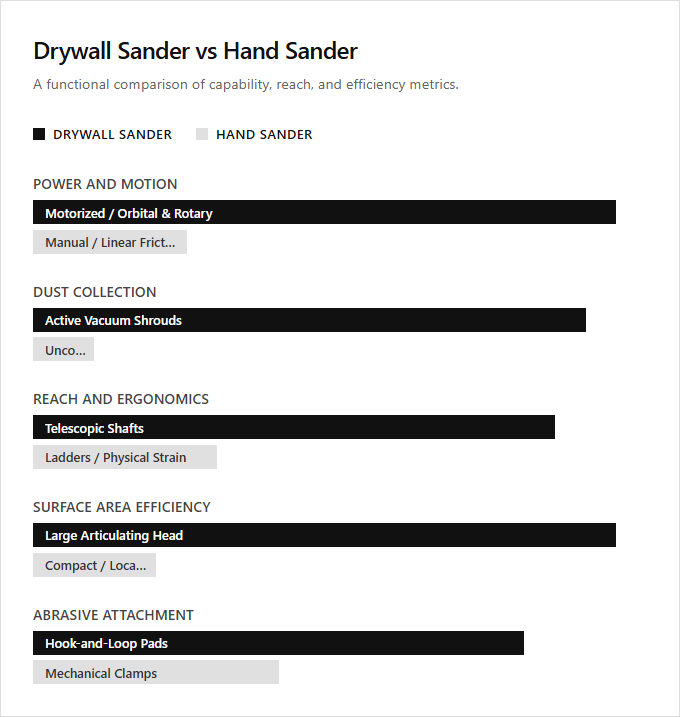
| Power and Motion | Drywall sanders utilize an electric motor to drive orbital or rotary motion for rapid material removal, whereas hand sanders rely entirely on manual physical force and linear friction. |
| Dust Collection | Drywall sanders feature integrated vacuum shrouds for active dust extraction to mitigate airborne particulates, while hand sanders lack suction mechanisms and generate uncontained debris. |
| Reach and Ergonomics | Telescopic shafts on drywall sanders allow operators to finish high ceilings without scaffolding, whereas hand sanders require ladders and induce greater physical strain. |
| Surface Area Efficiency | The large, articulating sanding head of a drywall sander maximizes surface contact for large-scale walls, whereas the compact footprint of a hand sander is suited for detailed, localized sanding. |
| Abrasive Attachment | Drywall sanders use hook-and-loop backing pads for fast disc changes, while traditional hand sanders utilize mechanical clamps to secure standard abrasive sheets. |
Integrated dust extraction ports versus manual dust exposure
Drywall sanders are engineered with integrated dust extraction ports that connect directly to workshop vacuums. This design actively captures fine gypsum particles at the source, drastically reducing airborne contamination and maintaining a clear line of sight. By keeping the workspace virtually dust-free, these power tools protect respiratory health and minimize post-project cleanup times during extensive drywall installations.
Manual hand sanders offer no active filtration, exposing operators to immediate dust clouds that require constant ventilation and heavy personal protective equipment. This manual exposure increases cleanup labor and poses greater health risks over prolonged use. While drywall sanders are indispensable for professional contractors executing large-scale renovations, hand sanders are best suited for detail-oriented DIY enthusiasts completing minor patch repairs.
Articulating sanding heads versus rigid manual block application
Power drywall sanders utilize motorized, articulating sanding heads that dynamically pivot to maintain flat contact with the surface. This flexible mechanism automatically adjusts to wall contours and angles, significantly reducing the risk of gouging joint compound while maximizing dust collection efficiency over large expanses.
Manual hand sanders rely on a rigid block application. This traditional method offers direct tactile feedback and absolute control over pressure, making it highly effective for detailed corner work and targeted touch-ups where mechanical rotation might be too aggressive.
Professional contractors tackling large-scale drywall installations benefit most from the high-efficiency articulating power sander, while DIY homeowners executing minor patching repairs find the control and simplicity of the manual hand sander ideal.
Variable speed orbital motion versus hand-powered linear strokes
Electric drywall sanders utilize variable speed orbital motion to rapidly smooth joint compounds. This motorized rotation minimizes physical fatigue while preventing deep gouges on large wall and ceiling surfaces. Adjusting the tool's operating speed allows operators to transition from heavy material removal to fine finishing seamlessly.
In contrast, manual hand sanders rely on hand-powered linear strokes. This traditional approach offers exceptional control over pressure and edge alignment, which is critical for tight corners and delicate touch-ups where power tools might easily oversand the paper backing.
Professional contractors tackling large-scale commercial renovations benefit most from the high-efficiency drywall sander, whereas DIY homeowners and detail-oriented finishers often prefer the cost-effective precision of the hand sander.
Telescopic pole reach extension versus physical scaffolding necessity
Drywall sanders equipped with telescopic poles offer a significant advantage for high-reach applications. These specialized power tools allow operators to sand ceilings and high walls directly from the floor, eliminating the setup time and safety hazards associated with physical scaffolding. This continuous reach ensures a more consistent finish across large surface areas without interrupting the workflow.
In contrast, manual hand sanders require physical scaffolding or elevated platforms to access high zones safely. While this setup demands more preparation and physical effort, hand sanders provide superior tactile feedback and precision control for detailed, close-up work. Electric drywall sanders are ideal for commercial contractors managing large-scale ceiling installations, whereas hand sanders remain the preferred choice for detail-oriented DIYers and residential spot-repair specialists.
Hook-and-loop backing pad attachment versus manual wire-clamp retention
Drywall sanders typically utilize a hook-and-loop backing pad attachment. This design allows for rapid, tool-free abrasive changes, which maximizes efficiency during large-scale ceiling and wall preparation. The secure grip ensures even pressure distribution across the wide rotating head, minimizing operational downtime.
By comparison, manual hand sanders often employ a wire-clamp retention system. This mechanical method securely locks standard sheets of sandpaper in place, offering a highly cost-effective solution. While paper changes require more manual effort, the physical clamp provides a reliable, non-slip hold that does not degrade over time.
Drywall sanders with hook-and-loop systems are ideal for professional contractors requiring speed on large surfaces, while manual wire-clamp hand sanders best serve detail-oriented DIYers and budget-conscious woodworkers.
Consistent surface plane planar flatness versus localized gouging vulnerability
Drywall sanders feature a large, pivoting head that naturally spans across joints and seams. This design ensures exceptional planar flatness by distributing pressure evenly across a wide surface area, preventing the tool from dipping into softer joint compound and creating waves.
Hand sanders rely on direct manual pressure, which increases the vulnerability to localized gouging. Because the contact area is much smaller, uneven hand force easily creates deep depressions and inconsistent textures on the drywall surface.
Professional contractors requiring flawless, high-production finishes on large walls benefit most from drywall sanders, whereas detail-oriented DIYers tackling small-scale repairs are better suited for the control of a hand sander.
Vibration dampening handles versus direct musculoskeletal joint strain
Power drywall sanders are engineered with advanced vibration dampening handles that absorb mechanical oscillations before they reach the operator's upper body. This structural mitigation minimizes long-term nerve fatigue and vascular issues, allowing for safer, extended operation on large-scale overhead surfaces without compromising physical well-being.
Conversely, traditional hand sanders lack any mechanical absorption, transferring the full force of friction and manual exertion directly to the user's wrist, elbow, and shoulder joints. This repetitive, unbuffered pressure significantly increases the risk of acute musculoskeletal strain and localized joint inflammation. Professional contractors managing extensive commercial renovations benefit most from the protective, motorized efficiency of a power drywall sander, while detail-oriented DIY enthusiasts executing sporadic, small-scale touch-ups are well-suited for the simplicity and control of a hand sander.
Leave a comment