
Selecting the incorrect adhesive compound for industrial hot melt glue gun dispensers often leads to costly joint failures, structural delamination, and severe production downtime. Engineers and procurement specialists frequently struggle to balance cure times with substrate compatibility under demanding operational conditions.
While facilities typically rely on standard procurement budgets and general-purpose capital to source everyday workshop consumables, investing in specialized adhesive dispensing systems requires a more analytical approach to material science. Making the correct choice upfront grants operators unparalleled bond longevity and shear resistance, drastically reducing long-term maintenance overhead.
However, this efficiency is subject to the stipulation that users accurately match the chemical properties of the adhesive to their specific substrate environment. For instance, heavy-duty automotive interior trim assembly requires vastly different thermal tolerances than high-volume paperboard packaging lines.
This article provides a comparative analysis of Polyurethane Reactive (PUR) and Ethylene Vinyl Acetate (EVA) compounds, examining their open times, thermal resistance, and structural properties to help you select the ideal formulation for your dispensing equipment.
| Factor | Summary |
|---|---|
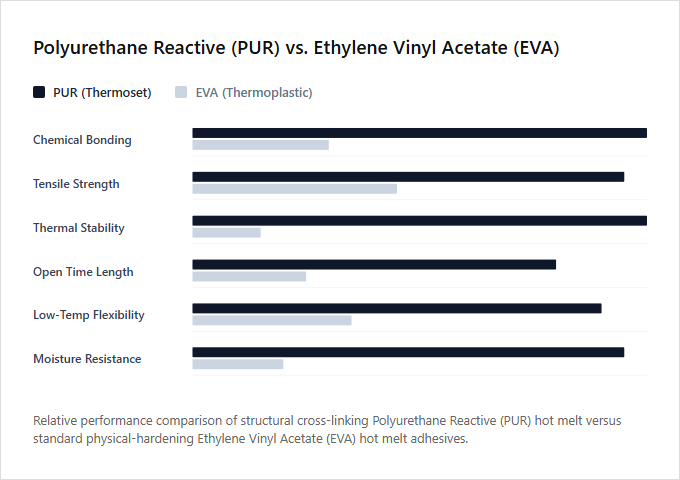
| Chemical Bonding | PUR cures via chemical cross-linking with atmospheric moisture to form a permanent thermoset bond, whereas EVA relies solely on physical solidification as a thermoplastic. |
| Tensile Strength | PUR adhesives provide exceptionally high structural tensile strength for heavy-duty load-bearing applications, whereas EVA offers moderate cohesive strength suitable for light assembly. |
| Thermal Stability | Once cured, PUR exhibits excellent heat resistance and will not remelt, while EVA is highly susceptible to thermoplastic deformation at elevated temperatures. |
| Open Time | PUR offers a significantly longer open time to facilitate the positioning of large substrates, whereas EVA features a rapid set time governed by quick thermal cooling. |
| Flexibility | PUR retains superior elastomeric flexibility in dynamic joints, whereas EVA can become increasingly brittle below its glass transition temperature. |
| Environmental Resistance | The hydrophobic polymer network of cured PUR provides superior resistance to water and solvents compared to the more vulnerable formulation of EVA. |
Irreversible Polyurethane Reactive vs. Reversible Ethylene Vinyl Acetate
In professional adhesive applications, the choice between Polyurethane Reactive (PUR) and Ethylene Vinyl Acetate (EVA) dictates bond performance. PUR adhesives undergo an irreversible moisture-curing process, reacting with atmospheric humidity to create highly stable, cross-linked polymer networks. This chemical transformation provides exceptional resistance to heat, moisture, and solvents once cured.
Ethylene Vinyl Acetate functions as a reversible thermoplastic, melting when heated and solidifying as it cools. This physical state change allows the adhesive to be reheated and adjusted, though it remains sensitive to elevated temperatures. While EVA is best suited for high-speed packaging technicians and crafters prioritizing rapid assembly and cost-efficiency, PUR is ideal for professional woodworkers and building contractors demanding permanent, high-strength bonds in extreme environments.
PUR Outperforms EVA in Post-Cure Thermal Resistance
When selecting adhesives for professional glue gun applications, understanding the thermal properties of the polymer is essential. Polyurethane Reactive (PUR) and Ethylene Vinyl Acetate (EVA) represent two distinct classes of hot melt adhesives with contrasting performance profiles. The primary differentiator lies in post-cure thermal resistance. PUR undergoes a chemical cross-linking process triggered by atmospheric moisture, resulting in an irreversible bond that withstands extreme temperatures.
EVA is a thermoplastic adhesive that remains susceptible to heat after application. It possesses a much lower softening point, meaning bond integrity degrades when exposed to elevated temperatures, whereas PUR remains stable under thermal stress once cured. Industrial manufacturers requiring permanent, heat-resistant structural bonds benefit most from PUR, while craft hobbyists and packaging operators seeking rapid, low-stress assembly are ideal users of EVA.
Comparing EVA and PUR Adhesives: Speed vs. Strength
Selecting the appropriate adhesive chemistry for professional hot glue guns is critical for optimizing production efficiency. Ethylene Vinyl Acetate (EVA) is highly valued for its rapid set time, making it the industry standard for high-speed assembly lines where instantaneous bonding is required. Conversely, Polyurethane Reactive (PUR) adhesives offer a longer open time, allowing operators a generous window to precisely align complex components before curing. Despite this extended working time, PUR provides exceptional initial green strength, ensuring structural integrity through a moisture-curing chemical bond.
These distinct performance profiles serve specific operational workflows. High-speed packaging operators benefit most from the immediate set times of EVA, whereas precision woodworkers and product assembly technicians requiring meticulous alignment and superior bond strength are ideally suited for PUR systems.
PUR Outperforms EVA on Low Surface Energy Substrates
In industrial adhesive applications, selecting the appropriate hot melt chemistry determines bond longevity. Polyurethane Reactive (PUR) adhesives undergo a secondary moisture-cure process, enabling them to achieve superior mechanical adhesion on low surface energy substrates such as plastics, metals, and non-porous composites. Ethylene Vinyl Acetate (EVA) is a thermoplastic polymer that relies solely on physical cooling, which chemically limits its bonding effectiveness to porous substrates like paper, cardboard, and wood.
While EVA offers fast set times for straightforward packaging, PUR provides unmatched resistance to heat, moisture, and mechanical stress. EVA-based systems are ideal for high-volume packaging technicians and hobbyists requiring rapid bonding of paperboard, whereas PUR systems are best suited for product designers and structural fabricators who demand high-strength, permanent joints on challenging non-porous materials.
PUR Outperforms EVA in Low-Temperature Flexibility
When selecting adhesives for specialized assembly, the thermal performance of the polymer is a critical engineering consideration. Polyurethane Reactive (PUR) adhesives offer superior mechanical resilience in cold environments compared to traditional Ethylene Vinyl Acetate (EVA) hot melts. Because PUR possesses a significantly lower glass transition temperature, it maintains elastomeric flexibility under freezing conditions, successfully avoiding the low-temperature brittleness that commonly causes EVA bonds to fracture.
While EVA remains a cost-effective, fast-setting solution for general bonding in climate-controlled environments, PUR provides a chemically cured, highly durable bond that resists moisture and extreme temperatures. Outdoor contractors and product manufacturers requiring high-strength, weatherproof bonds in harsh climates will benefit most from PUR, whereas high-volume packaging facilities and craft hobbyists will find EVA to be the ideal, user-friendly choice.
PUR vs. EVA: Sealed vs. Open Dispenser Requirements
Industrial adhesive applications frequently rely on either Polyurethane Reactive (PUR) or Ethylene Vinyl Acetate (EVA) hot melts, which differ significantly in their chemistry and dispensing requirements. PUR adhesives undergo a moisture-curing process that creates exceptionally strong polymer cross-links. To prevent premature gelation in the nozzle, PUR requires specialized, moisture-sealed dispensers that isolate the adhesive from ambient air. In contrast, EVA is a thermoplastic that melts and solidifies solely through temperature changes, allowing it to operate reliably in standard, open-reservoir applicators.
Selecting the appropriate technology depends on the specific demands of the project and the operator. PUR is highly suitable for professional furniture makers and automotive manufacturers requiring structural, weather-resistant bonds, whereas EVA is ideal for packaging technicians and high-volume product assemblers seeking rapid, low-maintenance operations.
Purging Methods for PUR vs. EVA Dispensers
In industrial adhesive applications, selecting the appropriate glue gun technology depends heavily on maintenance protocols. Polyurethane Reactive (PUR) adhesives offer superior bond strength but require highly diligent dispenser maintenance. Because PUR cures chemically through moisture exposure, operators must use specialized, non-reactive purging compounds immediately after use to prevent the adhesive from permanently curing inside the gun's chamber. In contrast, Ethylene Vinyl Acetate (EVA) adhesive systems offer a much simpler maintenance profile, as residual material can be cleared through simple thermal purging by reheating the tool.
The operational complexity of these adhesive types dictates their ideal user base. EVA-based tools are perfect for high-volume packaging operators and crafters seeking rapid, low-maintenance setups, while PUR systems are best suited for industrial manufacturers and professional woodworkers who require high-strength, moisture-resistant bonds and possess the technical discipline to manage reactive chemical purging.
Leave a comment