
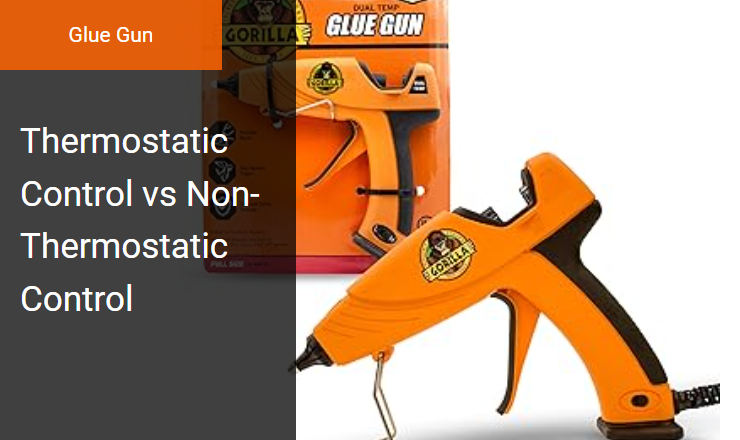
Assembly technicians and industrial manufacturers often struggle with inconsistent hot melt adhesive delivery, where fluctuating viscosity leads to adhesive charring, stringing, or weak bonds that compromise product integrity. To address this, operations traditionally rely on standard, off-the-shelf high-wattage glue guns, assuming raw power equates to thermal consistency.
However, selecting a tool with advanced thermostatic control grants operators precise temperature regulation, ensuring the adhesive remains at its optimal flow rate throughout the production cycle. Under the stipulation that hot melt chemistry behaves differently based on specific polymer formulations and ambient workshop temperatures, thermal success requires looking beyond raw wattage alone. In demanding applications like automotive trim assembly and delicate electronics packaging, this precise temperature management is critical to prevent substrate damage.
Below, we examine the technical differences between thermostatic and non-thermostatic glue guns, analyzing how active temperature regulation directly impacts adhesive viscosity, tool longevity, and overall bond integrity.
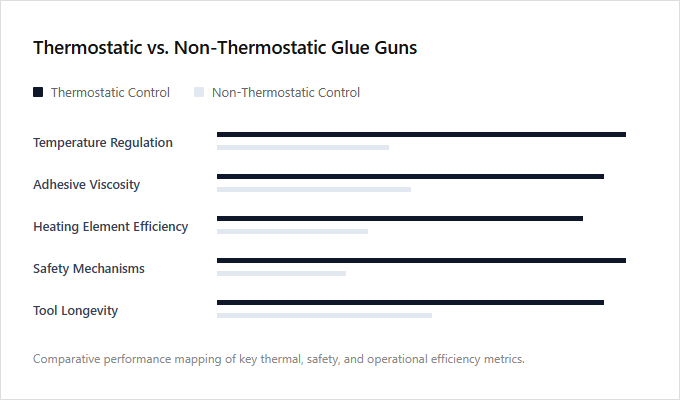
| Factor | Summary |
|---|---|
| Temperature Regulation | Thermostatic models utilize a closed-loop feedback sensor to maintain a constant operating temperature, whereas non-thermostatic models rely on continuous power draw, leading to thermal overshoot during idle periods. |
| Adhesive Viscosity | Dynamic temperature management in thermostatic glue guns ensures consistent polymer viscosity, while non-thermostatic guns can cause adhesive degradation or drooling due to uncontrolled heating. |
| Heating Element Efficiency | Thermostatic controls modulate current to the positive temperature coefficient heating element, optimizing power consumption compared to the continuous, unregulated resistance heating of non-thermostatic alternatives. |
| Safety Mechanisms | Integrated thermal fuses and automatic shut-off circuits in thermostatic units mitigate the risk of thermal runaway, which is a critical hazard in unregulated, non-thermostatic heating elements. |
| Tool Longevity | By preventing localized overheating of the nozzle and internal seals, thermostatic control reduces thermal stress and extends the mean time between failures of the tool. |
Closed-loop feedback system versus open-loop temperature drift
Thermostatic glue guns utilize a sophisticated closed-loop feedback system to maintain a constant operating temperature. An internal sensor continuously monitors the heating element, dynamically adjusting electrical power to match the thermal load. This precise regulation prevents adhesive thermal degradation and ensures a highly consistent flow rate during demanding applications.
In contrast, non-thermostatic models rely on a basic open-loop system, making them highly susceptible to temperature drift. Lacking active thermal feedback, these tools overheat during periods of inactivity and cool down rapidly under heavy application, resulting in unpredictable adhesive viscosity and weakened bond strength.
Thermostatic models are ideal for industrial assembly technicians requiring precise, high-volume bonding, whereas non-thermostatic options suit budget-conscious DIY hobbyists performing quick, occasional repairs.
Dynamic viscosity control of thermoplastic polymers
Thermostatic glue guns maintain a precise, constant temperature, which directly stabilizes the dynamic viscosity of thermoplastic polymers. By preventing thermal degradation and ensuring a consistent shear-thinning behavior, these tools allow for uniform adhesive flow and optimal substrate wetting. Non-thermostatic glue guns experience continuous temperature fluctuations based on trigger rate and idle time, causing the polymer's dynamic viscosity to fluctuate unpredictably and risking bond failure.
Selecting the appropriate heating system depends on the application requirements and operator profile. Non-thermostatic models are best suited for DIY hobbyists performing quick, non-structural tasks, whereas thermostatic models are essential for industrial assembly technicians requiring precise, repeatable polymer dispensing.
PID controller integration for minimizing thermal hysteresis
Non-thermostatic glue guns rely on continuous, unregulated heating, which results in significant thermal hysteresis and wide temperature fluctuations. Advanced thermostatic glue guns mitigate this issue by integrating Proportional-Integral-Derivative (PID) controllers. This integration allows the tool to continuously calculate thermal error values and adjust power delivery in real time, effectively minimizing hysteresis and ensuring a highly stable adhesive melt rate.
By maintaining a consistent temperature, PID-controlled systems prevent both adhesive degradation from overheating and poor bonding from premature cooling. Non-thermostatic models are best suited for casual DIY hobbyists undertaking brief, low-precision tasks, whereas PID-integrated thermostatic models are essential for industrial technicians requiring exact thermal regulation and high-strength, repeatable bonds.
Self-regulating PTC heating element limitations in non-thermostatic models
Standard non-thermostatic glue guns rely entirely on self-regulating Positive Temperature Coefficient (PTC) heating elements. While PTC technology inherently limits maximum temperature to prevent thermal runaway, it lacks the precision required for consistent thermal output. During periods of rapid application, the heat draw easily outpaces the element's recovery rate, resulting in significant temperature drops and poorly melted adhesive that compromises bond strength.
Thermostatic glue guns address this limitation by incorporating active sensors to monitor and maintain a specific temperature, ensuring a stable melt rate regardless of extrusion speed. This active feedback loop prevents both adhesive degradation from overheating and premature cooling during continuous use. Non-thermostatic models are suitable for occasional hobbyists seeking a simple, cost-effective tool for light crafts, whereas thermostatic models are designed for industrial operators and professionals requiring precise, high-volume bonding.
Prevention of thermal degradation and adhesive charring
Thermostatic glue guns utilize active temperature regulation to maintain a stable operating limit. This prevents thermal degradation and eliminates adhesive charring, which can degrade the chemical integrity of the glue and cause nozzle blockages. In contrast, non-thermostatic models heat continuously, frequently causing the adhesive to overheat, discolor, and lose its bonding efficacy during idle periods.
By preventing the polymer breakdown associated with excessive heat, thermostatic control ensures consistent viscosity and maximum joint strength. Thermostatic models are highly suitable for industrial assembly professionals requiring reliable structural bonds, whereas non-thermostatic tools are better suited for occasional crafters undertaking rapid, less critical projects.
Volumetric flow rate stability during continuous extrusion
Thermostatic glue guns maintain a consistent nozzle temperature by dynamically adjusting power, ensuring a highly stable volumetric flow rate during continuous extrusion. Non-thermostatic models rely on continuous, unregulated heating, which causes the nozzle temperature to drop during rapid dispensing. This thermal loss increases adhesive viscosity, resulting in a fluctuating flow rate and inconsistent bead deposition over extended use.
Maintaining thermal equilibrium is critical for automated systems and high-volume manual assembly where precise adhesive volume is required. Non-thermostatic units serve basic bonding needs where flow rate variations are acceptable. Professional technicians demanding exact, repeatable material deposition require thermostatic control, whereas casual DIY hobbyists performing quick, non-critical repairs are best served by non-thermostatic tools.
Heat sink effect mitigation under high melt rate demands
In high-demand adhesive applications, the "heat sink effect" poses a significant technical challenge. When cold glue sticks are rapidly fed into a heating chamber, they quickly draw thermal energy away from the nozzle. Non-thermostatic glue guns, relying solely on basic heating elements, suffer from severe temperature drops under these high extrusion loads, resulting in inconsistent adhesive viscosity and weak bonds.
Thermostatic control systems actively mitigate this thermal depletion by monitoring nozzle temperatures and dynamically boosting power to maintain a stable operating state. High-volume industrial operators require thermostatic control for precise, continuous manufacturing lines, whereas occasional DIY hobbyists are well-served by the simpler, slower recovery of non-thermostatic tools for intermittent tasks.
Leave a comment