
For manufacturing engineers and shop managers, securing high-tonnage mechanical leverage without over-allocating valuable workshop square footage remains a persistent operational struggle. While standard equipment funding sources and capital expenditure budgets can readily cover these machinery acquisitions, deploying those resources efficiently requires a precise alignment with your production workflow.
Selecting the correct equipment configuration grants your facility immediate improvements in cycle times, setup repeatability, and operator safety. However, a critical educational stipulation must be kept in mind: raw force capacity is ultimately useless if the machine's throat depth or ram stroke cannot accommodate your specific workpieces. For example, high-precision tasks like pressing interference-fit bearings or broaching keyways using industry-standard Dake or JET machinery demand distinct structural footprints.
This article compares benchtop and floor-model arbor presses, evaluating their respective tonnage capacities, footprint requirements, and ergonomic advantages to help you choose the ideal system for your facility.
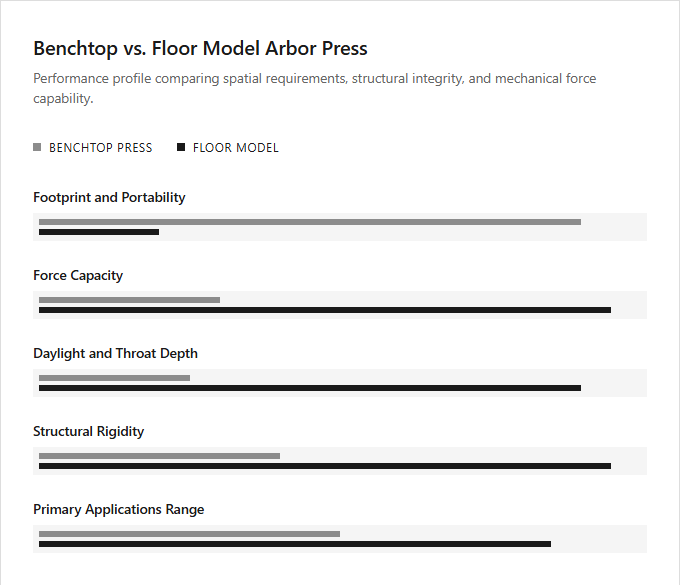
| Factor | Summary |
|---|---|
| Footprint and Portability | Benchtop models offer a compact footprint suitable for mounting on existing workstations, whereas floor models require a dedicated area of shop floor space due to their integrated, heavy-duty pedestals. |
| Force Capacity | Floor models deliver significantly higher mechanical advantage and tonnage capacity, whereas benchtop presses are limited to lighter force operations. |
| Daylight and Throat Depth | Floor-mounted units provide much greater vertical daylight and throat depth for inserting large workpieces, while benchtop alternatives are constrained by a smaller working envelope. |
| Structural Rigidity | Floor models feature heavy cast-iron frames designed to minimize frame deflection under load, whereas benchtop models have lighter frames prone to flexing at high forces. |
| Primary Applications | Benchtop presses excel at precision press-fitting and broaching of small components, while floor models are engineered for heavy-duty industrial assembly and metal-forming tasks. |
Floor Models Deliver Superior Tonnage Over Benchtop Alternatives
When selecting an arbor press, the primary differentiator between benchtop and floor models lies in their force capabilities. Floor model arbor presses are engineered with heavy-duty, reinforced frames to deliver significantly higher rated tonnage capacity than benchtop alternatives. While compact benchtop units are designed for lower-force tasks, floor models leverage their robust vertical structures to safely execute high-pressure operations without structural deflection.
This variance in capacity directly influences workspace integration and application suitability. Technicians performing delicate press-fits or small-scale assemblies benefit most from the space-saving benchtop design, whereas industrial manufacturers and heavy automotive mechanics require the immense mechanical advantage and stability of a floor-standing unit.
Floor Model Frames: Superior Rigidity Prevents Deflection
When selecting an arbor press for industrial or workshop applications, the choice between benchtop and floor models hinges on space availability and force requirements. Benchtop arbor presses offer a compact footprint suitable for lighter, precision assembly tasks. In contrast, floor models are engineered to withstand significantly higher loads during heavy-duty pressing operations.
The defining advantage of floor model arbor presses lies in their robust construction. Floor model frames offer superior torsional rigidity to prevent structural deflection under maximum tonnage, ensuring precise alignment of the ram throughout the stroke. High-production fabricators requiring extreme precision under heavy loads benefit most from floor models, whereas mobile technicians and hobbyists find the space-saving utility of benchtop presses ideal for lighter, intermittent tasks.
Maximizing Leverage in High-Tonnage Floor Presses
Arbor presses are essential tools for pressing, bending, and riveting, categorized primarily into benchtop and floor models. Benchtop presses offer a compact footprint suitable for lighter, precision assembly work in limited workspaces. In contrast, floor models are engineered for heavy-duty industrial applications. High-tonnage floor presses utilize compound leverage gear trains to maximize mechanical advantage, allowing operators to exert immense force with minimal manual effort.
These robust floor units feature reinforced frames to withstand extreme physical stress during repetitive, high-force operations. Compact benchtop models are best suited for electronics technicians and hobbyists performing delicate component assembly, while heavy-duty floor models are ideal for industrial machinists and automotive technicians requiring maximum force for heavy fabrication.
Floor Models: Expanded Capacity for Oversized Workpieces
When selecting an arbor press for industrial or workshop applications, the choice between benchtop and floor models depends primarily on spatial capacity. Benchtop arbor presses offer a compact footprint suitable for standard, smaller-scale assembly and pressing tasks. In contrast, floor model arbor presses are engineered with significantly greater daylight opening and throat depth dimensions, allowing operators to position and manipulate oversized workpieces that exceed the physical limits of bench-mounted alternatives.
The structural rigidity of floor units also supports higher tonnage capacities for demanding heavy-duty operations, whereas benchtop units remain favored for precision work where workspace conservation is a priority. Compact benchtop models suit hobbyists and electronics technicians performing light assembly, while robust floor models are ideal for industrial fabricators and automotive machinists handling large-scale mechanical components.
Why Heavy-Duty Floor Presses Use Larger Rams
Benchtop arbor presses provide a space-saving and cost-effective solution for light-to-medium assembly and repair tasks. In contrast, floor-standing units are engineered for high-capacity industrial environments that require significant vertical clearance and force. Heavy-duty floor presses incorporate larger ram diameters to resist bending under off-center loading, maintaining precise alignment and structural integrity during demanding pressing or broaching operations.
Compact benchtop models are ideally suited for hobbyists and electronics technicians performing delicate, low-tonnage assemblies, whereas robust floor models are the preferred choice for industrial machinists and automotive mechanics who regularly execute high-force fabrication tasks.
Floor Models Use Adjustable Bolster Plates
Arbor presses are essential tools for pressing, bending, and riveting operations, with benchtop and floor models serving distinct workshop scales. Benchtop units are compact and utilize simple, flat slotted anvil plates that support light, small-scale workpiece positioning directly on a standard workbench.
Floor-standing models offer superior versatility by employing heavy-duty, adjustable bolster plates rather than simple slotted plates. These bolster plates can be raised or lowered along the vertical frame to accommodate much larger workpieces, providing stable support for high-force applications.
Benchtop presses are ideal for precision instrument makers and electronics technicians, while floor models are best suited for industrial machinists and heavy automotive rebuilders.
Floor Press Space and Anchoring Requirements
When selecting an arbor press, the choice between benchtop and floor models depends largely on force requirements and workspace constraints. Benchtop units offer compact versatility, easily mounting to existing workbenches for light to medium-duty pressing tasks. In contrast, floor models are engineered for heavy-duty industrial applications requiring maximum leverage and tonnage.
Because of the immense forces involved, floor presses require a dedicated footprint in the workshop. To ensure operator safety and structural integrity, these units must be anchored directly to the concrete floor, stabilizing them against high rotational torque during operation. Benchtop models are ideal for hobbyists and light assembly technicians, while floor presses are best suited for industrial manufacturers and heavy machinery mechanics.
Leave a comment