
For manufacturing engineers and workshop managers, battling micro-deflections during high-tolerance press-fitting is a constant, costly struggle that frequently results in misaligned bearings and scrapped workpieces. When seeking to resolve these precision bottlenecks, procurement teams typically look to standard capital equipment budgets or traditional machinery financing to upgrade their pressing stations.
However, selecting the proper frame metallurgy grants operators an inherent deflection resistance and geometric stability that no amount of manual calibration can replicate. This holds true under the strict stipulation that even a microscopic frame flex under a 3-ton load will compromise critical interference fits. High-precision aerospace assembly lines, for instance, rely on these exact structural dynamics to maintain zero-defect production runs.
To guide your next shop floor upgrade, this article will compare cast iron and steel plate arbor presses, analyzing their structural behavior under high-pressure loads and identifying which material offers the ultimate rigidity for your precision-fitting operations.
| Factor | Summary |
|---|---|
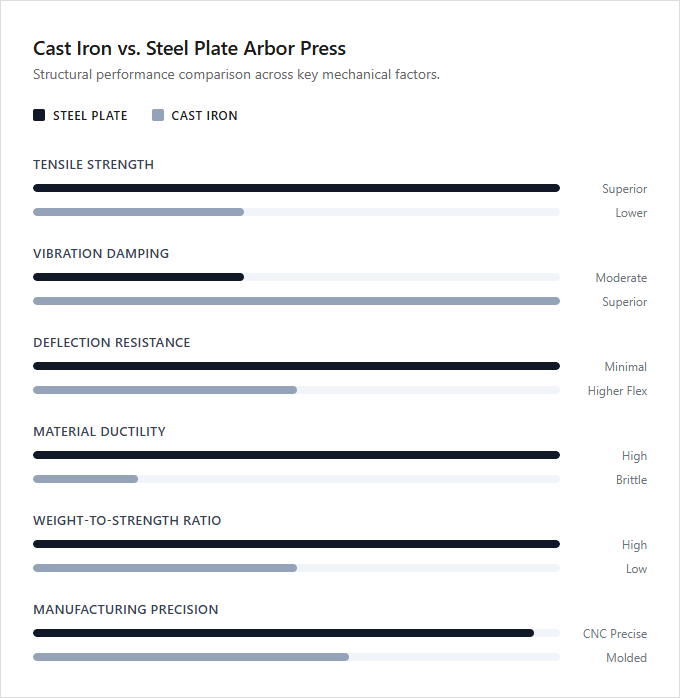
| Tensile Strength | Steel plate arbor presses offer superior tensile strength and yield strength compared to cast iron, preventing structural failure under maximum load capacity. |
| Vibration Damping | Cast iron frames inherently provide superior vibration damping capacity due to their graphite flake microstructure, which absorbs kinetic energy better than steel. |
| Deflection and Flex | Steel plate construction exhibits minimal angular deflection under high-tonnage force, ensuring precise ram alignment compared to the more flexible gray iron castings. |
| Material Ductility | Welded steel plates possess high ductility and fatigue resistance, making them less susceptible to sudden catastrophic fracturing under sudden shock loads than brittle cast iron. |
| Weight-to-Strength Ratio | Steel plate designs achieve a much higher strength-to-weight ratio, allowing for a lighter overall machine footprint without sacrificing rated tonnage capacity. |
| Manufacturing Tolerance | Steel plate presses allow for precise CNC flame cutting and machining, whereas cast iron requires complex foundry molding and extensive post-cast milling to achieve dimensional tolerance. |
Young's Modulus and Frame Deflection Resistance
When selecting an arbor press, frame rigidity under peak tonnage is dictated by the material's Young's modulus of elasticity. Structural steel plate features a Young's modulus of approximately 200 GPa, which is significantly higher than that of cast iron, typically ranging between 100 and 130 GPa. This difference means steel plate arbor presses resist frame deflection far more effectively under high loads, maintaining precise perpendicular alignment during pressing operations.
While cast iron frames offer superior vibration damping, they experience greater elastic deformation under maximum force. High-volume industrial manufacturers requiring absolute precision and minimal deflection under heavy loads benefit most from steel plate models, whereas maintenance technicians and hobbyists performing lighter, intermittent assembly tasks will find the damping properties and cost-efficiency of cast iron ideal.
Material damping capacity of gray cast iron versus steel plate
In the selection of arbor presses, the frame material significantly influences operational stability. Gray cast iron features a graphite flake microstructure that provides exceptional material damping capacity. This internal structure absorbs mechanical vibrations and disperses kinetic energy far more effectively than steel plate, reducing tool chatter during high-pressure applications.
Welded steel plate presses offer superior tensile strength and resistance to structural flexing under extreme loads. Steel lacks the natural dampening qualities of cast iron, leading to increased vibration transmission during operation. Heavy-duty industrial operators requiring maximum structural elasticity under high pressure benefit from steel plate presses, while precision craftsmen and machinists seeking chatter-free, high-accuracy assembly work are better suited for cast iron models.
Tensile yield strength limits under maximum tonnage loads
Cast iron arbor presses utilize ductile or grey iron, which offers excellent compressive strength but lower tensile yield strength limits under maximum tonnage loads. When subjected to extreme pressure, cast iron frames are susceptible to sudden, brittle fracturing if these tensile thresholds are exceeded. In contrast, steel plate arbor presses exhibit significantly higher tensile yield strength, allowing the fabricated frame to withstand intense pulling and bending forces without catastrophic failure.
Steel plates accommodate high-tonnage loads through elastic deformation rather than immediate breakage, ensuring structural integrity under peak stress. Traditional cast iron presses are suitable for hobbyists and light-duty workshops performing low-impact assembly, whereas high-tensile steel plate models are designed for industrial manufacturers requiring maximum durability under extreme force.
Dimensional stability of cast iron for maintaining ram perpendicularity
When selecting an arbor press, the choice between cast iron and steel plate construction significantly impacts operational accuracy. Cast iron frames excel in dimensional stability because the material naturally dampens vibrations and resists warping under pressure. This structural integrity is critical for maintaining precise ram perpendicularity, ensuring that force is applied along a perfectly vertical axis without angular deflection during high-pressure cycles.
Steel plate models offer higher tensile strength and resistance to sudden shock loads, though they can experience minor flexing under maximum force if not heavily reinforced. Cast iron presses are ideal for precision machinists performing delicate assembly work, whereas steel plate presses are better suited for heavy-duty fabrication environments requiring rugged durability.
Fatigue limit of fabricated steel plates under high-cycle operations
When selecting an arbor press, the material composition of the frame dictates its longevity under continuous stress. Fabricated steel plate arbor presses offer a distinct advantage over traditional cast iron in high-cycle operations due to their superior fatigue limit. While cast iron is prone to progressive micro-cracking under repetitive loads, structural steel plates possess a well-defined endurance limit, allowing them to withstand millions of cycles without structural failure when operated below this stress threshold.
Heavy-duty industrial manufacturers requiring maximum durability for high-frequency assembly lines are best suited for steel plate presses, while maintenance technicians and hobbyists performing occasional, low-cycle tasks will find the vibration-dampening properties of cast iron presses highly sufficient.
Structurally Homogeneous, Porosity-Free Steel Plates
When selecting an arbor press, the choice of construction material significantly impacts tool longevity and performance. Traditional cast iron presses are popular for general tasks but can suffer from internal casting porosity-microscopic voids formed during the cooling process that can weaken the frame under high stress.
Steel plate arbor presses offer superior structural homogeneity. Because these plates are rolled and milled rather than cast, they lack the unpredictable air pockets associated with cast iron. This uniform grain structure ensures reliable tensile strength and consistent resistance to deflection under heavy, repetitive loads.
Cast iron presses are ideal for hobbyists performing light-duty assembly, while steel plate models are suited for industrial machinists requiring maximum precision and high-tonnage reliability.
Torsional rigidity and shear modulus under eccentric or off-center loading
Cast iron arbor presses offer high compressive strength and excellent vibration damping, but their lower shear modulus makes them susceptible to deflection under eccentric loading. When forces are applied off-center, the limited torsional rigidity of cast iron can result in structural twisting. Steel plate arbor presses possess a significantly higher shear modulus, providing superior torsional rigidity. This structural integrity allows steel frames to withstand intense asymmetrical forces without bending, maintaining precise alignment under demanding, off-center pressures.
Cast iron presses are suitable for hobbyists and light repair shops performing standardized, centered operations, while steel plate models are optimal for industrial fabricators requiring extreme precision under variable, high-torque loading conditions.
Leave a comment