
Achieving consistent, high-tonnage force without compromising workpiece integrity remains a persistent challenge for workshop managers and fabrication specialists. When seeking to upgrade fabrication capabilities, teams typically look to standard equipment loans or capital expenditure budgets to fund these vital acquisitions.
Investing in the correct machinery grants operators ultimate control over pressure application, significantly reducing costly material deformation. However, a key stipulation remains: raw tonnage is useless without the appropriate delivery mechanism, as uncalibrated force can ruin expensive tooling. For instance, while a heavy-duty Dake Manual Arbor Press excels in precise, low-tonnage seating, high-force demands inevitably require hydraulic assistance.
This article compares manual and hydraulic arbor presses, examining their mechanical advantages, operational limits, and cost efficiencies to guide your next high-tonnage tooling investment.
| Factor | Summary |
|---|---|
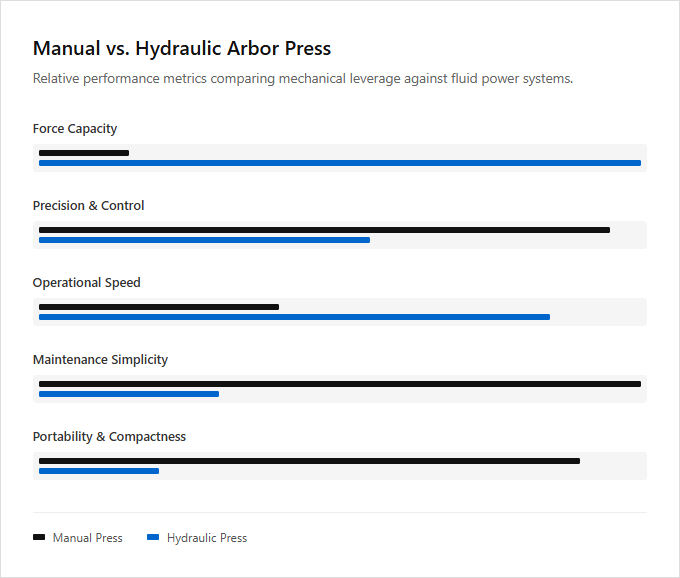
| Power Source | Manual arbor presses rely on mechanical leverage applied via a hand-operated lever, whereas hydraulic arbor presses utilize pressurized hydraulic fluid and a piston-cylinder assembly to generate force. |
| Force Capacity | Manual presses are limited to lower tonnage capacities, while hydraulic models can exert immense force exceeding fifty tons for heavy-duty industrial applications. |
| Precision and Control | Manual presses offer superior tactile feedback and fine stroke control, whereas hydraulic presses rely on pressure relief valves and analog pressure gauges to regulate force. |
| Operational Speed | Manual operation allows for rapid individual strokes but causes operator fatigue, while hydraulic systems maintain a consistent duty cycle with minimal physical exertion. |
| Maintenance and Complexity | Manual presses feature a simple pinion-and-rack mechanical design requiring minimal maintenance, while hydraulic presses involve complex components like seals and fluid reservoirs that require periodic inspection. |
| Footprint and Portability | Manual presses have a compact, bench-top footprint ideal for small workshops, whereas hydraulic presses are typically larger, heavier floor-standing units due to their integrated hydraulic power units. |
Hydraulic vs. Manual Presses: Fluid Power vs. Mechanical Advantage
Selecting the appropriate arbor press requires understanding the fundamental differences in power delivery. Manual arbor presses rely strictly on mechanical advantage, employing a lever, rack, and pinion mechanism to amplify manual input. This mechanical design provides operators with direct tactile feedback, making it highly effective for delicate components, light assembly, and precision riveting.
Hydraulic arbor presses utilize fluid power to achieve high-tonnage force. By compressing hydraulic fluid through a cylinder, these machines generate immense, consistent pressure without physical strain. This capability allows for the efficient execution of demanding tasks such as heavy-duty metal forming and bearing installation.
Manual presses are suitable for technicians and hobbyists engaged in low-force, intricate assembly work, whereas hydraulic systems are designed for industrial operators requiring high-capacity force for heavy fabrication.
Manual vs. Hydraulic Press Capacities
Arbor presses are essential mechanical tools used for pressing, bending, and installing components. Manual arbor presses rely on manual leverage, but their operation is strictly limited by the shear strength of the rack and pinion system. Applying excessive force to a manual model risks gear failure, making these tools best suited for low-force applications.
Hydraulic arbor presses utilize fluid pressure to deliver massive force. This design allows them to easily sustain rated tonnage capacities exceeding 50 tons, offering consistent pressure throughout the entire stroke without the risk of mechanical gear breakage.
Manual presses are ideal for technicians performing light, precise assemblies, while hydraulic presses are suitable for industrial fabricators requiring high-force metalworking capabilities.
Force Feedback: Manual vs. Hydraulic Presses
Arbor presses are essential workshop tools, available in both manual and hydraulic configurations. Manual arbor presses rely on mechanical leverage, providing operators with direct tactile feedback. This physical connection allows the user to feel the resistance of the material during the pressing operation, making it easy to adjust force instantly by hand.
Hydraulic arbor presses utilize fluid power to generate significantly higher forces. Because they lack physical tactile feedback, operators must rely on integrated pressure gauges and flow control valves to monitor and regulate the applied force accurately. This reliance on instrumentation ensures precision and repeatability during heavy-duty applications.
Manual presses are ideal for artisans and jewelers requiring delicate, sensory-driven control, while hydraulic models are best suited for industrial technicians executing high-capacity fabrication tasks.
Hydraulic vs. Manual: The Constant Force Advantage
When selecting an arbor press, the mechanism of force delivery is a critical differentiator. Hydraulic arbor presses utilize fluid power to maintain constant ram speed and consistent force throughout the entire stroke. This uniform pressure ensures high precision and prevents sudden drops in force during critical insertion or forming operations.
In contrast, manual arbor presses rely on mechanical leverage, where the applied force fluctuates depending on the handle angle and the operator's physical effort. This variance requires greater manual skill to control quality and can lead to fatigue during high-volume production. Manual presses are ideal for operators performing light-duty, low-volume tasks requiring tactile feedback, while hydraulic models are best suited for industrial professionals executing high-force, repetitive assembly processes.
Overload Protection: Hydraulic vs. Manual Presses
When selecting between manual and hydraulic arbor presses, force regulation represents a critical engineering distinction. High-tonnage hydraulic presses incorporate integrated pressure relief valves that automatically prevent overloading by diverting hydraulic fluid once maximum capacity is reached. This built-in safeguard protects both the machinery and the workpiece from structural damage during high-force operations.
Conversely, manual arbor presses rely entirely on mechanical leverage and lack any automated over-pressure protection, requiring operators to depend on physical feedback to avoid exceeding structural limits. Manual presses are ideal for hobbyists and low-volume technicians who require precise tactile control, while hydraulic presses are best suited for industrial operators managing heavy-duty, repetitive fabrication tasks.
Manual Mechanical vs. Electro-Hydraulic Presses
Arbor presses are essential workshop tools, categorized primarily by their actuation mechanism. Manual arbor presses rely entirely on mechanical leverage, utilizing a hand-operated lever and gear system to apply force. In contrast, high-tonnage hydraulic arbor presses utilize fluid power, requiring an integrated electro-hydraulic power unit to generate and sustain the high force levels necessary for heavy-duty applications.
The choice between these systems depends on the force and precision required for the task. Manual units offer immediate tactile feedback for delicate components, while hydraulic systems provide consistent, effortless force for high-volume environments. Manual presses are ideal for hobbyists and light fabrication technicians needing precision control, whereas hydraulic presses suit industrial manufacturers executing heavy-force operations.
Manual vs. Hydraulic Unit Maintenance
When selecting between a manual arbor press and a hydraulic arbor press, maintenance requirements represent a key operational distinction. Manual arbor presses feature a straightforward mechanical design, relying on physical leverage and simple gear lubrication to ensure smooth rack-and-pinion movement. This minimal upkeep ensures high reliability and low operating costs over the machine's lifespan.
Hydraulic arbor presses deliver significantly higher force but require a more rigorous maintenance schedule. Operators must regularly monitor hydraulic fluid viscosity and inspect the system's seal integrity to prevent leaks and pressure loss. Manual units are ideal for hobbyists and light assembly technicians requiring precision control, while hydraulic models are best suited for industrial fabricators performing heavy-duty pressing operations.
Leave a comment