
Achieving perfectly flush, gap-free biscuit joints is a persistent challenge, often frustrated by joint misalignment or fiber tear-out during the plunge. While woodworkers frequently attempt to resolve these issues by adjusting fence calibrations or switching adhesives, the true root of joint integrity lies deeper in the tool's anatomy.
Selecting the correct cutter blade grants your plate joiner the capacity for splinter-free slots and maximum glue surface contact. However, achieving this level of precision stipulates a clear understanding of how tooth configuration interacts with material density and feed speed. For example, plunging into stubborn hard maple requires a different cutting dynamic than pocketing stable Baltic birch.
This guide compares the operational dynamics of six-tooth and twelve-tooth blades, establishing a clear framework to help you select the ideal cutter for your next project.
| Factor | Summary |
|---|---|
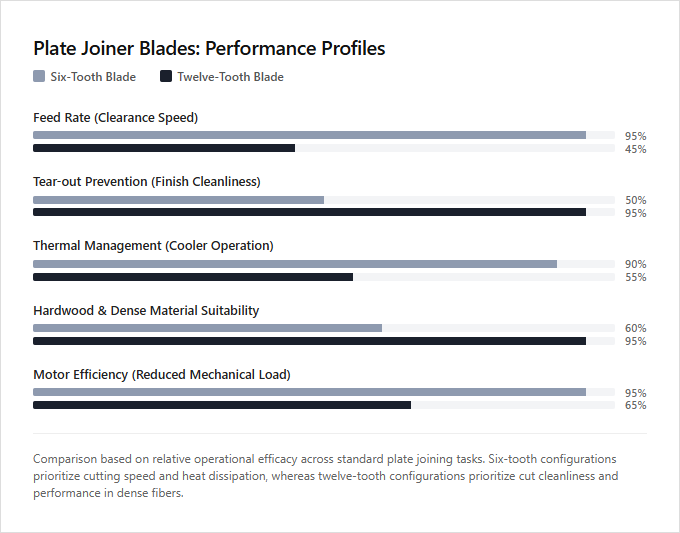
| Feed Rate | The six-tooth blade permits a much faster feed rate because its larger gullets allow for rapid chip clearance during the plunge cut. |
| Tear-out Prevention | The twelve-tooth blade produces a significantly cleaner kerf with minimal tear-out due to its higher frequency of tooth contact per revolution. |
| Thermal Management | Six-tooth blades experience less friction and heat buildup, reducing the risk of thermal degradation to the carbide tips. |
| Material Compatibility | While the six-tooth blade is ideal for softwoods and MDF, the twelve-tooth blade excels at cleanly cutting dense hardwoods without splintering the wood grain. |
| Motor Load | Using a twelve-tooth blade increases the mechanical resistance, requiring higher rotational torque from the plate joiner's motor. |
12-Tooth Blades for Cleaner Plywood Veneer Cuts
Selecting the right blade for a plate joiner significantly impacts the quality and precision of the joint. While standard six-tooth blades are common for general woodworking, twelve-tooth blades offer distinct advantages for specialized tasks. The additional teeth distribute the cutting workload, which results in a much smoother plunge action during operation.
Specifically, twelve-tooth blades yield cleaner cuts with minimal tear-out in delicate plywood veneers and pre-finished materials. The higher tooth count ensures smaller, more frequent bites, preventing the fragile face fibers of the wood from fracturing and splintering along the edges of the slot.
The six-tooth blade is ideal for production-focused carpenters prioritizing speed in solid lumber, whereas the twelve-tooth blade is best suited for cabinetmakers and detail-oriented woodworkers crafting high-end veneer furniture.
Six-Tooth Blades: Larger Chip Load, Faster Feed
When selecting a blade for a plate joiner, the tooth count significantly impacts cutting dynamics and efficiency. A six-tooth blade features larger gullets between the teeth, allowing it to accommodate a much larger chip load. This design enables woodworkers to maintain a significantly faster feed rate without overloading the motor or burning the workpiece, making it highly efficient for rapid material removal.
A twelve-tooth blade distributes the cutting force across more points of contact, resulting in smaller individual chips and a smoother, cleaner finish. This configuration requires a slower feed rate to prevent heat buildup, but it minimizes tear-out in delicate materials like veneered plywood. High-production fabricators prioritizing speed favor the six-tooth option, while detail-oriented artisans requiring flawless joint alignment choose the twelve-tooth blade.
Six-Tooth Blades Optimize Plunge Cut Waste Clearing
When selecting a blade for a plate joiner, the tooth count significantly influences cutting efficiency and material clearance. A six-tooth blade features larger gullets between the teeth, providing superior capacity for clearing waste during rapid plunge cuts. This design prevents wood chips from binding in the cut, allowing the tool to maintain optimal speed and reduce heat buildup in dense hardwoods or plywood.
Twelve-tooth blades distribute the cutting load across more points of contact, yielding a smoother, cleaner edge with minimal tear-out. While they clear waste less efficiently in deep plunges, they excel in delicate materials where surface quality is paramount. High-production woodworkers prioritizing speed and efficient chip clearance benefit most from six-tooth blades, whereas precision cabinetmakers requiring flawless, splinter-free joints prefer the twelve-tooth variety.
12-Tooth Design Ensures Consistent Kerf Width
When selecting a blade for a plate joiner, the tooth count significantly influences both cut quality and tool control. While a standard six-tooth blade offers rapid material removal, it is more susceptible to minor deviations during operation. In contrast, twelve-tooth designs excel at reducing blade deflection. By distributing the cutting forces across more contact points, the twelve-tooth blade maintains a highly consistent kerf width, ensuring that biscuit slots are precisely aligned and snug.
Choosing the right configuration depends on the specific demands of your woodworking projects. The six-tooth blade is ideal for high-volume production workers prioritizing speed in rough cabinetry, whereas the twelve-tooth blade is best suited for precision furniture makers and detail-oriented artisans who require flawless joint alignment.
Six-Tooth Blades Lower Plate Joiner Motor Torque
When selecting a blade for a plate joiner, the tooth count significantly impacts tool performance and motor longevity. A six-tooth blade features larger gullets and fewer cutting points, which lowers the required rotational torque on the plate joiner motor. This reduction in resistance allows the machine to maintain optimal operating speeds with minimal strain, preventing overheating during prolonged use.
A twelve-tooth blade distributes the cutting load across more contact points, producing a smoother finish but requiring more power. Professional cabinetmakers requiring pristine, splinter-free joints in delicate hardwoods typically benefit from the precision of a twelve-tooth blade, while high-volume production woodworkers prioritizing speed and tool endurance find the six-tooth blade ideal for rapid framing.
Why 12-Tooth Blades Overheat in Hardwood
When selecting a plate joiner blade, tooth count significantly influences thermal dynamics and cut quality. A six-tooth blade features large gullets that facilitate rapid chip clearance and cooler operation. A twelve-tooth blade delivers a cleaner cut but suffers from increased friction. This dense tooth configuration generates substantial thermal buildup when plunging into dense hardwoods, which can scorch the workpiece and dull the carbide tips.
Managing this heat is vital for tool longevity. While the six-tooth blade offers fast, cool cuts in general construction, the twelve-tooth blade excels in precise cabinet-making applications. Busy construction contractors typically prefer the rapid clearance of the six-tooth model, while meticulous furniture makers requiring ultra-smooth joints in softer or composite materials are better suited for the twelve-tooth option.
Optimized Hook Angles for Plunge Cutting
Plate joiner performance relies heavily on blade selection, specifically between six-tooth and twelve-tooth configurations. Both blade types utilize specific hook angles optimized for plunge-cutting geometry, ensuring stable entry into the workpiece and minimizing kickback during the plunging motion. This specialized hook design facilitates efficient chip clearance while maintaining precise alignment within the cut.
The six-tooth blade features larger gullets, making it ideal for rapid material removal in softer woods and composite materials. Conversely, the twelve-tooth blade provides a higher density of cutting edges, yielding exceptionally clean, tear-out-free cuts in hardwoods and delicate veneers. Production-oriented woodworkers prioritizing speed and tool longevity typically favor the high-clearance six-tooth design, whereas precision cabinetmakers and detailed artisans benefit most from the refined finish of the twelve-tooth alternative.
Leave a comment