
Selecting the right pneumatic stapler often leaves professionals wrestling with a critical trade-off: tool longevity versus material protection. Oil-lubricated models risk staining delicate workpieces, while oil-free alternatives can demand more frequent component replacements. For contractors utilizing standard funding sources-such as capital equipment loans or commercial fleet budgets-making the wrong decision directly impacts project margins.
Fortunately, aligning your choice with your specific application grants your team unparalleled operational efficiency, with the stipulation that strict operational guidelines must be met. For instance, utilizing 18-gauge finish staplers on high-end cabinetry serves as a proven example of how selecting oil-free technology eliminates the risk of oil-spoilage on expensive timber.
In this guide, we will analyze the functional differences between oil-free and oil-lubricated systems, evaluating their lifespan, maintenance demands, and ideal applications to help you optimize your tool fleet.
| Factor | Summary |
|---|---|
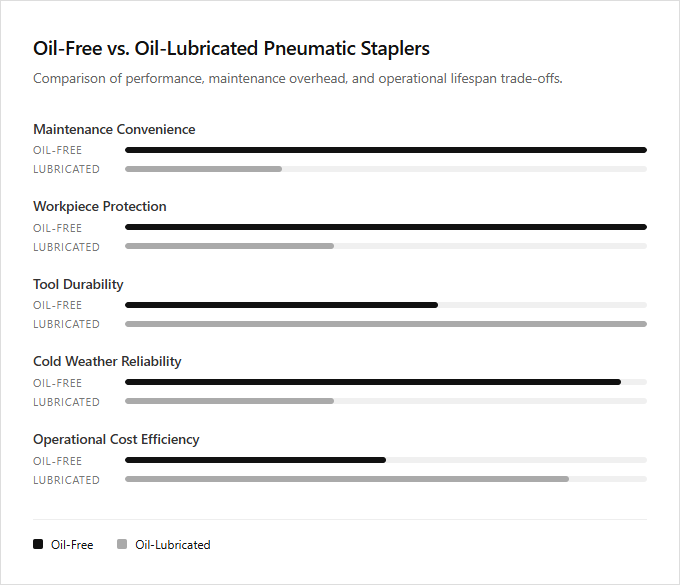
| Maintenance requirements | Oil-lubricated staplers require manual addition of specialized pneumatic lubricant, whereas oil-free models utilize maintenance-free self-lubricating seals. |
| Workpiece contamination | Oil-free staplers eliminate the risk of oil-spit, protecting delicate wood surfaces from exhaust aerosol contamination. |
| Tool durability | Oil-lubricated staplers typically offer a longer service life because constant lubrication minimizes frictional wear on the piston O-ring. |
| Cold weather operation | Oil-free models perform more reliably in freezing temperatures because they do not suffer from lubricant viscosity degradation which causes sluggish valve cycling. |
| Operational cost | While oil-lubricated units require ongoing purchases of pneumatic oil, oil-free units may incur higher long-term costs due to the non-replaceable nature of their internal cylinder coatings. |
Maintenance-free operation utilizing self-lubricating Teflon-coated piston seals
Pneumatic staplers are divided into oil-lubricated and oil-free models, each offering distinct operational advantages. Oil-free pneumatic staplers utilize advanced self-lubricating Teflon-coated piston seals to achieve maintenance-free operation. This engineering design eliminates the risk of oil exhausting onto delicate work surfaces, such as upholstery fabrics or unfinished wood, while significantly reducing daily upkeep requirements.
In contrast, oil-lubricated staplers require regular manual lubrication to protect internal metal components from friction, offering superior longevity under continuous, heavy-duty industrial cycles. High-volume manufacturing facility operators requiring maximum tool durability benefit most from oil-lubricated models, while mobile residential contractors and trim carpenters prioritizing clean, stain-free workspaces prefer oil-free units.
Risk of workpiece staining from oil-lubricated exhaust blowback
When selecting between oil-free and oil-lubricated pneumatic staplers, the primary operational distinction lies in maintenance and the risk of material contamination. Oil-lubricated models require regular lubrication to protect internal components, but this process introduces a risk of exhaust blowback. During rapid firing, microscopic oil droplets can escape through the tool's exhaust port, settling onto the workpiece and leaving stubborn stains that ruin fine wood finishes, leather, or delicate fabrics.
Oil-free pneumatic staplers eliminate this contamination risk by utilizing sealed bearings and advanced composite materials for self-lubrication. This design ensures that the exhaust air remains completely clean, protecting valuable upholstery and trim projects from oily residue. Oil-free models are ideal for upholstery specialists and finish carpenters working with sensitive, high-end materials, while oil-lubricated units suit high-volume industrial manufacturers who prioritize maximum tool longevity in rugged environments.
Tool longevity and wear resistance of steel cylinder sleeves
Pneumatic staplers with oil-lubricated systems typically offer superior long-term durability. These tools frequently feature robust steel cylinder sleeves that benefit from constant lubrication, which significantly reduces friction, dissipates heat, and prevents premature wear during heavy-duty applications.
In contrast, oil-free models utilize advanced synthetic seals and self-lubricating materials to eliminate daily maintenance. While this design prevents oil stains on delicate workpieces, the absence of continuous liquid lubrication can accelerate wear on internal components under prolonged, high-cycle demands. Oil-lubricated staplers are best suited for high-volume industrial operators requiring maximum tool lifespan, while oil-free models are ideal for finish carpenters and DIY enthusiasts prioritizing clean, maintenance-free operation.
Daily manual application of pneumatic tool oil for optimal lubrication
Pneumatic staplers are categorized into oil-free and oil-lubricated models, each presenting distinct maintenance profiles. Standard oil-lubricated staplers require the daily manual application of two to three drops of specialized pneumatic tool oil directly into the air inlet before operation. This essential lubrication process minimizes internal component friction, dissipates heat, and protects vital rubber O-rings from drying out and failing prematurely.
Oil-free staplers feature self-lubricating cylinders that eliminate the risk of oil exhausting onto delicate work surfaces. Delicate trim carpenters and DIY enthusiasts working on pre-finished materials thrive with maintenance-free oil-free designs, whereas heavy-duty industrial fabricators prioritizing tool longevity and continuous performance are best served by robust oil-lubricated models.
O-ring degradation rates in dry versus lubricated chambers
Pneumatic staplers rely heavily on internal seals to maintain cylinder pressure. In oil-lubricated models, a continuous film of oil coats the chamber, drastically reducing friction and heat during operation. This lubrication protects the rubber O-rings from premature wear and thermal degradation. Oil-free staplers utilize specialized composite seals and dry-glide coatings. While these materials eliminate manual oiling, the dry chambers experience higher friction during rapid firing, leading to faster O-ring degradation over extended periods.
Oil-lubricated staplers are ideal for high-volume industrial manufacturers who prioritize tool longevity and can manage daily maintenance, whereas oil-free models are best suited for finish carpenters and cleanroom operators who require zero risk of oil staining on delicate work surfaces.
Duty cycle capacity and heat dissipation under continuous operation
Oil-lubricated pneumatic staplers excel in high-demand environments due to their superior heat dissipation. The internal oil film continuously reduces friction during rapid, repetitive cycling, allowing these tools to maintain a demanding duty cycle without overheating. This constant lubrication protects internal seals from thermal degradation during prolonged, continuous operation.
In contrast, oil-free pneumatic staplers rely on specialized low-friction composite seals. While they eliminate the risk of oil stains on work surfaces, continuous high-frequency operation generates significant frictional heat that cannot dissipate as quickly, which can shorten seal life under relentless duty cycles. Oil-lubricated models are ideal for high-volume industrial manufacturers requiring non-stop production, whereas oil-free models best serve finish carpenters and upholsterers seeking maintenance-free operation and pristine, stain-free workpieces.
CFM and PSI pressure regulation sensitivity of internal valving
Pneumatic staplers rely heavily on precise pressure regulation to ensure consistent fastener drive depth. Oil-lubricated models feature robust internal valving designed to tolerate minor fluctuations in CFM and PSI, as the lubricating oil cushions the seals and maintains a reliable airtight barrier under varying pressures. Conversely, oil-free pneumatic staplers utilize highly sensitive, low-friction synthetic valves. These oil-free systems require strict pressure regulation, as they are less tolerant of pressure drops and demand a highly stable CFM delivery to prevent valve stall and premature component wear.
For optimal performance, oil-lubricated staplers are best suited for heavy-duty industrial operators who require continuous, high-volume production, while oil-free models are ideal for finish carpenters and hobbyists seeking maintenance-free operation without the risk of oil-stained workpieces.
Leave a comment