
For professional drywall contractors, the relentless cycle of driving thousands of screws daily inevitably leads to severe grip fatigue and inconsistent depth control. While relying on standard variable-speed drills or basic corded models has long been the default field workaround, these legacy tools struggle to sustain the pace of modern, high-volume production schedules.
Upgrading to a dedicated drywall screw gun grants installers a critical competitive edge, unlocking unmatched fastening speed and significant ergonomic relief. However, achieving these gains comes with a vital stipulation: the tool's actuation system must match your specific workflow, as efficiency gains depend heavily on material density and operator experience.
For example, commercial crews hanging board on heavy-gauge steel studs face different demands than residential teams working with light-gauge wood framing. Below, we compare Push-to-Start and Trigger-Activated screw guns, evaluating their ergonomics, battery conservation, and speed to help you choose the ultimate high-efficiency tool.
| Factor | Summary |
|---|---|
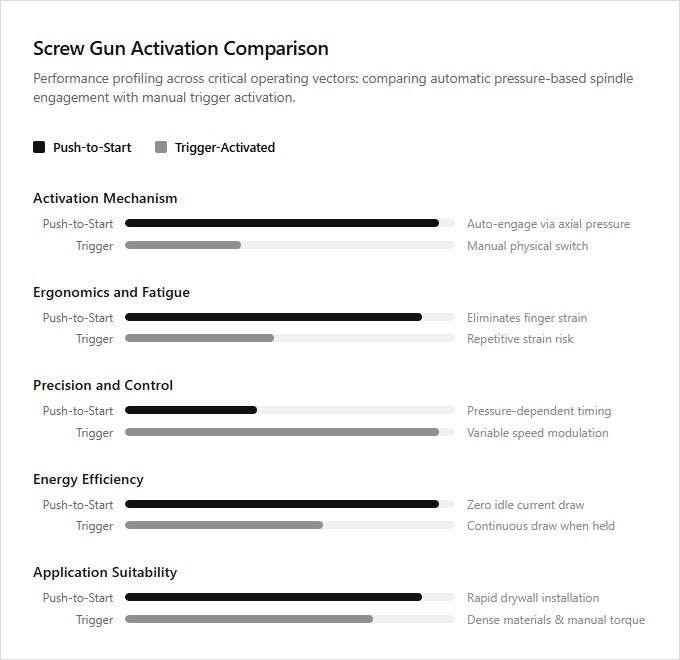
| Activation Mechanism | Push-to-start tools engage the motor automatically when axial pressure is applied to the spindle, whereas trigger-activated models require manual depression of a physical switch. |
| Ergonomics and Fatigue | Trigger-activated screw guns can cause repetitive strain injury during high-volume fastening, while push-to-start designs eliminate continuous finger strain. |
| Precision and Control | Trigger-activated units offer superior control over variable speed modulation, allowing operators to carefully align the fastener before driving it. |
| Energy Efficiency | Push-to-start mechanisms reduce idle power consumption because the electric motor only draws current when the drive bit is engaged with the workpiece. |
| Application Suitability | Push-to-start is highly efficient for rapid drywall installation, whereas trigger-activated models are preferred for dense materials requiring manual torque control. |
Pressure-sensitive clutch activation in autostart mode
When selecting a professional screw gun, the activation mechanism is a critical factor for operational efficiency. Trigger-activated models rely on manual finger pressure to engage the motor, while push-to-start (autostart) systems utilize a pressure-sensitive clutch. In autostart mode, the motor remains idle until force is applied against the work surface. This physical pressure instantly engages the clutch to drive the screw, minimizing energy consumption and reducing tool wear during high-volume installation tasks.
Conversely, trigger-activated units offer precise speed modulation through manual trigger depth. While push-to-start mechanisms excel in rapid, repetitive applications by eliminating trigger fatigue, trigger-activated models provide superior control for intricate work. Autostart units are ideal for high-volume drywall installers seeking maximum efficiency, whereas trigger-activated models are best suited for cabinetmakers and detail-oriented contractors requiring precise fastening control.
Variable speed trigger modulation versus constant maximum RPM
Trigger-activated screw guns utilize variable speed modulation, allowing operators to dynamically adjust the spindle RPM based on trigger pressure. This capability provides superior control during initial screw engagement, preventing surface damage and fastener slippage. In contrast, push-to-start mechanisms bypass trigger modulation entirely, activating the motor at a constant, pre-set maximum RPM immediately upon physical engagement with the workpiece.
By eliminating the need to depress a trigger, push-to-start models reduce operator hand fatigue during continuous, high-volume fastening applications. Trigger-activated tools are ideal for carpentry professionals who require precise control over varying materials, while push-to-start systems are best suited for high-production drywall installers and assembly-line workers prioritizing speed and repetitive consistency.
Depth-sensitive nosecone calibration for flush fastener seating
The depth-sensitive nosecone is a critical component in professional screw guns, ensuring fasteners seat perfectly flush without damaging the substrate. In trigger-activated models, the operator controls motor engagement via a physical switch, allowing manual speed regulation before the nosecone's clutch disengages at the pre-set depth. This design offers maximum control over individual fastener placement, as the tool only spins when the trigger is actively depressed.
Push-to-start screw guns bypass the manual trigger entirely, keeping the motor idle until the operator applies axial pressure. Pressing the nosecone against the work surface automatically engages the drive clutch and spins the bit, which streamlines high-volume tasks and maintains consistent depth calibration across repetitive installations. Trigger-activated units are ideal for precision carpenters requiring meticulous control over varied materials, while push-to-start models suit high-production drywall installers prioritizing speed and reduced finger fatigue.
Brushless motor efficiency and duty cycle optimization
In high-volume fastening applications, selecting between push-to-start and trigger-activated screw guns directly impacts brushless motor efficiency. Brushless motors excel by drawing power only when actively engaged, making the actuation method critical for duty cycle optimization. Push-to-start models maximize energy conservation by drawing current only when physical pressure is applied to the fastener, which minimizes idle motor wear and extends battery runtimes.
In contrast, trigger-activated screw guns offer manual control over motor startup, allowing operators to position fasteners precisely before engagement. While this manual activation can slightly lower overall duty cycle efficiency due to brief periods of idle trigger holding, advanced brushless electronics mitigate unnecessary power draw. Push-to-start tools are ideal for high-speed, repetitive assembly line operators, whereas trigger-activated models best suit construction professionals requiring precise, intermittent fastening control.
Mitigation of ergonomic strain through trigger-lock mechanisms
In high-volume fastening applications, selecting between push-to-start and trigger-activated screw guns significantly impacts operator comfort. Trigger-activated models historically required continuous finger pressure, leading to repetitive strain injuries. Modern designs mitigate this ergonomic stress by incorporating trigger-lock mechanisms, allowing continuous operation without constant manual engagement and reducing hand fatigue during prolonged tasks.
Push-to-start screw guns eliminate the trigger entirely, activating rotation only when axial pressure is applied to the fastener. This automatic mechanism minimizes hand fatigue during repetitive, downward driving tasks. While trigger-activated models with locks are ideal for maintenance technicians requiring precise control at various angles, push-to-start tools are best suited for assembly-line operators performing rapid, highly repetitive vertical fastening.
Integration compatibility with collated screw magazine attachments
Push-to-start screw guns engage the motor automatically when pressure is applied to the fastener, pairing seamlessly with collated screw magazine attachments. This integration allows for rapid, continuous driving because the tool operates without requiring manual trigger coordination to advance the collated strip. Conversely, trigger-activated screw guns require manual switch depression to power the motor. While fully compatible with collated attachments, this setup introduces a slight operational pause as the operator syncs the trigger pull with the physical placement of the magazine nosepiece.
Collated systems on push-to-start models maximize efficiency during rapid, repetitive installations. Push-to-start systems with collated attachments are ideal for high-volume drywall installers seeking maximum installation speed, while trigger-activated setups best suit general contractors who prioritize precise, intermittent fastening control.
Amp-hour battery draw comparison during idle versus active fastening
When selecting a cordless screw gun, understanding the battery efficiency of push-to-start versus trigger-activated mechanisms is essential for maximizing runtime. Trigger-activated models maintain a minor standby draw when the trigger is depressed, consuming amp-hours even during positioning. In contrast, push-to-start technology completely eliminates idle battery draw because the motor only engages and draws current when physical pressure is applied to the nosecone.
During active fastening, both systems exhibit similar amp-hour consumption because the energy required to drive the fastener remains constant. Push-to-start tools optimize overall battery life by eliminating energy loss during non-driving intervals. High-volume drywall installers benefit from the automated efficiency of push-to-start models, whereas general contractors performing varied, intermittent tasks often prefer the tactile control of trigger-activated systems.
Leave a comment