
Every tradesperson knows the frustration of a fastening bit slipping, camming out, or flying loose mid-task, stalling critical productivity. While standard three-jaw keyless chucks have long been the industry's go-to standard for general drilling applications, high-torque fastening demands a much more specialized connection. Transitioning to an impact driver's quick-release mechanism provides the bridge to superior performance, granting operators absolute rotational security and ensuring maximum power transfer without the risk of jaw slippage.
To leverage this mechanical advantage, however, there is an important technical stipulation: impact collet chucks require specialized 1/4-inch hex-shank, impact-rated bits to lock into place properly. When driving heavy fasteners, such as 3-inch structural timber screws, this exact fit is critical to preventing tool wear and bit breakage.
In this guide, we will analyze the mechanical differences between collet and keyless chucks, evaluate how each handles extreme rotational force, and help you determine the optimal retention system for your high-torque projects.
| Factor | Summary |
|---|---|
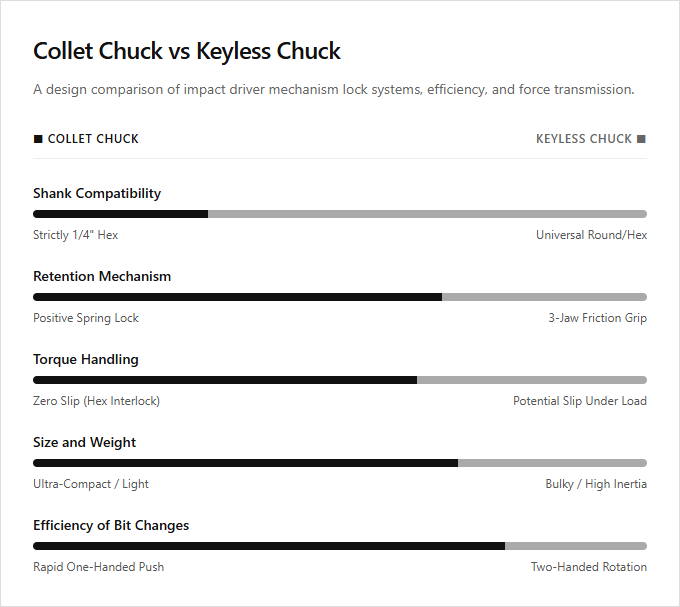
| Shank Compatibility | Collet chucks are strictly designed for standard quarter-inch hex-shank bits, whereas keyless chucks accommodate various round and polygonal accessory shanks. |
| Retention Mechanism | The collet chuck utilizes a quick-release, spring-loaded sleeve for positive mechanical locking, while the keyless chuck relies on a three-jaw friction-grip system. |
| Torque Handling | Collet chucks prevent rotational slippage during high-torque impact driving due to their interlocking hex design, whereas keyless chucks can slip under heavy torsional load. |
| Size and Weight | Integrating a collet chuck allows the impact driver to maintain an ultra-compact head length and lower rotational inertia compared to the bulkier keyless chuck assembly. |
| Efficiency of Bit Changes | The rapid-insert capability of a spring-loaded collet enables rapid one-handed bit changes, while a keyless chuck requires two hands to manually rotate and tighten the outer sleeve. |
Hexagonal shank positive engagement preventing rotational slippage
Impact drivers utilize a specialized quick-release collet chuck designed specifically for 1/4-inch hexagonal shank accessories. Unlike traditional keyless chucks that rely solely on frictional clamping force, the collet system features a positive mechanical engagement. The hexagonal flats of the shank lock directly into the matching internal geometry of the collet, preventing rotational slippage even under extreme torque loads.
Standard keyless chucks offer versatility for various round-shank drill bits but can slip when encountering high resistance. The positive engagement of the collet chuck eliminates this risk, ensuring efficient power transfer and protecting the accessory from damage.
High-volume contractors requiring rapid bit changes and slip-free heavy fastening thrive with the collet chuck, whereas general craftspeople prioritizing maximum tool compatibility for diverse drilling tasks are better suited to the keyless chuck.
Detent ball axial locking mechanism engaging the power groove
Impact drivers primarily utilize a hex collet chuck, which relies on a specialized detent ball axial locking mechanism. When a quarter-inch hex shank accessory is inserted, internal spring-loaded detent balls retract and then snap firmly into the shank's recessed power groove. This direct mechanical engagement prevents axial movement, securing the bit against the high-torque rotational concussions characteristic of impact driving.
Traditional keyless chucks use three compressing jaws to grip cylindrical or hexagonal shanks. While keyless chucks offer versatility for various bit shapes, they lack the positive mechanical interlock of the detent ball system, making them prone to slipping under intense torque. Production fabricators requiring rapid, slip-free fastening favor the collet chuck, whereas general contractors and DIY enthusiasts seeking multi-material utility benefit more from the keyless chuck.
Lower rotational inertia optimizing anvil-and-hammer kinetic energy transfer
Impact drivers rely on specialized chuck designs to manage the concussive force of the internal anvil-and-hammer mechanism. A hexagonal collet chuck features a streamlined, low-mass design compared to the bulkier, adjustable keyless chuck. This reduction in mass yields significantly lower rotational inertia, allowing the tool to optimize the transfer of kinetic energy from the hammer strike directly to the fastening bit with minimal energy dissipation.
Keyless chucks introduce greater rotational mass, which slightly dampens the impact mechanism's instantaneous power output while providing the convenience of accepting round-shank accessories. Trade professionals requiring maximum torque and rapid driving in structural timber benefit most from the high-efficiency collet chuck, while general maintenance technicians needing frequent transitions between drilling and driving tasks are better suited to a keyless chuck.
High-frequency vibration resistance preventing jaw loosening and back-off
Impact drivers generate intense rotational concussions, making chuck stability critical. Traditional keyless chucks rely on threaded jaws that can slowly back off and loosen under sustained, high-frequency vibrations. A collet chuck utilizes a spring-loaded sleeve to lock hex-shank bits directly into a fixed recess. This mechanical interface bypasses threaded friction entirely, ensuring the bit remains securely seated regardless of the vibration intensity.
Eliminating the threaded jaw design prevents the incremental slippage common during heavy-duty fastening. While keyless chucks offer versatility across various bit shapes, they remain susceptible to loosening under repeated impact. A collet chuck is ideal for professional tradespeople requiring uninterrupted, high-torque fastening, while a keyless chuck suits general DIYers who prioritize rapid, tool-free swaps of various shank shapes.
Friction-based three-jaw clamping versus mechanical interlocking geometry
Impact drivers predominantly utilize a hex collet chuck, which relies on mechanical interlocking geometry. The one-quarter-inch hexagonal shank of the bit locks directly into the matching receptacle of the collet. This design prevents slippage under high rotational torque, as the physical shapes of the driver and bit bind together mechanically rather than relying on surface pressure.
In contrast, keyless chucks utilize a friction-based three-jaw clamping mechanism. These jaws tighten around smooth, cylindrical shanks, relying solely on surface friction to hold the bit. While versatile for various shank sizes, this system can slip under the sudden, concussive blows of an impact mechanism. Professionals requiring maximum torque transfer for heavy-duty driving benefit most from the secure collet chuck, while general DIY users seeking broad accessory compatibility prefer the versatile keyless chuck.
Minimal radial runout preserving drive guide concentricity under high torque
In high-torque impact applications, the mechanism of bit retention directly dictates fastening precision. Hexagonal collet chucks establish a positive, mechanical lock with hex-shank accessories. This secure interface minimizes radial runout by preventing lateral play, preserving strict drive guide concentricity even under severe rotational shock.
Three-jaw keyless chucks rely on frictional clamping rather than a mechanical interlock. Under intense torque, this friction can yield, leading to minor bit slippage, increased axial deviation, and compromised concentricity. Specialized assembly technicians requiring maximum stability during heavy-duty fastening favor the rigid collet chuck, while general maintenance operators who frequently switch between varied round and hex shank bits are better served by the versatility of a keyless chuck.
Spring-loaded quick-release sleeve for secure bit retention under impact forces
Impact drivers typically employ a hex collet chuck rather than the keyless chuck found on standard drills. This collet chuck features a spring-loaded quick-release sleeve engineered specifically to withstand intense rotational concussive forces. While a keyless chuck relies on friction to grip round shanks and can loosen under rapid vibration, the collet system locks hex bits securely into place, preventing slippage or accidental ejection during heavy-duty fastening.
This specialized locking mechanism ensures consistent torque transfer and operational safety during high-impact tasks. Professional tradespeople requiring rapid, secure fastening on demanding jobsites benefit most from the robust collet chuck, whereas general homeowners seeking versatility across diverse drilling and driving tasks are ideal candidates for a keyless chuck.
Leave a comment