
Driving long, heavy fasteners into dense timber often results in stripped screw heads, stalled motors, and immense wrist strain. While standard drill drivers are the traditional go-to for general boring and light fastening, relying solely on their constant rotational force frequently falls short under heavy loads.
This is where the impact driver excels, granting users unparalleled rotational torque through rapid-fire concussive blows that drive screws effortlessly. However, a key stipulation remains: impact drivers are not universal solutions, as they lack the precision clutch required for delicate woodwork. Yet, when sinking heavy 3-inch lag screws into pressure-treated ledger boards, their mechanical superiority is undeniable.
Below, we analyze the key mechanical differences between impact drivers and hammer drills, comparing their internal mechanisms, torque delivery, and ideal applications to help you choose the right tool for your next heavy-duty project.
| Factor | Summary |
|---|---|
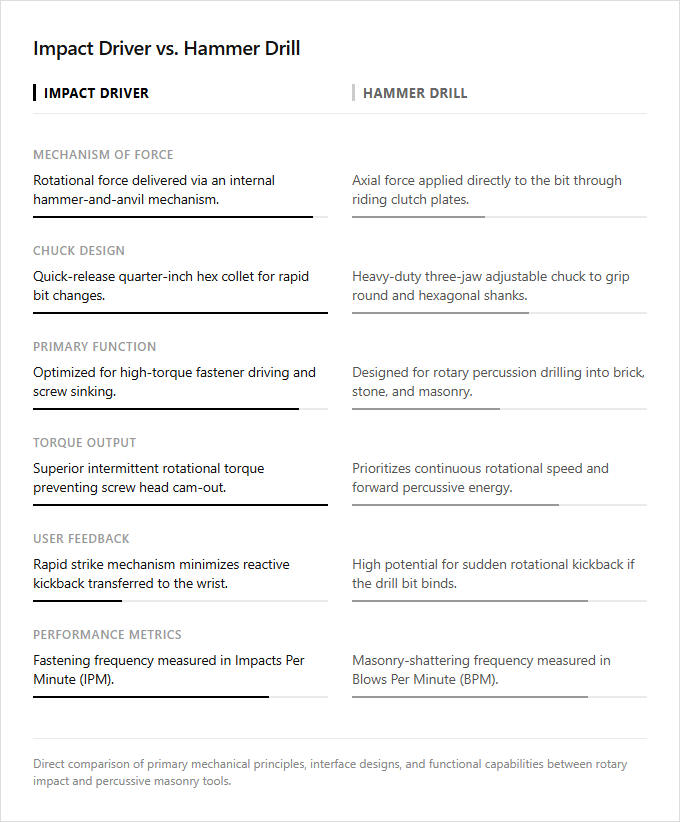
| Mechanism of Force | Impact drivers deliver rotational force using an internal hammer-and-anvil mechanism, whereas hammer drills apply axial force to the drill bit through riding clutch plates. |
| Chuck Design | An impact driver features a quick-release quarter-inch hex collet, while a hammer drill utilizes a heavy-duty three-jaw adjustable chuck to grip round shanks. |
| Primary Function | Impact drivers are optimized for high-torque fastener driving, whereas hammer drills are designed for rotary percussion drilling into masonry. |
| Torque Output | Impact drivers generate superior rotational torque that prevents screw head cam-out, whereas hammer drills prioritize rotational speed and forward percussive energy. |
| User Feedback | The rapid strike mechanism of an impact driver reduces reactive torque transmitted to the operator, whereas hammer drills can produce severe rotational kickback when a bit binds. |
| Performance Metrics | Hammer drills measure their masonry-shattering speed in blows per minute (BPM), while the fastening frequency of impact drivers is rated in impacts per minute (IPM). |
High-Torque Hammer and Anvil Fastening Mechanism
While both impact drivers and hammer drills deliver concussive force, their internal mechanisms serve distinct applications. The impact driver utilizes a specialized anvil and hammer mechanism that strikes rotationally. As driving resistance increases, this mechanism engages to deliver high rotational torque directly to the fastener, which prevents slip-out and drives heavy screws into dense materials with minimal user strain.
In contrast, a hammer drill applies its concussive force forward along the axis of the drill bit, designed to pulverize masonry, concrete, and stone. Carpenters and woodworkers requiring rapid, high-torque fastening benefit most from the impact driver, whereas masons and general contractors needing to bore holes in concrete will find the hammer drill indispensable.
Tangential force application minimizes the risk of driver bit cam-out
While both tools deliver concussive force, they apply pressure in entirely different directions. A hammer drill exerts axial thrust forward along the drill bit, which is ideal for pulverizing stone but prone to slipping during screw driving. Conversely, an impact driver utilizes an internal anvil mechanism to deliver rapid, rotational impacts. This tangential force application increases torque directly to the fastener head, which minimizes the risk of driver bit cam-out and prevents stripped screws.
This mechanical distinction dictates their primary applications on the job site. Woodworkers and deck builders will benefit most from the precision fastening of an impact driver, whereas masons and electricians requiring frequent concrete penetration are ideal candidates for a hammer drill.
Rotational Impact Replaces Hammer Drill Axial Force
While both impact drivers and hammer drills deliver concussive force to handle demanding materials, their mechanical actions are fundamentally different. An impact driver utilizes rotational impact, applying rapid bursts of torque perpendicular to the fastener to prevent slipping and drive large screws efficiently. In contrast, a hammer drill relies on axial concussive force, driving the bit forward along its axis to chip away at dense substrates.
This distinction dictates their practical applications. Cabinet makers and general contractors prioritizing high-torque fastening require the precision of an impact driver, whereas masonry professionals and those drilling into concrete and brick should select a hammer drill.
Minimal reactionary torque is transferred to the operator during fastening
The primary distinction between an impact driver and a hammer drill lies in torque delivery. An impact driver utilizes an internal rotary hammer and anvil mechanism that directs force both downward and rotationally. This specific action ensures that minimal reactionary torque is transferred to the operator during fastening, preventing the violent wrist-twisting common with traditional high-torque drills.
A hammer drill delivers rapid forward concussive blows alongside continuous rotation to bore into masonry. Because this rotational force is constant, resistance is transferred directly to the user's hands. Impact drivers are best suited for woodworkers and installers seeking effortless, fatigue-free fastening, whereas hammer drills are the ideal choice for masonry professionals needing to penetrate concrete or stone.
Quick-release hex shank collet secures specialized impact-rated driving bits
While both tools deliver force with concussive action, the impact driver and hammer drill serve distinct functions. The defining feature of the impact driver is its quick-release hex shank collet, which securely locks specialized impact-rated driving bits. This mechanism allows for rapid bit changes and prevents slippage under high-torque loads. Conversely, hammer drills utilize a traditional chuck to grip round-shank masonry bits, directing concussive energy forward to pulverize stone.
The rotational impact of the driver is engineered for heavy-duty fastening in wood and metal without stripping screws. Professionals focused on high-volume timber construction and cabinetry will gain the most efficiency from the impact driver, whereas tradespeople drilling frequently into concrete or brick require the specialized action of the hammer drill.
High IPM Speeds Fastening Through Dense Materials
While both tools deliver concussive force, they apply it differently to achieve distinct results. An impact driver utilizes a rotational blow mechanism, delivering high impacts per minute (IPM) alongside massive torque. These high IPM thresholds enable rapid fastening through dense materials, allowing long screws to sink effortlessly without stripping the fastener heads or stalling the motor.
A hammer drill applies its percussive force forward, hammering the bit directly into masonry and concrete to facilitate drilling rather than driving. Selecting the correct tool depends on the specific demands of the trade. Heavy-duty masons drilling into stone require the forward percussive force of a hammer drill, while woodworkers and deck builders benefit more from the rapid, high-torque fastening of an impact driver.
Preventing Fastener Shear via Rotational Blows
While both tools handle demanding applications, their driving mechanisms differ fundamentally. A hammer drill delivers axial concussive force to pulverize masonry, whereas an impact driver utilizes an internal hammer and anvil to apply rapid rotational blows. This perpendicular force modulation is highly efficient for driving threaded fasteners into dense materials.
By delivering torque in rapid, tangential pulses under load, the impact driver prevents fastener shear. This precise modulation of rotational force maintains driver bit engagement and prevents cam-out, protecting both the workpiece and the hardware. The mechanism delivers high torque output without transferring heavy reactionary strain to the operator.
Hammer drills are best suited for masonry specialists drilling into stone and concrete, while impact drivers are ideal for woodworkers and renovators managing high-volume fastening installations.
Leave a comment