
Selecting the wrong impact driver anvil often leads to sheared socket adapters, stripped fasteners, and costly project delays. While standard tool procurement budgets and routine equipment funding sources typically cover general-use drills, investing in specialized high-torque fastening requires a more calculated approach.
Opting for the correct drive interface grants operators maximum torque transfer and enhanced site safety, immediately reducing tool downtime. However, as a crucial stipulation, peak tool performance is only realized when the anvil size directly matches the fastener's load requirements, rather than relying on weak aftermarket adapters. For instance, high-torque applications like structural timber framing and automotive suspension assembly demand fundamentally different anvil dynamics.
This guide analyzes the mechanical differences between the 1/4-inch hex and 1/2-inch square drive. We will evaluate torque transmission capacities, socket retention mechanisms, and application-specific suitability to help you make an informed procurement decision.
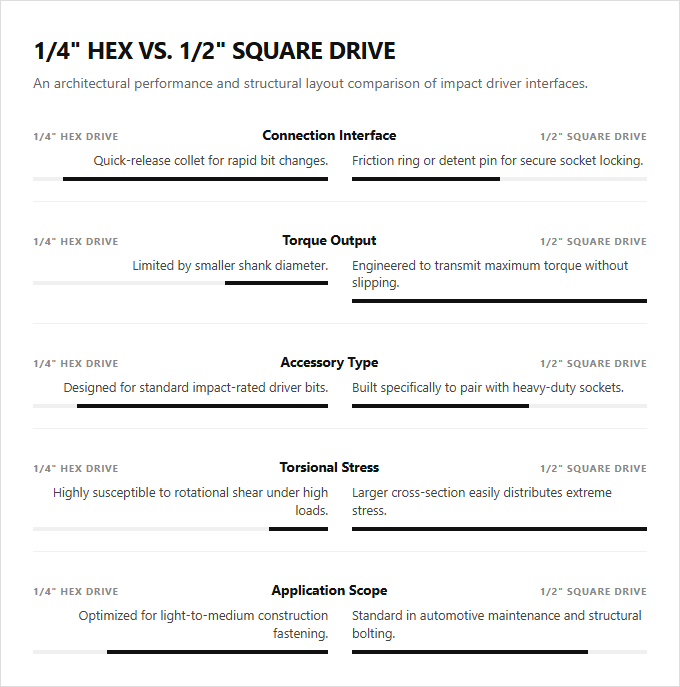
| Factor | Summary |
|---|---|
| Connection Interface | The quarter-inch hex utilizes a quick-release collet for rapid bit changes, whereas the half-inch square drive employs a friction ring or detent pin to lock impact sockets in place. |
| Torque Output | Half-inch square drives are engineered to transmit maximum fastening torque without slipping, whereas quarter-inch hex drives are limited by their smaller shank diameter. |
| Accessory Type | The quarter-inch hex is designed for standard impact-rated driver bits, while the half-inch square drive is built specifically to pair with heavy-duty sockets. |
| Torsional Stress | Quarter-inch hex shanks are highly susceptible to rotational shear under high loads, whereas the larger cross-section of the half-inch anvil easily distributes extreme stress. |
| Application Scope | Quarter-inch tools are optimized for light-to-medium construction fastening, whereas half-inch square drives are standard in automotive maintenance and structural bolting. |
Torque Limits: 1/4" Hex vs. 1/2" Square Drives
The primary differentiator between a 1/4-inch hex shank and a 1/2-inch square drive lies in their structural capacity to withstand torsional shear stress. Under high breakaway torque applications, the smaller cross-sectional area of the 1/4-inch hex shank concentrates stress at its recessed corners, limiting its safe torque threshold to approximately 200 foot-pounds before risking mechanical shear failure.
The robust geometry of a 1/2-inch square drive distributes rotational forces over a significantly larger surface area, allowing it to routinely manage breakaway torques exceeding 1,000 foot-pounds without material yield. The nimble 1/4-inch hex is ideal for technicians and woodworkers performing high-speed, precision fastening, whereas the high-capacity 1/2-inch square drive is essential for heavy-duty mechanics and industrial installers requiring maximum torque for large fasteners.
Rotational Inertia: Heavy Anvils vs. Lightweight Collets
The distinction between a quarter-inch hex quick-release collet and a half-inch square drive lies in their rotational physics. The larger, heavier anvil of a half-inch square drive possesses significantly higher rotational inertia. This mass allows the tool to store and transfer massive amounts of kinetic energy per impact, maximizing torque output. The lightweight quarter-inch hex collet minimizes rotational inertia, facilitating rapid acceleration and precise energy delivery suited for smaller fasteners where excess force could damage the workpiece.
Energy transfer efficiency also differs, as the direct socket-to-anvil interface of the square drive minimizes energy loss, whereas hex bits experience slight play within the quick-release mechanism. Heavy-duty mechanics and structural steel erectors require the high-torque output of the half-inch square drive, whereas carpenters and electricians benefit most from the rapid, adaptable fastening of the quarter-inch hex.
Preventing Deformation in 1/2-Inch Cr-Mo Impact Sockets
Impact drivers utilize distinct drive interfaces to match specific torque requirements. The compact 1/4-inch hex drive is engineered for rapid bit changes and light-to-medium fastening tasks. In contrast, the robust 1/2-inch square drive is designed for high-torque applications, requiring heavy-duty components that can withstand extreme rotational stress without structural failure.
To manage this intense energy, 1/2-inch impact-rated sockets are manufactured from high-strength chromium-molybdenum (Cr-Mo) alloy steel. This alloy offers exceptional yield strength and ductility, allowing the socket to flex slightly under load. This elasticity prevents plastic deformation and fracturing, ensuring the tool maintains its dimensional integrity during demanding fastening cycles.
The highly maneuverable 1/4-inch hex drive is ideal for finish carpenters and drywall installers prioritizing speed, whereas the powerful 1/2-inch square drive is indispensable for heavy machinery mechanics and structural steel workers requiring maximum torque.
Energy Loss and Deflection in Hex-to-Square Adapters
Selecting between a quarter-inch hex impact driver and a native half-inch square drive involves understanding energy transfer efficiency. Utilizing a hex-to-square adapter on a quarter-inch tool to spin larger sockets introduces mechanical play. This interface results in parasitic rotational energy loss, as vital impact energy is absorbed within the adapter mating points rather than transferring directly to the fastener. The extended coupling also increases mechanical deflection under load, reducing precise torque delivery and accelerating tool wear.
A native half-inch square drive eliminates these intermediate connections, ensuring direct, uncompromised torque transmission. The versatile quarter-inch hex system suits carpenters and residential electricians handling light-to-medium fastening, while the robust half-inch square drive is designed for automotive technicians and structural steel erectors requiring maximum torque for heavy-duty rigging and lug nuts.
Socket Retention: Friction Ring vs. Quick-Change Sleeve
The quarter-inch hex drive utilizes a spring-loaded, quick-change sleeve mechanism designed for rapid bit insertion and extraction. This collar-based system securely locks hex-shank bits in place, minimizing downtime during tasks that require frequent accessory changes. In contrast, the half-inch square drive relies on heavy-duty anvil retention systems, specifically friction rings or detent pins. Friction rings allow for swift socket changes, while detent pins provide a semi-permanent, highly secure lock that prevents socket detachment under intense vibration.
These mechanical differences directly dictate tool capability and torque transmission. The quick-change hex drive suits electricians and assembly technicians performing rapid, lighter-duty fastening, while the robust square drive anvil serves automotive mechanics and structural ironworkers who require maximum socket retention for heavy-duty, high-torque applications.
How Contact Surface Area Prevents Fastener Cam-Out
The primary distinction between a quarter-inch hex and a half-inch square drive lies in their interface geometry and the resulting distribution of rotational force. The quarter-inch hex drive utilizes six narrow contact points, which concentrates torque on smaller fasteners but increases the risk of driver slippage or cam-out under high resistance. Conversely, the larger surface area of the half-inch square drive distributes rotational energy more evenly across the socket walls. This expanded contact area significantly reduces stress concentration, preventing fastener cam-out and ensuring efficient energy transfer during high-torque applications.
The highly maneuverable quarter-inch hex is ideal for electricians and finish carpenters requiring rapid bit changes for precision fastening, while the high-torque half-inch square drive is suited for automotive mechanics and structural steel erectors performing heavy-duty assembly.
From Light Screws to Heavy Structural Bolting
The choice between a quarter-inch hex and a half-inch square drive impact tool depends entirely on the fastening application and required torque limits. A quarter-inch hex impact driver excels in light-to-medium-duty tasks, such as driving self-tapping sheet metal screws and wood fasteners. Its quick-release chuck is optimized for speed and accessibility, handling tasks that require precision rather than extreme rotational force.
A half-inch square drive impact wrench is engineered for heavy-duty structural bolting and high-torque demands. This drive system manages the high tension limits necessary for securing structural steel, automotive components, and heavy machinery fasteners. Trade professionals focusing on cabinetry and light framing favor the agile quarter-inch hex, whereas heavy equipment mechanics and structural steel erectors rely on the high-output half-inch square drive.
Leave a comment