
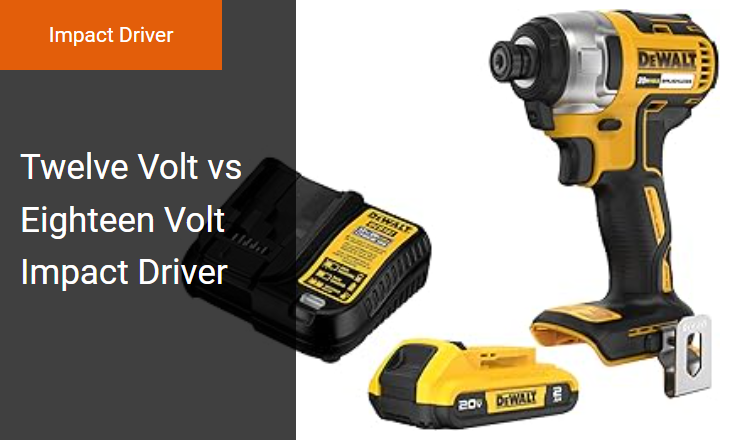
Selecting the right impact driver often presents a frustrating trade-off between physical fatigue and raw fastening power. Traditionally, tradespeople resolve this dilemma by relying on standard procurement routes-simply defaulting to their existing 18V battery platforms or purchasing tools based solely on the highest advertised torque rating on the box.
However, aligning your tool's voltage to your specific application grants you a significant operational advantage: the perfect balance of sustained rotational force and ergonomic efficiency. To manage expectations, we must stipulate that higher voltage does not universally yield superior outcomes; excessive power often leads to sheared fasteners. For example, while an 18V driver is essential for sinking structural lag bolts, a compact 12V unit offers the precise control required for delicate hinge and cabinet installations.
This article will systematically compare 12V and 18V impact drivers, analyzing their torque delivery profiles, battery runtimes, and physical footprints to ensure you invest in the optimal tool for your daily workflow.
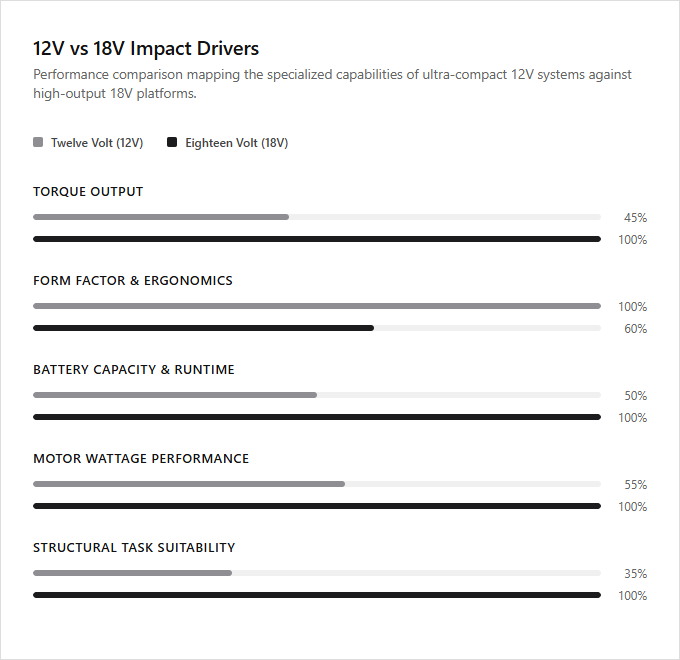
| Factor | Summary |
|---|---|
| Torque Output | Eighteen-volt impact drivers deliver significantly higher rotational force, measured in Newton-meters (Nm), allowing them to drive larger fasteners into dense materials. |
| Form Factor | Twelve-volt impact drivers feature a highly compact and lightweight chassis, optimizing ergonomics for overhead applications and tight workspaces. |
| Battery Capacity | The 18V platform utilizes larger lithium-ion cells with higher Amp-hour (Ah) ratings, providing extended runtime under heavy workloads. |
| Motor Performance | While both platforms utilize brushless motor technology, 18V models generate higher wattage to maintain rotational speed under heavy resistance. |
| Task Suitability | Twelve-volt drivers excel at precision fastening, whereas 18V drivers are essential for high-load structural applications like driving lag screws. |
Maximum peak torque measured in Newton-meters (Nm) favoring 18V systems
When selecting an impact driver, the choice between a 12-volt and an 18-volt platform directly dictates performance capabilities. The primary differentiator is maximum peak torque, measured in Newton-meters (Nm). While 12V systems offer sufficient force for standard fastening, 18V impact drivers deliver significantly higher torque, often exceeding 220 Nm. This superior power enables 18V tools to drive large lag screws and penetrate dense materials with ease.
The elevated torque rating of 18V impact drivers ensures faster task completion and reduces motor strain during demanding applications. The 12V models focus on compact, lightweight designs that minimize user fatigue in confined spaces. Professional contractors requiring heavy-duty fastening power benefit most from the robust 18V systems, while cabinet installers, technicians, and DIY hobbyists prioritize the maneuverability of the 12V platform.
Nominal voltage differences defining the wattage output threshold
The primary distinction between twelve-volt (12V) and eighteen-volt (18V) impact drivers lies in their nominal voltage, which directly establishes the tool's maximum wattage output threshold. Wattage, the product of voltage and current, determines the overall torque capability of the motor. Because 18V systems operate at a higher electrical potential, they deliver significantly greater wattage, allowing them to drive larger fasteners into dense materials with superior speed.
In contrast, 12V impact drivers operate under a lower wattage ceiling but excel in compact ergonomics and maneuverability. These tools prioritize a lightweight footprint for confined spaces where extreme fastening force is unnecessary. Heavy-duty contractors requiring maximum power for demanding construction projects benefit most from 18V models, whereas cabinet installers, electricians, and technicians seeking portability prefer the precision of 12V systems.
Impacts per minute (IPM) rate variations between the voltage platforms
The performance of an impact driver is heavily defined by its Impacts per Minute (IPM) rate, which dictates how rapidly the internal anvil strikes the output shaft. Higher voltage platforms directly influence this mechanism, allowing the motor to generate faster, more frequent impacts under load to drive fasteners efficiently.
Eighteen-volt impact drivers typically deliver between 3,500 and 4,000 IPM, providing the rapid-fire force necessary to break through dense materials. Twelve-volt models generally cap around 2,700 to 3,300 IPM, offering a slower, more controlled application of force that prevents over-driving or stripping smaller fasteners.
Twelve-volt units are best suited for cabinet makers and technicians prioritizing lightweight precision in tight spaces, while eighteen-volt systems are ideal for heavy timber framers and deck builders requiring maximum speed and driving power.
No-load speed (RPM) capabilities affecting kinetic energy delivery
The voltage of an impact driver directly dictates its motor's rotational velocity, measured as no-load speed (RPM). Because kinetic energy is proportional to the square of velocity, the higher RPM potential of an eighteen-volt system significantly amplifies the force of each impact. When the internal hammer strikes the anvil, this elevated speed translates to a much faster, more powerful delivery of torque compared to twelve-volt alternatives.
Conversely, twelve-volt impact drivers operate at lower maximum RPMs, yielding less kinetic energy but offering superior control and a reduced risk of stripping fasteners. Lightweight twelve-volt tools are highly suited for electricians and cabinet installers prioritizing precision in confined spaces, whereas robust eighteen-volt models are ideal for heavy-duty construction workers demanding maximum speed and fastening power.
Brushless motor efficiency in managing thermal dissipation during high-torque fastening
Brushless technology significantly enhances the performance of both twelve-volt and eighteen-volt impact drivers by optimizing energy conversion. During high-torque fastening, brushless motors eliminate carbon brushes to reduce internal friction, which directly minimizes thermal buildup. In eighteen-volt platforms, advanced electronic microcontrollers manage larger current flows and dissipate heat efficiently across heavy duty-cycles. Twelve-volt brushless impact drivers leverage this thermal efficiency to prevent overheating within a much tighter, compact housing, sustaining peak torque without compromising internal components.
While eighteen-volt systems offer superior heat dissipation during prolonged drilling, twelve-volt systems handle thermal spikes remarkably well for intermittent fastening. Lightweight twelve-volt drivers are ideal for cabinet installers and electricians prioritizing overhead maneuverability and precision, whereas robust eighteen-volt units are best suited for commercial framing contractors requiring continuous, high-demand driving power.
How Battery Ah Capacity Mitigates Voltage Sag
When selecting between a 12-volt and an 18-volt impact driver, understanding the relationship between operating voltage and battery capacity rated in Amp-hours (Ah) is crucial for sustaining performance under heavy resistance. During demanding applications, tools experience voltage sag, which is a temporary drop in delivered power. Utilizing a battery with a higher Ah rating mitigates this sag by providing a larger reserve of current, allowing both 12V and 18V systems to maintain more consistent torque and rotational speed under load.
While the 18V platform inherently delivers superior peak power, a 12V driver equipped with a high-capacity battery can sustain its maximum output longer than one with a standard compact battery. Lightweight 12-volt models are ideal for cabinet makers and technicians who require overhead maneuverability in tight spaces, whereas robust 18-volt systems are suited for general contractors executing heavy-duty structural fastening.
Electronic speed control regulation for sustaining maximum torque transfer
When evaluating twelve-volt versus eighteen-volt impact drivers, the sophistication of electronic speed control regulation is a key differentiator. Modern brushless motors in both platforms rely on digital controllers to monitor load feedback, dynamically adjusting current to sustain maximum torque transfer. This precise regulation prevents RPM drops during heavy fastening tasks, ensuring consistent power delivery throughout the drive cycle.
While eighteen-volt platforms leverage higher voltage overhead to maintain peak torque under extreme resistance, twelve-volt systems utilize refined speed regulation to deliver precise, controlled force without stripping fasteners. Compact twelve-volt units are highly suited for electricians and cabinetmakers focusing on precision overhead work, whereas robust eighteen-volt models are the definitive choice for framing contractors and industrial users tackling heavy-duty timber construction.
Leave a comment