
Contractors and industrial manufacturers often struggle with tool fatigue and inconsistent drive depths, which stall production lines and compromise structural integrity. While traditional pneumatic setups are the standard fallback, navigating bulky hose management and noisy compressors forces operations to seek cordless electric alternatives.
Transitioning to cordless staplers grants users the freedom of mobility alongside immediate, repeatable power that rivals pneumatic output. However, maximizing this efficiency stipulates a clear understanding of the underlying engineering, as neither gas nor mechanical systems are universally superior. For instance, high-volume roof decking requires a much faster recovery rate than delicate, low-tempo trim cabinetry work.
Below, we compare Gas Spring and Mechanical Spring drive mechanisms, analyzing their cycle times, ramp-up speeds, and long-term maintenance profiles to help you optimize your fastening workflow.
| Factor | Summary |
|---|---|
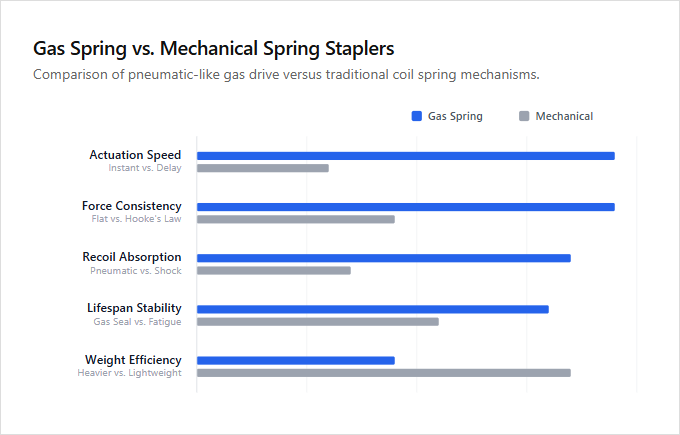
| Drive Mechanism | Gas spring staplers utilize highly compressed nitrogen gas in a sealed cylinder to drive the piston, whereas mechanical spring staplers rely on the physical tension and release of a steel coil spring. |
| Ramp-up Time | Gas spring technology offers near-instantaneous actuation with zero ramp-up time, while mechanical spring mechanisms require a brief motorized compression stroke prior to firing. |
| Force Consistency | Gas springs deliver a flat, constant force curve throughout the entire drive stroke, unlike mechanical coil springs which lose driving energy as they decompress according to Hooke's Law. |
| Recoil and Ergonomics | Gas spring systems absorb kinetic energy to yield a smoother, pneumatic-like recoil profile, whereas mechanical spring staplers produce a more abrupt vibrational shock wave upon release. |
| Durability and Lifespan | Mechanical springs are susceptible to gradual degradation from cyclic metal fatigue, while gas springs maintain consistent performance until seal degradation results in pressure loss. |
| Tool Weight and Balance | Mechanical spring staplers feature a lighter, more compact tool chassis, whereas gas spring variants require a heavier sealed cylinder assembly that shifts the tool's center of gravity. |
Hooke's Law force gradient versus constant nitrogen pressure profile
In power fastening, the mechanism of energy delivery defines tool performance. Mechanical spring staplers operate on Hooke's Law, where the driving force is directly proportional to spring displacement. This creates a steep force gradient; the energy peaks initially but diminishes rapidly as the spring decompresses, often resulting in incomplete staple seating in dense materials. In contrast, gas spring staplers utilize a sealed chamber of highly compressed nitrogen gas. This system delivers a virtually flat pressure profile, maintaining maximum, consistent force throughout the entire stroke for uniform penetration.
While mechanical springs offer straightforward, durable utility with no risk of gas depletion, gas spring technology provides superior speed and reduced physical fatigue. Mechanical spring models are best suited for budget-conscious DIYers undertaking occasional home projects, whereas gas spring staplers are ideal for high-production framing and roofing professionals who require rapid, repeatable depth precision in engineered lumber.
Elastic hysteresis and steel stress relaxation versus hermetic seal degradation
Power staplers utilize distinct energy storage mechanisms, each governed by specific material degradation pathways. Mechanical spring staplers rely on tempered steel coils, which are subject to elastic hysteresis and gradual stress relaxation over prolonged compression cycles. This physical degradation slowly reduces the tool's peak driving force over years of heavy use, though the system remains highly resilient to extreme environmental fluctuations.
In contrast, gas spring staplers utilize pressurized nitrogen to deliver consistent, rapid firing with minimal recoil. This technology remains limited by hermetic seal degradation, where microscopic seal wear leads to gradual pressure loss and eventual tool failure, even during periods of inactivity. High-volume framing contractors requiring rapid, consistent power benefit most from gas spring models, while occasional users or those working in extreme temperatures are better served by the enduring reliability of mechanical spring systems.
Instantaneous pneumatic expansion velocity versus mechanical coil acceleration lag
Gas spring technology utilizes a sealed cylinder of compressed air to drive the fastening piston. This design delivers instantaneous pneumatic expansion velocity, achieving full driving force immediately upon trigger activation. Because there is no mechanical delay, the tool provides rapid, flush fastening with virtually zero ramp-up time, maximizing productivity in high-volume applications.
Mechanical spring staplers rely on a physical metal coil that must be compressed and released. This mechanism introduces a minor acceleration lag as the potential energy translates through the winding of the physical spring. While highly reliable and structurally straightforward, this physical movement slightly limits the cycle rate compared to pneumatic alternatives.
Gas spring staplers are ideal for high-volume production line workers requiring rapid-fire efficiency, while mechanical spring models suit DIY enthusiasts and light contractors prioritizing durability and low maintenance.
Elastomer Seal Wear vs. Alloy Steel Fatigue
Gas spring staplers rely on compressed nitrogen sealed within a cylinder. Over time, the high-pressure environment subjects the dynamic elastomer seals to friction, heat, and gradual degradation, which eventually leads to pressure loss. In contrast, mechanical spring staplers utilize heavy-duty alloy steel springs. These systems are limited primarily by the fatigue limit of the alloy steel, where repeated stress cycles over millions of actuations eventually cause micro-cracking and structural failure.
While gas technology offers consistent, rapid firing, mechanical springs provide predictable, long-term durability without the risk of sudden seal failure. High-volume production manufacturers requiring rapid, effortless driving power benefit most from gas spring models, whereas mobile contractors needing highly reliable, low-maintenance tools in extreme temperatures prefer mechanical spring staplers.
Kinetic energy transfer efficiency and recoil vibration damping
Gas spring staplers utilize compressed nitrogen to deliver highly efficient, instantaneous kinetic energy transfer, ensuring consistent staple drive depth even in dense hardwoods. Conversely, mechanical spring staplers rely on physical coil expansion, which suffers from inherent energy loss through friction and spring fatigue, often resulting in inconsistent power delivery over extended use.
In terms of recoil vibration damping, the pneumatic chamber of a gas spring system naturally cushions the tool's backward force, dramatically reducing joint strain. Mechanical spring models lack this fluid deceleration, transmitting a sharper, unmitigated shock wave directly to the operator. High-volume construction professionals requiring rapid, low-fatigue production benefit most from gas spring technology, whereas occasional DIYers seeking a lightweight, cost-effective tool are better suited to mechanical spring alternatives.
Thermal expansion coefficient of compressed gas versus temperature-independent shear modulus
Gas spring staplers utilize compressed nitrogen to drive the piston, a design sensitive to environmental conditions due to the thermal expansion coefficient of gas. In extreme heat, internal pressure rises, increasing drive force, while freezing temperatures decrease pressure and can lead to incomplete staple seating.
Mechanical spring staplers rely on the physical deformation of a metal coil. The drive energy depends on the shear modulus of the steel, a physical property that remains virtually independent of standard temperature fluctuations, ensuring highly consistent depth of drive across diverse climates.
Gas spring models are ideal for high-speed factory assembly workers seeking rapid cycle times, while mechanical spring options suit roofing contractors who require reliable tool performance in unpredictable outdoor environments.
Volumetric energy density and drive stroke output ratio
When evaluating professional fastening systems, the primary differentiator between gas spring and mechanical spring staplers lies in volumetric energy density. Gas spring technology utilizes compressed nitrogen, offering a significantly higher energy density than traditional steel springs. This allows gas-powered tools to pack substantial driving force into a compact housing, whereas mechanical alternatives require physically larger coils to achieve comparable power.
This difference directly impacts the drive stroke output ratio. Gas springs maintain a flat, consistent force curve throughout the piston stroke, ensuring reliable countersinking in dense materials. Mechanical springs lose energy as they decompress, often resulting in proud staples. High-volume construction professionals requiring rapid, consistent penetration in engineered lumber favor gas spring models, whereas budget-conscious DIYers and light-duty upholsterers are better suited to the simplicity of mechanical spring designs.
Leave a comment