
Many tradespeople and woodworking enthusiasts share a common frustration: stripped screw heads, snapped fasteners, and marred workpieces caused by the raw, untamed force of a standard impact driver. Traditionally, professionals managed this risk solely through manual trigger feathering-the standard, yet highly inconsistent, source of speed control in fast-paced work environments.
However, upgrading to an impact driver featuring a multi-speed selector grants operators surgical precision over variable torque and rotational speed. To manage expectations, we must stipulate that while these electronic controls drastically reduce errors, they work best when paired with proper driving technique and the correct accessories-such as when fastening delicate brass screws into cabinetry versus sinking heavy structural lag bolts into timber.
Below, we will compare single-speed and multi-speed selectors, detailing how variable torque control optimizes fastening efficiency, prevents material damage, and extends the overall lifespan of your power tools.
| Factor | Summary |
|---|---|
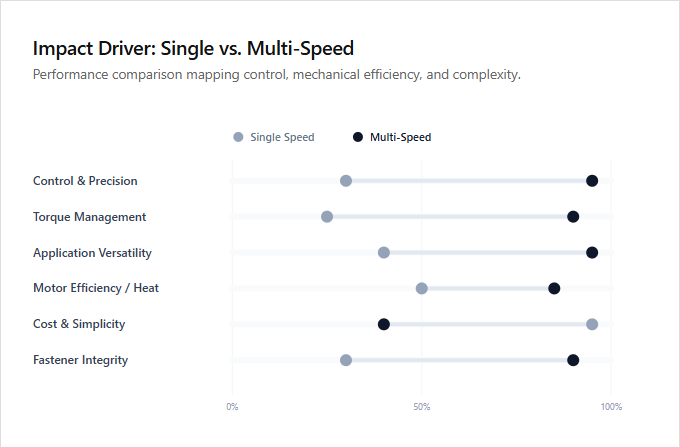
| Control and Precision | Multi-speed selectors allow users to adjust the maximum RPM (Revolutions Per Minute) to prevent stripping delicate fasteners, whereas single-speed models require precise manual trigger feathering. |
| Torque Management | Multi-speed impact drivers offer variable torque output settings to match the resistance of different materials, while single-speed drivers deliver full rotational force constantly. |
| Application Versatility | A multi-speed selector enables a broader range of applications from driving heavy-duty lag bolts to small woodwork screws by adjusting the IPM (Impacts Per Minute). |
| Motor Efficiency and Heat | Multi-speed drivers optimize brushless motor efficiency by running at lower electronic speeds, reducing heat buildup compared to single-speed motors running continuously at high loads. |
| Cost and Complexity | Single-speed impact drivers feature simpler trigger switch assemblies and electronic circuitry, making them more budget-friendly and durable but less adaptable than multi-speed alternatives. |
| Fastener Integrity | Multi-speed selectors mitigate the risk of cam-out and head shearing by limiting rotational velocity when working with soft metals or plastics. |
Dynamic RPM and IPM Control Prevents Workpiece Damage
When selecting an impact driver, the choice between single-speed and multi-speed models dictates your control over the fastening process. Multi-speed selectors offer dynamic regulation of both Rotations Per Minute (RPM) and Impacts Per Minute (IPM). This precise calibration prevents common application mishaps, such as over-driving screws, stripping heads, or snapping fasteners in delicate materials. By matching the tool's kinetic output to the material density, operators protect the workpiece from structural damage.
Single-speed drivers operate at a fixed maximum threshold, requiring manual trigger modulation to control force, whereas multi-speed units feature electronic limiters for consistent power delivery. Single-speed models are best suited for general DIYers performing repetitive, heavy-duty tasks like deck building, while multi-speed drivers are ideal for professional tradespeople working with varied materials from fragile plastics to dense hardwoods.
Prevention of fastener shearing through selectable peak torque limitation
In impact drivers, the choice between single-speed and multi-speed models directly affects fastening control and material protection. Single-speed units deliver maximum power continuously, requiring precise manual trigger modulation to prevent damage. In contrast, multi-speed selectors introduce electronic limits on speed and torque. This selectable peak torque limitation prevents the tool from overpowering smaller fasteners, minimizing the risk of shearing screw heads or stripping threads in delicate materials.
By capping the maximum rotational force, multi-speed settings allow operators to match the tool's output to the fastener's structural limits. This threshold protection is valuable when transitioning from heavy-duty framing to precise cabinetry installations. Single-speed impact drivers are ideal for heavy-duty construction workers requiring constant maximum power, while multi-speed models suit versatile tradespeople and woodworkers handling diverse materials and delicate fastening tasks.
Electronic clutch integration for automatic shut-off to prevent over-tightening
Single-speed impact drivers rely entirely on manual trigger control, requiring a high level of user finesse to avoid over-tightening. In contrast, multi-speed models often feature advanced electronic clutch integration. This technology automatically regulates torque and shuts off the motor when a specific resistance threshold is reached, safeguarding both the fastener and the work surface from damage.
By electronically managing the power output, multi-speed selectors offer precise control over delicate fastening tasks, whereas single-speed tools deliver raw, uninterrupted drive. Single-speed models are best suited for framing contractors who prioritize rapid, high-volume fastening, while multi-speed units with electronic clutches are ideal for cabinetmakers and technicians who require exact torque control for sensitive materials.
Synergizing Triggers and Selectors for Precise Start Control
While single-speed impact drivers rely entirely on trigger pressure for modulation, multi-speed selectors establish a digital ceiling on the tool's maximum output. The synergy between a physical speed selector and a variable speed trigger provides unmatched control when starting fasteners. By restricting the maximum RPM and torque at the selector level, the variable trigger gains a significantly wider, more forgiving range of motion. This prevents the driver bit from slipping off the screw head during the critical initial turns, protecting both the workpiece and the fastener.
Single-speed tools demand precise manual feathering of the trigger to avoid overdriving, whereas multi-speed units allow operators to confidently apply full throttle within safe, pre-defined limits. Single-speed models are highly efficient for production framing and repetitive heavy-duty construction, whereas multi-speed drivers are ideal for finish carpenters and cabinet installers who require adaptable, high-precision control across diverse materials.
Optimizing Brushless Motor Efficiency via Speed-Based Current Control
Single-speed impact drivers operate on a fixed configuration, drawing a high, continuous current regardless of the application's demands. In contrast, multi-speed models optimize brushless motor efficiency through advanced electronic speed selectors. By regulating the current draw across specific speed levels, the internal circuitry prevents energy waste during low-torque tasks. This precise modulation restricts current flow to match the resistance of the fastener, which minimizes heat buildup and maximizes battery runtime.
Single-speed drivers provide robust, straightforward power for heavy-duty applications where delicate control is unnecessary. Multi-speed models offer the versatility needed to protect fragile fasteners and workpieces from over-tightening. Single-speed units are ideal for general construction workers performing repetitive, high-torque driving, while multi-speed models are best suited for cabinet makers and precision installers who require exact control across diverse materials.
Regulating Kinetic Energy in Hammer-Anvil Impacts
Impact drivers utilize an internal hammer and anvil mechanism to generate rotational torque through rapid concussive blows. In a single-speed configuration, the motor operates at a fixed maximum velocity, meaning the hammer consistently strikes the anvil with unyielding kinetic energy and maximum impact force. Multi-speed selectors electronically regulate the motor's rotational speed, which directly controls the kinetic energy of the hammer before impact. This capability allows operators to reduce the force for delicate materials or increase it for heavy-duty applications.
Managing this energy transfer prevents fastener stripping and workpiece damage. Single-speed models are suited for dedicated framing carpenters requiring continuous maximum power, while multi-speed models are ideal for precision tradespeople who demand versatility across diverse materials.
T-Mode Pre-sets to Prevent Metal Screw Cam-Out
While single-speed impact drivers deliver constant, maximum power, multi-speed models offer sophisticated control through electronic speed selectors. The most significant advantage of multi-speed tools in metal-to-metal fastening is the inclusion of specialized T-Mode pre-sets. This advanced function automatically manages the tool's RPM and torque transitions during operation.
T-Mode prevents screw cam-out and head shearing by starting at high speed to drill through sheet metal, then instantly downshifting to low-speed, high-torque impacts as the threads engage. Single-speed drivers require manual trigger feathering to avoid stripping fasteners, which demands immense user focus. Single-speed units suit casual DIYers undertaking basic woodworking tasks, whereas multi-speed drivers with T-Mode are ideal for professional HVAC technicians and metal fabricators who require precision and efficiency.
Leave a comment