
Industrial product designers and manufacturing engineers frequently battle joint failures and adhesive bond degradation that halt assembly lines and compromise product integrity. While standard funding sources and capital equipment budgets typically prioritize expensive, high-end hot-melt glue gun applicators, the critical selection of the consumable adhesive polymer itself is often overlooked as a minor detail.
However, investing in the precise formulation grants operations the invaluable benefit of high-performance, long-lasting bonds-stipulating, of course, that the chemical properties match your specific substrate materials and applicator nozzle specifications. For example, in demanding aerospace wiring and automotive electronics potting, utilizing the incorrect adhesive can lead to catastrophic failure.
To prevent this, the following analysis provides a comprehensive comparison of Ethylene-Vinyl Acetate (EVA) and Polyamide adhesives, evaluating their thermal limits, shear strength, and open times to guide your next procurement decision.
| Factor | Summary |
|---|---|
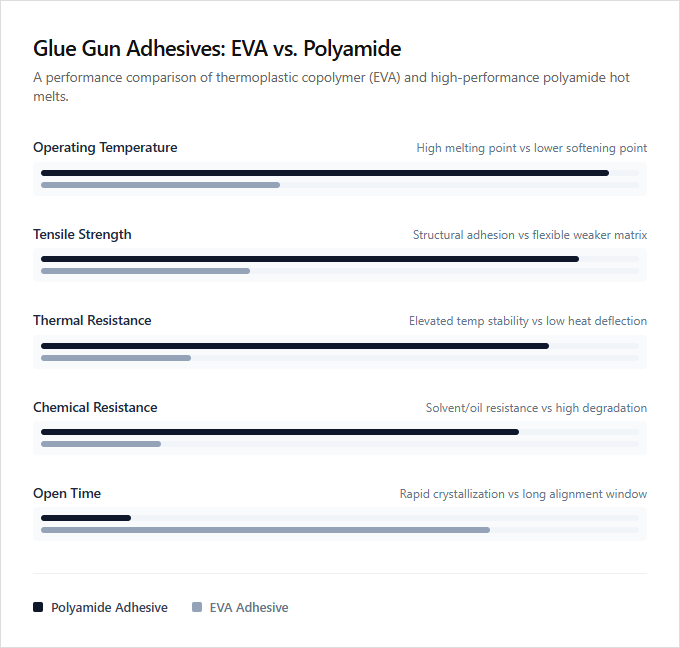
| Operating Temperature | Polyamide adhesives require heavy-duty high-temperature glue guns due to their high melting point, whereas EVA adhesives operate at much lower temperatures due to their lower thermoplastic softening point. |
| Tensile Strength | Polyamide provides superior structural adhesion and tensile strength under mechanical load compared to the highly flexible but weaker copolymer matrix of EVA. |
| Thermal Resistance | Polyamide polymers maintain chemical stability and bond integrity at elevated temperatures, whereas EVA adhesives exhibit a low heat deflection temperature and will easily remelt. |
| Chemical Resistance | Polyamide displays excellent resistance to organic solvents, oils, and plasticizers, while EVA is highly susceptible to chemical degradation and plasticizer migration. |
| Open Time | EVA formulations offer a longer open time for precise substrate alignment, whereas polyamide has a rapid crystallization rate that results in an almost instantaneous set time. |
Polyamide Adhesives Outperform EVA in Thermal Stability
In industrial hot melt glue gun applications, choosing the correct adhesive chemistry is critical for long-term bond integrity. Polyamide adhesives exhibit superior thermal stability and resistance to thermal degradation at high operating temperatures compared to ethylene-vinyl acetate (EVA). While EVA adhesives tend to char, discolor, and lose viscosity when subjected to prolonged heat within the glue gun chamber, polyamide formulas maintain their chemical structure and mechanical properties under elevated thermal stress.
Beyond thermal resistance, polyamide provides robust adhesion to difficult substrates and excellent chemical resistance, whereas EVA offers high flexibility and economical general bonding. EVA is ideal for packaging operators and craft hobbyists requiring rapid, low-cost sealing, while polyamide is suited for automotive and electronics assembly technicians who need high-performance, heat-resistant bonds in demanding environments.
EVA Outperforms Polyamides in Low-Temperature Flexibility
When selecting hot melt adhesives for professional glue gun applications, the choice between ethylene-vinyl acetate (EVA) and polyamide formulations depends heavily on thermal performance. EVA adhesives provide superior low-temperature flexibility because they possess a lower glass transition temperature than polyamides. This molecular characteristic ensures that EVA remains resilient and resists cracking in freezing environments, preserving bond integrity under cold stress.
Polyamides offer excellent resistance to elevated temperatures and chemical solvents, but their higher glass transition temperature makes them susceptible to embrittlement in cold conditions. EVA is ideal for packaging specialists and hobbyists requiring flexible bonds in refrigerated spaces, while polyamide is suited for industrial technicians needing high-strength, heat-resistant seals for automotive or electronic assemblies.
High-Temperature Applicators for Polyamide Hot-Melts
Ethylene-vinyl acetate (EVA) and polyamide represent two distinct classes of hot-melt adhesives used in professional bonding. While EVA adhesives flow easily at standard temperatures, polyamide formulations demand advanced thermal control. Due to their elevated melt viscosity and high Ring and Ball softening point, polyamide hot-melts require specialized high-temperature gun applicators. Standard glue guns cannot reach or sustain the precise, elevated temperatures necessary to process these robust polymers safely and effectively.
Polyamide adhesives offer superior thermal and chemical resistance, whereas EVA provides excellent general-purpose adhesion with faster set times. Standard EVA is ideal for casual hobbyists and packaging technicians requiring quick, economical bonds, while heavy-duty polyamide is best suited for automotive engineers and electronics manufacturers tackling harsh, high-stress environments.
Polyamide Adhesives Set Faster Than EVA Copolymers
In professional assembly and product manufacturing, selecting the correct hot melt chemistry for a glue gun determines the ultimate integrity of the bond. Ethylene-vinyl acetate (EVA) copolymers represent the highly versatile, standard option for general-purpose bonding. These adhesives provide a relatively long open time and flexibility, accommodating minor adjustments during assembly.
In contrast, polyamide adhesives feature a faster crystallization rate and shorter open time than versatile ethylene-vinyl acetate copolymers. This rapid setting capability allows for immediate handling of bonded components, though it requires precise, swift application. Polyamides also offer superior thermal stability and chemical resistance for demanding industrial environments.
EVA is ideal for craft hobbyists and packaging operators who require extended alignment windows, whereas polyamide suits high-speed automotive or electronics assembly technicians demanding rapid, high-strength bonds under extreme temperatures.
Polyamide Enables High-Temperature Structural Bonding
When selecting hot melt adhesives for industrial applications, understanding the thermal limitations of each formulation is critical. Ethylene-vinyl acetate (EVA) adhesives are widely utilized for general-purpose packaging and assembly due to their fast set times and cost-effectiveness. For demanding environments, polyamide adhesives offer superior performance. Polyamide delivers an exceptionally high shear adhesion failure temperature rating, ensuring robust structural bonds under thermal stress.
The distinct chemical structures of these two materials dictate their target applications and users. EVA is ideal for craft hobbyists and packaging operators requiring rapid, low-stress bonding, while polyamide is engineered for product designers and automotive engineers who require resilient, high-temperature structural joints.
EVA vs. Polyamide: Matching Adhesives to Substrates
Selecting the appropriate hot melt adhesive for professional glue gun applications depends heavily on the specific substrates involved. Ethylene-vinyl acetate (EVA) remains a highly popular choice, offering a cost-effective bonding solution with a fast set time. This polymer is particularly efficient for bonding porous substrates such as paper, cardboard, and wood, where the adhesive can easily penetrate the fibers to create a secure, reliable hold.
Polyamide adhesives provide superior thermal stability, elevated heat resistance, and excellent chemical resistance. This advanced formulation excels on difficult, low surface energy plastics and metals that typically reject standard hot melts. High-volume packaging operators and woodworkers find EVA ideal for economical, rapid assembly, while product designers and electronics technicians requiring high-strength bonds on engineered plastics should opt for polyamide.
Polyamide Outperforms EVA in Chemical and Plasticizer Resistance
When selecting hot melt adhesives for professional glue gun applications, understanding the material science between ethylene-vinyl acetate (EVA) and polyamide formulations is critical. Polyamide adhesives deliver superior performance under challenging environmental conditions. Specifically, polyamide formulations offer superior plasticizer resistance and chemical resistance against oils and solvents compared to ethylene-vinyl acetate, preventing bond degradation in harsh settings.
While EVA remains a highly versatile and cost-effective choice for standard packaging and general product assembly, it lacks the specialized resilience required for extreme exposures. EVA is ideal for craftspeople and packaging operators seeking rapid, light-duty bonding, whereas polyamide is best suited for automotive technicians and industrial product manufacturers requiring durable bonds in chemically demanding environments.
Leave a comment