
In high-throughput manufacturing and precision product assembly, operators frequently battle the costly bottleneck of tool downtime-specifically, the unproductive minutes spent waiting for adhesive equipment to reach optimal melting temperatures. While standard 40W to 100W heating elements have long served as the baseline for commercial workflows, they often stifle productivity during intermittent operations.
Advanced fast-heating technology resolves this operational lag, granting facilities near-instantaneous thermal readiness and uninterrupted adhesive flow. However, an important technical stipulation must be noted: high nominal wattage does not automatically guarantee rapid thermal recovery if the tool's internal core lacks efficient conductivity. For instance, in rapid-sealing packaging lines, selecting a specialized PTC (Positive Temperature Coefficient) system over a traditional wire-wound element directly dictates hourly output.
To assist in your procurement decision, this article analyzes the critical differences between fast heat-up and standard hot melt glue guns, comparing thermal efficiency, recovery rates, and duty cycles to identify the optimal tool for your extrusion requirements.
| Factor | Summary |
|---|---|
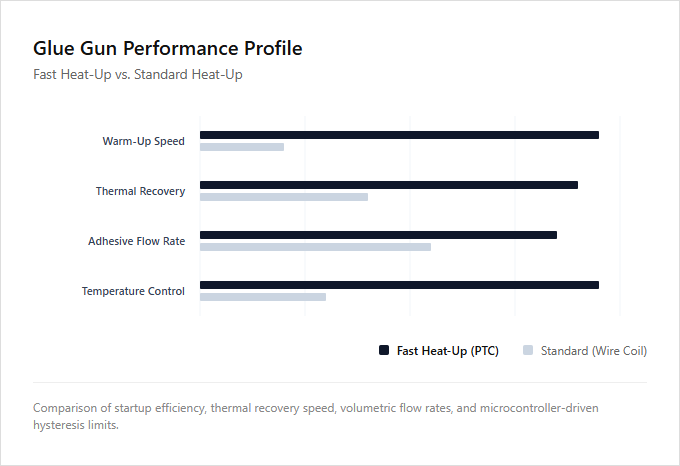
| Heating Technology | Fast heat-up models typically utilize advanced ceramic PTC (Positive Temperature Coefficient) heating elements, whereas standard models rely on traditional resistive wire coils. |
| Warm-Up Duration | Fast-heating units reach operating temperature in under sixty seconds by minimizing thermal lag, while standard units require a longer stabilization period of three to five minutes. |
| Power Consumption | High-speed models exhibit higher initial electrical wattage to accelerate the adhesive phase transition, while standard guns maintain a lower, constant wattage draw. |
| Adhesive Flow Rate | Fast heat-up guns support a higher volumetric flow rate of adhesive due to rapid thermal recovery, whereas standard guns may experience temporary cooling during continuous extrusion. |
| Temperature Regulation | Premium fast heat-up tools often feature integrated micro-controllers for precise temperature hysteresis control, while standard units rely on basic thermodynamic equilibrium. |
Positive Temperature Coefficient (PTC) heating element technology
Positive Temperature Coefficient (PTC) heating technology serves as the self-regulating core of modern hot glue guns, ensuring both thermal safety and energy efficiency. Standard heat-up glue guns utilize traditional PTC ceramic elements that steadily increase in temperature over five to ten minutes, maintaining a highly stable and consistent adhesive flow once fully primed.
Fast heat-up models leverage advanced, high-density PTC elements designed to achieve optimal melting temperatures in less than two minutes. These high-performance systems temporarily draw maximum wattage to liquefy glue sticks rapidly, then automatically throttle down to sustain a safe operating temperature. Standard models are ideal for industrial assembly workers requiring prolonged, continuous operation, whereas fast heat-up tools are best suited for mobile technicians and DIY enthusiasts who need quick, spontaneous repairs.
Melt rate efficiency measured in grams per hour (gph)
In professional adhesive applications, the choice between fast heat-up and standard heat-up glue guns depends on melt rate efficiency, measured in grams per hour (gph). Fast heat-up models utilize high-wattage elements to reach operating temperature in under two minutes. This rapid recovery enables a high-output flow exceeding 1,500 gph, ensuring uninterrupted adhesive delivery during high-volume tasks.
Standard heat-up glue guns require up to ten minutes to stabilize, delivering a moderate melt rate between 300 and 600 gph. While slower to start, they offer excellent temperature stability for intermittent bonding. Fast heat-up models are engineered for industrial manufacturers requiring continuous, rapid-fire assembly, whereas standard units are ideal for general maintenance technicians and hobbyists performing low-frequency, detailed repairs.
Thermal recovery time during continuous extrusion
Fast heat-up glue guns utilize high-wattage heating elements to reach operating temperatures rapidly and maintain superior thermal recovery during continuous extrusion. When dispensing adhesive at a high rate, the heating chamber experiences a sharp temperature drop as cold glue stick material is fed into the nozzle. Fast heat-up models quickly compensate for this heat loss, ensuring a consistent, fluid melt flow without requiring operational pauses to let the tool recover.
Standard heat-up models employ lower-wattage systems, resulting in a slower thermal recovery rate during prolonged tasks. Continuous extrusion often forces the user to pause, allowing the heating block time to regain its target temperature to prevent the adhesive from fracturing or cooling prematurely. High-volume industrial fabricators require the uninterrupted workflow of fast heat-up models, whereas occasional DIYers and hobbyists are well-served by the economical, straightforward nature of standard heat-up tools.
Minimization of adhesive thermal degradation and charring
In professional adhesive applications, managing the thermal exposure of hot melt glue is critical to maintaining bond integrity. Fast heat-up glue guns reach operating temperatures rapidly, minimizing the time the adhesive spends idle in the heating chamber. This rapid thermal transition prevents the polymeric breakdown and charring that occurs when adhesives are subjected to prolonged heat, ensuring consistent viscosity and clean, degradation-free extrusion.
Conversely, standard heat-up models subject the adhesive to extended warming periods. This slow heating cycle increases the risk of thermal degradation, which can lead to nozzle clogging from charred residue and weakened mechanical properties in the final bond. Fast heat-up tools suit high-volume industrial operators requiring immediate, pristine adhesive flow for continuous assembly, whereas standard models are ideal for budget-conscious DIYers undertaking occasional, low-demand tasks.
Closed-loop temperature control and thermistor accuracy
Fast heat-up glue guns employ high-output heating elements coupled with closed-loop temperature control and high-accuracy thermistors. This integration allows the tool to reach operating temperatures rapidly while actively preventing thermal overshoot through real-time sensor feedback. Standard heat-up models utilize traditional heating elements that warm up gradually, relying on stable thermal equilibrium to offer reliable, steady-state performance once heated.
The precise thermal regulation in fast-heating models ensures consistent adhesive viscosity during demanding tasks, whereas standard models provide dependable, low-maintenance operation. High-speed, fast heat-up guns are ideal for industrial operators requiring immediate uptime and precise thermal management, while standard heat-up models are best suited for hobbyists and light packaging applications where simplicity and steady, prolonged use are preferred.
Heat block thermal mass and conductivity differentials
The operational distinction between fast heat-up and standard heat-up glue guns lies in the engineering of their heating blocks. Fast heat-up models utilize low thermal mass blocks paired with high-conductivity materials, such as specialized aluminum alloys, to facilitate rapid thermal transfer directly to the adhesive. Conversely, standard heat-up systems employ denser, high-mass blocks that absorb and store heat incrementally. This higher thermal inertia provides superior temperature stability, preventing the thermal sag often experienced during continuous dispensing.
Choosing the correct tool depends on specific workflow demands. Fast heat-up models are ideal for mobile technicians and hobbyists requiring immediate, intermittent bonding, whereas standard heat-up units are suited for industrial assembly operators who need sustained thermal consistency during high-volume production.
Transient wattage spikes versus steady-state power consumption
Fast heat-up glue guns utilize high-power heating elements that draw a significant transient wattage spike upon startup. This initial surge rapidly elevates the tool to its operating temperature before the electronics throttle back to a lower, steady-state power consumption. In contrast, standard heat-up models feature a modest, uniform wattage draw from the moment of activation, avoiding sharp electrical spikes but requiring several minutes of thermal ramp-up time to melt the adhesive.
While fast-heating units demand robust electrical circuits to accommodate temporary load surges, standard units offer predictable, low-demand energy consumption. Fast heat-up models are best suited for high-volume industrial operators requiring minimal downtime and rapid deployment, whereas standard models are ideal for hobbyists and light crafters seeking reliable, budget-friendly performance for prolonged projects.
Leave a comment